Eternity is Rated PG-13 for sexual content and some strong language.
Ever wondered what would happen if a classic love triangle followed you into the afterlife? And not in a spooky-horror way, but in a “Wait… am I really fighting someone for my wife in heaven?” kind of way? Eternity, the latest film from David Freyne, takes that exact thought and runs with it or more like sprints, tumbles, and gleefully barrel-rolls into a rom-com afterworld that’s far sweeter (and far dumber) than it has any right to be.
At first glance, the movie looks like your typical sweeping love story decades-long marriage, a devoted husband, a bittersweet ending until Freyne and co-writer Patrick Cunnane basically shrug and say, “Why not have both a happy ending and a tragic one?” It’s chaotic, cheeky, and surprisingly tender.
The story kicks off when Larry (Miles Teller), a husband who spent 65 full years making his wife Joan (Elizabeth Olsen) blissfully happy, dies in the most un-cinematic way possible: choking on a pretzel. One second he’s at home, the next he’s in the afterlife and hilariously younger. Before he can even wrap his head around his new, wrinkle-free situation, he’s already plotting how to find Joan.
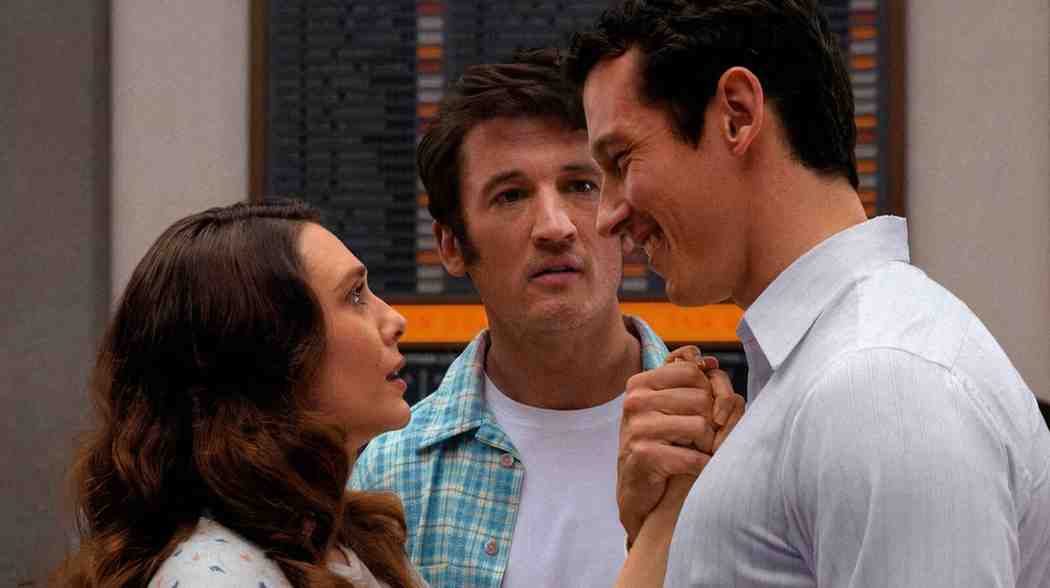
But Larry’s not prepared for what (or rather who) is waiting for her: Luke (Callum Turner), Joan’s impossibly handsome, impossibly heroic first husband who died in “the war.” Which war? Don’t worry the film has a field day with that question.
Once Joan finally arrives on the other side, all glowing and confused and very much in the middle of the weirdest reunion of her life (or death?), the real battle begins. Two men. One woman. Infinite afterlife. The result is a delightfully messy love triangle that plays like a cross between The Good Place and a very caffeinated Hallmark movie.
What’s especially charming is how Freyne handles the afterlife itself. Forget pearly gates, harps, clouds, or Tim Burton’s stop-motion chaos. This version looks like a doctor’s waiting room collided with a train station… and then both gave up halfway through decorating. Stark white walls, hallways leading to nowhere, hotel rooms that scream “convention discount rate” — it’s intentionally bland, because no one’s meant to stay. It’s more like the world’s most boring airport terminal, but with eternity hanging in the balance.
This is where Larry meets Anna (Da’Vine Joy Randolph), an afterlife counselor who’s seen so many “forever decisions” that she’s basically spiritually burnt out. Randolph plays her with a delicious mix of cynicism and heart; you can feel she wants to root for someone, and Larry this confused, cranky man in a 30-something body ends up being her perfect underdog.
Every soul has to pick a destination forever. And the choices are wild: beaches, mountains, museums, outer space, a neon-soaked 1930s Germany that’s all glam and cabaret (minus the Nazis, thankfully). Even a bizarre world called “Capitalist World,” which feels like a joke everyone’s in on. These little background gags add color without overwhelming the plot.
But at the heart of everything is the sparring match between Larry and Luke. Luke is all soft gazes and heroic timing the kind of guy who could sweep Joan into his arms even in zero gravity. Larry, on the other hand, is basically a golden retriever with bad impulse control. One of his proudest afterlife discoveries is that he can squat again. No cracking knees! No groans! No ibuprofen required! It’s stupidly funny and disarmingly sweet.
This contrast is where the film shines. Freyne and Cunnane take the cliché of “idealized romance” and mash it up against the messy, mundane bits of long-term love the parts that don’t make it into Nicholas Sparks movies but very much exist in real relationships. Teller leans fully into Larry’s insecurity and petulance, often taking the comedic punches (literal ones too). Meanwhile, Turner plays Luke like he’s stepped straight out of a vintage war romance all glowing nostalgia and movie-star posture.
And then there’s Joan. Olsen gives the movie its emotional center. She’s luminous, funny, annoyed, and torn all at once the woman who loved two very different men across two very different lifetimes, and now has to decide what “forever” actually means. The afterlife’s gorgeous color palette deep reds, glowing greens, shimmering golds makes every flicker of emotion on her face even more vivid.
Behind the scenes of this love-war is another fight entirely: office politics. Luke’s counselor, Ryan (John Early), is basically the overachiever coworker who’s been waiting 67 years for the big promotion — in this case, reuniting Luke and Joan. His rivalry with Anna adds fizzy comedic energy; every beige suit, every fake-polite smile, every tiny power play is played for maximum absurdity, and both actors make even the driest jokes land.
Visually, Eternity looks like a scrapbook of postcards soft horizons, rich hues, shimmering landscapes. It somehow makes death look like a luxury vacation you’re not quite sure you can afford.
But beneath all the jokes and charming ridiculousness is a surprisingly thoughtful question:
If you were given eternity, who or what would you choose it with?
The film never mocks the audience for loving grand romances; instead, it gently nudges the genre, pokes fun at its most dramatic tendencies, and then wraps it all in something warm, smart, and sincerely swoon-worthy.
Bottom line: Eternity is a rom-com that feels both timeless and refreshingly odd. If you love stories about second chances, big emotions, and a little harmless absurdity, this one’s absolutely worth your time. It’s funny, it’s heartfelt, and it has enough charm to last… well, forever.
The movie premiered at TIFF and hits theaters Nov. 26 and trust me, it’s worth catching on the big screen, preferably with someone you’d at least consider spending an eternity with.
Content Breakdown for Parents
Violence & Intensity: The “death by pretzel” moment is played for comedy, not shock.Larry and Luke engage in a few physical tussles more slapstick than threatening.No gore or realistic violence.Emotional tension forms the bulk of the “intensity,” especially around Joan’s decision.
Language: Occasional light profanity (“hell,” “damn,” etc.)Some snarky insults between rival love interests.No slurs or harsh verbal attacks.
Sexual Content / Nudity: Flirty banter and romantic longing.One or two mildly suggestive jokes about afterlife bodies feeling “brand new.”No explicit sex scenes; kisses are affectionate and tasteful.Themes revolve around love, not lust.
Drugs, Alcohol & Smoking: A couple of scenes show wine or cocktails in the background.No drug use, no smoking.
Parental Concerns: The entire plot revolves around death, albeit handled playfully. Sensitive kids may struggle with that. Some jokes lean slightly risqué nothing explicit, but not PG-rated innocence either. The love triangle may raise questions about remarriage, grief, loyalty, and “who you love most,” which could spark big conversations at home. For most teens, none of this will be surprising, but younger children may feel overwhelmed.