Bugonia is Rated R by Motion Picture Rating (MPA) for bloody violent content including a suicide, grisly images and language. Given the R rating and content, this film is most suitable for older teens (16-17+) and adults.
Bugonia (2025) Review: Yorgos Lanthimos Thinks We’re the Real Aliens
Ever wonder if maybe the conspiracy theorists are right not about lizard people or chemtrails, but about how broken the world actually is? Bugonia, Yorgos Lanthimos’s latest dive into human absurdity, plays with that exact anxiety. It’s a movie that asks, “What if we really are the problem?” and then laughs darkly as we squirm in our seats.
The story is pure Lanthimos weirdness, but it’s also his most accessible film in years. Teddy (Jesse Plemons), a sweaty, paranoid beekeeper who looks like he hasn’t seen daylight in months, becomes convinced that the planet’s collapse the dying bees, the poisoned air, the moral rot all traces back to one woman: Michelle Fuller (Emma Stone), a Big Pharma CEO he’s certain is an alien from the Andromeda galaxy. Together with his cousin Donny (Aidan Delbis), who’s equal parts naive and loyal, Teddy hatches a plan to “save humanity.” Step one? Kidnap Michelle. Step two? Cleanse themselves of their “psychic compulsions.” Step three? Demand the aliens leave Earth alone.
Also Read: Springsteen: Deliver Me from Nowhere (2025) Parents Guide
It’s ridiculous and that’s exactly the point. Lanthimos starts the film with this feverish montage that mirrors the insanity of modern life. Teddy and Donny, in their cluttered, grimy house, prepare for their mission with cult-like intensity. They stretch, they chant, they perform chemical self-castration all while Michelle, in her sleek, sterile mansion, jogs on a treadmill and pops a rainbow of vitamins. It’s a hilarious split-screen of delusion and privilege: both sides believing they’re saving something, both hopelessly lost.
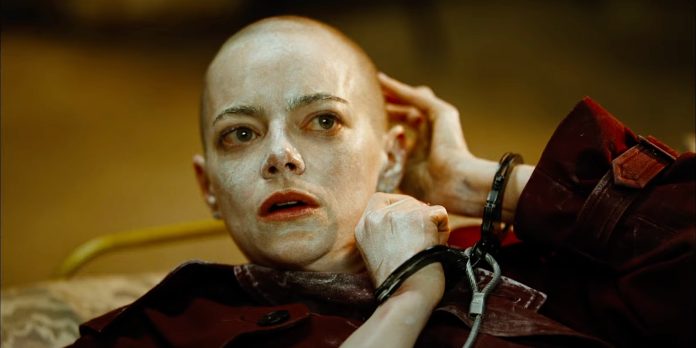
Then, the kidnapping. Teddy and Donny show up in silver tracksuits and dollar-store masks, looking like budget sci-fi villains. They drag Michelle to their basement, shave her head (apparently how she “communicates”), slather her in lotion, and chain her to a bed. It’s horrifying, yes but Lanthimos frames it with such deadpan absurdity that you don’t know whether to laugh or cover your eyes. That’s his magic trick: making you complicit in the madness.
The rest of the film plays out mostly in that basement, a claustrophobic theater for ideas and ego. Teddy interrogates Michelle, hurling pseudo-scientific theories he picked up from podcasts and YouTube rabbit holes. Michelle, cool and composed even while shackled, responds in that perfectly patronizing corporate tone the kind that somehow sounds both meaningless and threatening. Their conversations become an insane kind of duet: two people from totally different worlds, both absolutely certain they’re right.
Visually, Lanthimos does something fascinating here. He films Plemons from below, giving him this self-righteous, messianic posture, while Stone is always shot from above like a saint, or a martyr. Her shaved head, her wide eyes, her stillness it’s a direct nod to The Passion of Joan of Arc. But here’s the kicker: Stone’s character isn’t a martyr. She’s the face of the system Teddy claims is killing the planet. By framing her like one, Lanthimos blurs the moral lines until we don’t know who to root for.
Also Read: Love Is Blind Season 9 Parents Guide
And that’s the film’s central tension: who are the real monsters here? Teddy and Donny, delusional kidnappers acting out their anti-corporate fantasies? Or Michelle, the walking embodiment of everything sterile, soulless, and profit-driven? Lanthimos doesn’t give easy answers he just lets the unease fester.
What keeps it all grounded is the cast. Plemons is phenomenal, playing Teddy with this mix of menace and pathetic sincerity. You believe he’s dangerous, but you also kind of understand him. He’s the guy who’s spent too long online, too long ignored, until his paranoia becomes faith. Stone, meanwhile, gives one of her best performances cold, precise, and eerily empathetic. She doesn’t overplay the “is she or isn’t she?” alien mystery; instead, she leans into the idea that maybe the most alien thing is human detachment. And Aidan Delbis (who’s autistic and new to major film roles) gives the story a surprising heart. His Donny is caught between loyalty and confusion a quiet, human presence in all the chaos.
Lanthimos builds the film like a countdown. Each day leading up to a lunar eclipse becomes a chapter three days to save the Earth, or destroy it. Between the basement interrogations, we get these eerie black-and-white flashbacks of Teddy’s mother, Sandy (Alicia Silverstone), who died during a failed drug trial run by Michelle’s company. That’s the emotional core of Teddy’s madness: it’s not just conspiracy it’s grief, rotting into obsession.
Also Read: Harlan Coben’s Lazarus (2025) Parents Guide
And that’s what Bugonia nails. It’s not about aliens or conspiracies it’s about how pain curdles into ideology. Teddy’s anger feels justified, even noble at first, until it isn’t. His version of “cleansing” humanity becomes just another act of violence. Lanthimos doesn’t let us off the hook, either. He keeps circling this question of whether Michelle might actually be what Teddy thinks she is not to confirm it, but to remind us how easily we fall for comforting stories, no matter how insane they sound.
If there’s one criticism, it’s that the film’s anger feels a bit contained. Compared to Ari Aster’s Eddington (a film that swings wildly for the fences), Bugonia feels controlled, almost cautious. You sense Lanthimos’s rage at corporate greed, environmental collapse, and human stupidity, but he filters it through irony instead of pure chaos. The result is brilliant, but a little too neat like he’s pulling punches he really wanted to throw.
Still, by the end, the message hits hard: humanity might not need aliens to end the world. We’re doing just fine on our own. The “psychic compulsions” Teddy rants about the greed, the vanity, the craving for control are the real infection. And Lanthimos, a Greek outsider peering into American decay, seems to suggest that maybe extinction wouldn’t be the worst outcome after all.
Detailed Content Breakdown for Parents
Violence & Intensity: Strong presence. Kidnapping, captivity, interrogation/torture, grim imagery, at least one suicide referenced. The BBFC mentions “a person being tortured by electrocution while tied up and gagged.” Scenes of psychological torture, gruesome visuals (“grisly images”) and sustained threat. Young or sensitive viewers may find this deeply upsetting.
Language (Profanity, Slurs, Tone): Moderate to strong profanity throughout; characters are in high-emotion states, conspiratorial rants, threats, insults. No widely cited use of slurs (but adult language and tone prevail).
Sexual Content / Nudity: Some sexual material consistent with R-rating: there is mature relationship/ power-dynamic content; however it does not appear to be explicit in the sense of graphic sex, but more thematic (captor/captive, power, vulnerability).
Drugs, Alcohol & Smoking: While not a primary focus in the publicity, the story involves a pharmaceutical company and some references to experimentations and opioid-related context (per the German wiki summary) but there is no major drug-use/party scene highlighted in sources.
Scary or Disturbing Scenes: Yes the tone is disturbing, surreal, unsettling. The kidnapping, torture, threat of alien destruction, intensity of psychosis and paranoia may be frightening. Reviewers describe it as “unpleasant,” “odious,” “grotesque comedy and slapstick violence.”
Positive Messages / Role Models: There is less of a straight “heroic role model” in conventional terms; the film is more about chaos, critique, reflection. That said it presents opportunities for discussion: the dangers of extremist thinking, conspiracy theories, environmental collapse, corporate power, mental health and paranoia. For a perceptive teen/adult viewer it can prompt some strong thinking: “How far does fear drive you? When does activism become obsession? What is the cost of power and privilege?”
Parental Concerns:
- The intensity of the violence and psychological disruption may be too much for younger teens.
- The film’s tone is dark, uncompromising, and may not provide a “safe” or comforting viewing experience.
- Characters behave in morally ambiguous / disturbing ways; there’s no simple “good guy wins” feel.
- Themes of conspiracy, abuse, interrogation and torture may provoke anxiety, particularly for sensitive viewers.
- Some of the humour is dark, absurdist, so younger viewers may misinterpret or be unsettled rather than entertained.
Release date: October 24, 2025 (limited U.S.), wide release Oct 31, 2025.
