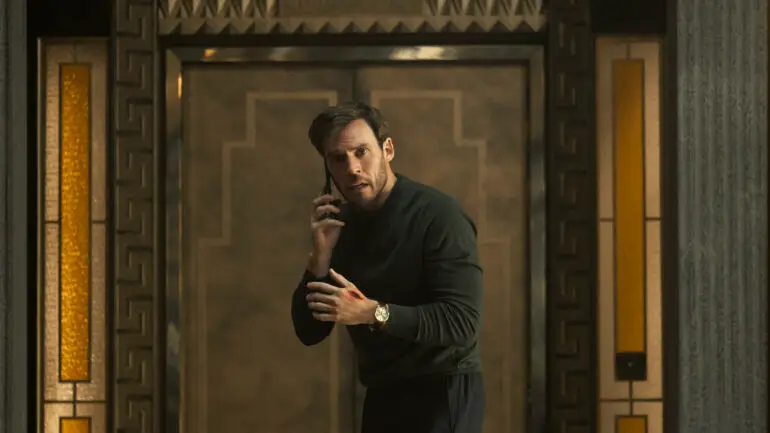
Harlan Coben’s Lazarus is rated TV-MA by Motion Picture Rating (MPA) for mature audiences. This series is best suited for older teens (16+) and adults.
“Lazarus” Review
There’s a rhythm to modern streaming culture that feels almost ritualistic: another month, another Stephen King adaptation on the big screen, and on television, another entry from the ever-prolific Harlan Coben universe. From the misty melancholy of the Polish miniseries The Woods (2020) to this year’s Missing You on Netflix, Coben’s work has been adapted so often it’s almost dizzying a carousel of moral puzzles and buried traumas that somehow keeps spinning. And yet, as thriller miniseries continue to dominate the screen, you realize he’s no longer a passing trend.
But that raises the inevitable question: with so many of these adaptations filling our queues, how different can they really be? Do they each earn their place, or do they start to blur into one long, shadowy labyrinth of guilt and revelation?
With Lazarus, his new original series for Prime Video, Coben attempts something fresh a story conceived directly for the screen. The six-part series follows Joel “Laz” Lazarus (Sam Claflin), a man returning home after his father’s suicide, only to find himself haunted quite literally by the dead and by the unresolved fractures of his own past. With the help of his sister Jenna (Alexandra Roach) and best friend Seth (David Fynn), Laz digs into a tangle of murders that tie back not only to his father’s mysterious death, but to his sister’s killing twenty-five years earlier.
What initially sets Lazarus apart from the crowded field of Coben thrillers is the way it flirts with the supernatural. Laz begins to experience vivid, hallucinatory visions of his father’s patients people he slowly comes to realize have long been dead. One patient, we learn, was murdered the very same year as his sister, their cases bound by eerie coincidences and unanswered questions. Seth tries to chase the facts and comes up empty, but Laz, caught in the fever dream of grief and obsession, refuses to let go of the connection.
As he burrows into his father’s old files, Laz finds himself pulled deeper into these people’s lives their traumas, their secrets, their unfinished stories. The show takes a fascinating risk here: rather than portraying these discoveries as clean detective work, it renders them as haunted memories, half-glimpsed and unstable. It’s as if Laz is cracking open not only the mysteries around him, but his own mind.
Visually, the series leans into that disorientation. The camera often looks as though it’s been filmed through a fogged pane edges blurred, light diffused, the world slightly off-kilter. These memories unspool like film left too long in the projector, flickering and warped. For a while, this effect is hypnotic a window into a consciousness fraying at the edges. But as the episodes go on, the trick starts to wear thin. What once felt eerie and cosmic begins to feel like repetition. The ghosts keep talking, but they stop saying much.
Still, those hallucinatory sequences give Sam Claflin an opportunity to explore a register we don’t often see from him. There’s something raw, almost feral, in the way he navigates Laz’s confusion crying out into the night at the spectral image of his father (Bill Nighy), who speaks in riddles designed to derail rather than enlighten. In quieter moments, Laz sits in his father’s chair, surrounded by memories that don’t feel like his own, as younger versions of family and patients emerge to whisper their secrets before vanishing. You can feel him trying to hold onto something solid, some truth that keeps slipping through his grasp.
When Laz discovers skeletal remains hidden within the walls of his father’s office belonging to someone tied to one of those long-dead patients the show teeters between psychological horror and procedural mystery. It’s a scene that encapsulates Lazarus at its best: intimate, shocking, and steeped in grief. In that instant, Laz’s realization is as much emotional as narrative that he may never have truly known his father at all.
The deeper Laz goes, the more blurred the boundaries become between his father’s identity and his own, between guilt and inheritance. The hallucinations start addressing him by his father’s name, recounting sessions he never attended. Each new conversation dangles a fragment of truth a suspect, a motive, a confession and Laz clings to them desperately, shaping them into a story that might restore order.
Detailed Content Breakdown for Parents
Violence & Intensity: There are multiple scenes of physical violence, some quite graphic (blunt force, blood, head wounds, strangulation, knife threats) and frequent suspense and threat sequences. For example, one episode shows a woman’s head repeatedly struck and a bloody aftermath, and another shows a corpse lying in a pool of blood. The tone is dark, with murder, stalking, home invasions and supernatural tension.
Language : Strong language is fairly frequent: expletives like “f**k,” “shit,” “bullshit,” “bastard,” “dick,” “whore,” and regional terms like “bellend.” There are also some derogatory references (e.g., “looney bin”) which are acknowledged as such.
Sexual Content / Nudity: There are verbal sex references, some crude mentions (for example fellatio is mentioned), and one scene includes sexual threat (a home invader restraining a teenage girl) though full nudity is not a major element.
Drugs, Alcohol & Smoking: Drug use is lightly referenced (drug-spiking is mentioned, though not graphic) and I did not find major scenes centred on alcohol or smoking.
Parental Concerns
- The overall tone is quite dark, suspenseful, and filled with threatening or violent imagery not easy for younger viewers.
- Some scenes include disturbing violence (including sexual threat) and gore, which may be more intense than expected.
- Suicide and self-harm are referenced repeatedly; conversations around death and trauma are heavy.
- Strong language and sexual references are present.
- Because of its supernatural and psychological components, younger viewers might be confused or distressed by the tone or visuals.
Basic Info
Title: Harlan Coben’s Lazarus
Release date: October 22 2025 (all six episodes drop simultaneously on Prime Video)
Format / Genre: Six-episode thriller/mystery miniseries with supernatural undertones.
Director(s): Nicole Volavka for some early episodes.
Cast: Sam Claflin as Joel “Laz” Lazarus, Bill Nighy as Dr. Jonathan Lazarus (father), Alexandra Roach as Jenna Lazarus, David Fynn, Karla Crome, Kate Ashfield among others.
Where to watch: Amazon Prime Video (global streaming).
