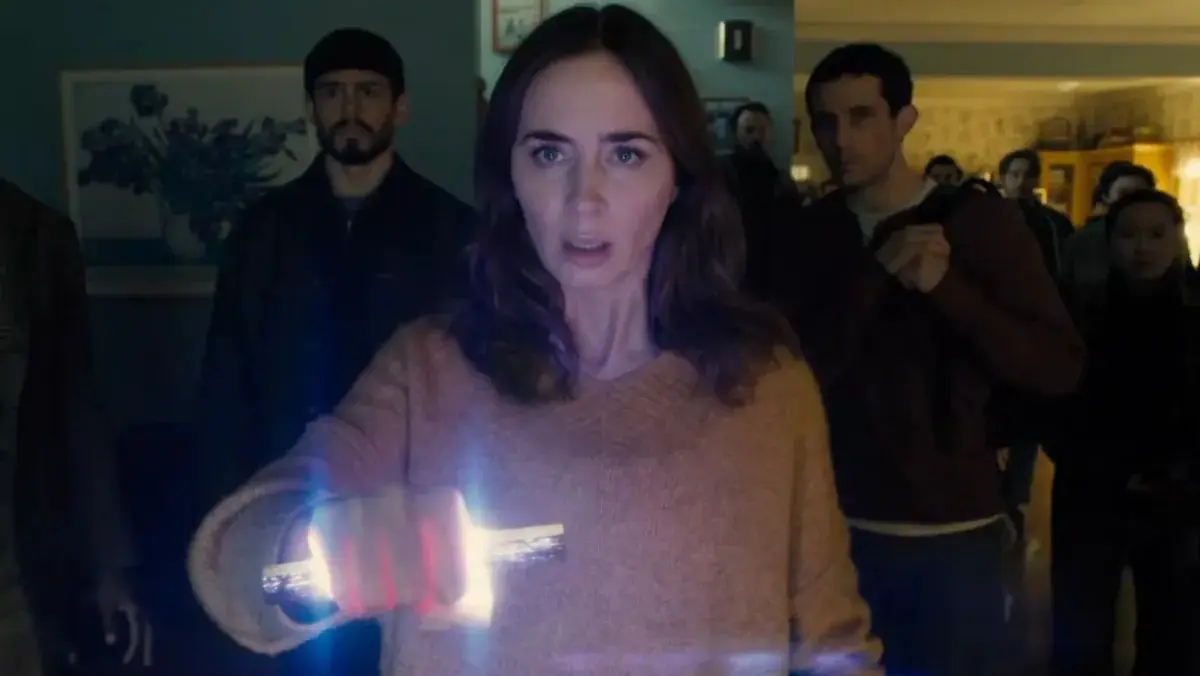
There’s a moment quiet, almost accidental, when Daniel Kellner tries to calm Margaret Fairchild down as she hyperventilates on a moving train somewhere in the middle of America. The world is apparently hours from nuclear war. Proof of extraterrestrial life is sitting on a hard drive between them. Margaret has recently discovered she can speak Korean without ever having learned a word of it.
And in this moment, Josh O’Connor reaches over and just waits with her, It’s maybe ninety seconds of two people trying to be human beings instead of plot delivery mechanisms. It’s the best thing in the film. The frustrating part is knowing Spielberg knows exactly what that scene is worth, and chose not to give us more of them.
Disclosure Day is the work of a filmmaker who clearly wants to make a propulsive 1970s paranoia thriller something in the All the President’s Men mold but with alien footage instead of White House tapes. The film arrives draped in that ambition.
Janusz Kaminski shoots it in textures that feel genuinely lived-in, practical and unglamorous in ways that blockbusters rarely bother with. John Williams’s score is an elegant near-homage to Jerry Goldsmith, particularly in one abduction sequence that could have been lifted wholesale from the Poltergeist soundtrack, and I mean that with tremendous affection. Sarah Broshar’s editing in the final twenty minutes is confident and moving in ways that surprise you. The craft here is real. Nobody phoned it in.
But the story written by David Koepp from Spielberg’s own original premise, keeps setting its own house on fire.
The premise is genuinely rich. Daniel (O’Connor, who continues to be one of the most watchable actors working right now) has escaped a black-site corporation called Wardex carrying documents and footage that prove not only that extraterrestrial life exists, but that it has visited Earth repeatedly and that a private company’s leadership has been quietly using alien technology for its own purposes.
Colin Firth’s Noah Scanlon runs Wardex. He has an alien weapon that lets him possess human bodies. The alien contact is slowly killing him. He wants his information back. Fine. We’re set. Let’s go.
The problem is that Koepp and Spielberg are so anxious to keep moving that they’ve forgotten to build anyone worth following. Characters arrive at a sprint and are defined by single gestures — a dead wife mentioned once and dropped, a boyfriend who moves cities for a woman we’re meant to understand without the film ever earning that understanding.
Margaret’s father had Parkinson’s. Daniel’s girlfriend Jane once lived in a monastery. These are handed to us like luggage tags, not character. And the film demands that we experience through these people the staggering weight of learning that humanity is not alone in the universe, which is asking a lot of luggage tags.
“Since when do you speak Korean?” “Speak Korean? What?”
That exchange is Emily Blunt being better than the material deserves, finding something wry and human in a line that, on the page, is simply exposition. Blunt’s Margaret grows into the film’s de facto center, a weatherwoman adrift in her own life, questing for something she can’t name, until the universe drops a very specific answer into her lap. There’s a late-film reveal that has Poltergeist-esque implications that the script then politely declines to explore. It hints at something stranger and bolder and then pulls back. It’s the movie’s pattern in miniature.
Eve Hewson actually steals scenes as Jane, the woman who struggles to reconcile alien contact with her faith, she’s the closest thing Disclosure Day has to a genuine moral complication, and she does more with the film’s thorniest questions in her limited screen time than the rest of the script does across two and a half hours.
Firth is given little beyond British menace until the third act, when his character makes a decision so abrupt it reads less like a story beat than a scheduling constraint. Colman Domingo, playing the mysterious Hugo who’s been orchestrating this disclosure from the shadows, spends most of his runtime on the phone dispensing cryptic platitudes. “When the time is right, all will be clear.” He’s being asked to substitute atmosphere for character, and he’s too good an actor to deserve that.
What’s genuinely strange about Disclosure Day is how small it thinks. The film sets its story against a backdrop of impending global catastrophe, news tickers screaming about WWIII, gas stations descending into panic buying, but our protagonists spend the bulk of the runtime on backroads and freight trains, essentially insulated from the collapse happening around them.
By keeping the story so tightly focused on Daniel and Margaret’s narrow trajectory, Spielberg forecloses any real examination of how seven billion people might actually receive the news that they are not alone. The film’s tagline poses exactly that question “would that frighten you?”, and then never seriously answers it.
Jane’s subplot comes closest. Her fear that alien confirmation will shake people’s faith, make them abandon their God, is the kind of real human dread this material demands. But it’s a tributary the film can’t afford to follow. The narrative current is always pulling you downstream toward the next cliffhanger, the next chase, the next piece of information. Spielberg used to be extraordinary at letting the river slow down.
Think of Roy Scheider watching his son copy his nervous hand-clasp at the dinner table in Jaws. Think of Richard Dreyfuss shaping mashed potatoes into a mountain while his family watches in horror. Those moments don’t pause the film, they are the film. They’re the reason you care when the shark appears.
There aren’t enough of those moments here. And the ones that exist are good enough to make their scarcity genuinely aggravating.
The third act gathers itself into something that almost works, a control room full of network executives deciding whether to broadcast the footage, with Spielberg doing something sweetly old-fashioned: asking us to believe in the press as the last honest institution, the place where truth still has a fighting chance. It’s touching in its naivety. If you remember Three Days of the Condor, you’ll know the feeling. Lord bless Steven Spielberg for wanting to believe that again, even now, even here.
Disclosure Day is a frustrating film because it’s frustrating in the way only earnest films can be. A cynical movie coasting on spectacle wouldn’t bother you like this. But Spielberg clearly means all of it, the empathy, the truth-telling, the quiet insistence that what we do with world-altering information says everything about who we are.
The film believes in its own themes. It just hasn’t given those themes enough room to breathe. In the end, what lingers isn’t the alien footage or the race to broadcast, it’s ninety seconds on a train. A man waiting with a woman. Two people being people. Spielberg built a machine to deliver that feeling, and it works better than it should. That it doesn’t work better than it does is the small heartbreak at its center.
A detailed content breakdown for parents and caregivers
Disclosure Day 2026 is rated PG-13 For action/violence, some bloody images, and strong language.
Violence & Intensity: Moderate; Features body-possession sequences, high-speed chases, home break-ins, and moments of alien-induced psychological terror. Some bloody images. Spielberg leans into dread and tension over gore. Global-collapse imagery (panic buying, threat of nuclear war) may be distressing for younger or sensitive viewers.
Language: Strong language present; Several uses of strong profanity. No slurs, Dialogue is tense and emotionally charged throughout but not gratuitously foul.
Sexual Content & Nudity: None; No sexual content or nudity. Romantic relationships are implied but not depicted physically.
Drugs, Alcohol & Smoking: Minimal; Incidental social drinking shown in background scenes. No drug use. No smoking prominently featured.
Thematic Concerns: Faith, government secrecy, global panic
The film explores conflict between religious belief and scientific revelation. Government cover-ups and institutional mistrust are central themes. The backdrop of potential world war may provoke anxiety in younger viewers.
