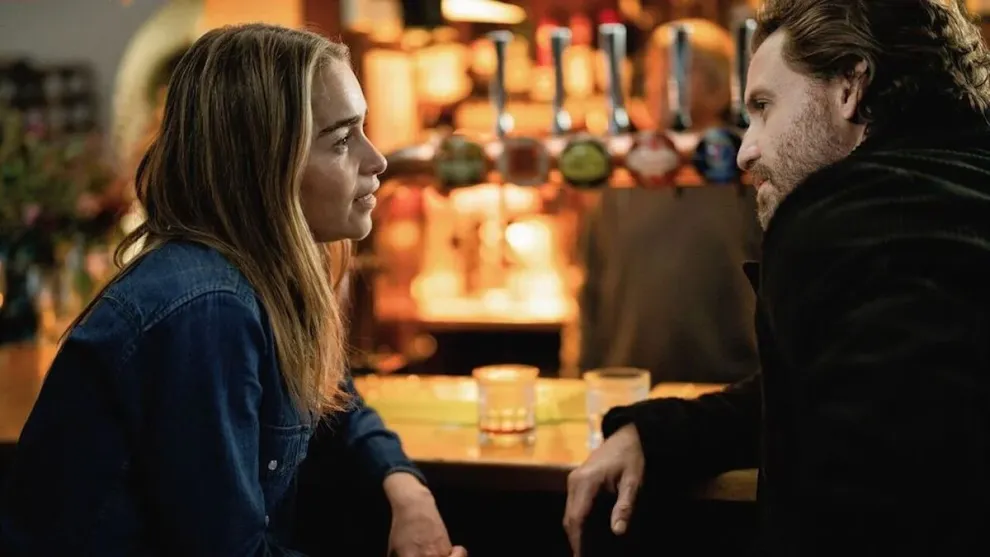
I’ve been trying to figure out what bothers me about Next Life, and I think it’s this: Emilia Clarke is giving a real performance in a film that keeps flinching away from her.
She plays Ivy, thirty-eight, freshly unemployed, freshly dumped, both by the same man, which is either efficient or catastrophic depending on your tolerance for overlap. We first catch her mid-sprint, cursing at an alarm clock, mascara not quite right, barely making her train to a goddaughter’s christening. It’s a strong entrance.
Clarke plays flustered the way very few actors can, not as a joke, not as a quirk, but as a whole emotional weather system passing through a person. Then she spills coffee on a handsome stranger, and the film splits in two.
That split is the thing. In one version of the story, she meets Diego, Édgar Ramírez, jazz musician, philosopher, a man who genuinely believes nothing happens by accident. In the other, she doesn’t. She shows up to the same christening, drinks a little too much, and falls back toward Noah, the ex-boyfriend-slash-former-boss played by Jack Farthing with more warmth than the role probably deserves.
Both timelines run concurrently for the film’s entire length. Both are lit differently, dressed differently Ivy in denim in one life, something warmer in the other, and Doremus cuts between them with an editorial fluency that’s genuinely impressive. You never lose the thread. The problem is the thread doesn’t go anywhere surprising.
Doremus came back to filmmaking after seven years away. His last film was Endings, Beginnings in 2019, and the hiatus apparently came from a real place, he’s said openly that he just didn’t have anything left in him. Then he met someone in Madrid, unexpectedly, and something unlocked.
That story, the actual lived version, sounds like the film he maybe meant to make. What he’s made instead is something more careful. More designed. A film that loves the architecture of feeling without always wanting to do the emotional labour.
The handheld camera stays close to faces throughout, Doremus and cinematographer Marianne Bakke searching for something unguarded, and Clarke gives them plenty. There’s a scene at the christening where she’s watching the baby being held, and something moves across her face that the script doesn’t mention and the scene doesn’t explain. It’s the best moment in the film.
It lasts maybe four seconds. Then the score swells and the camera cuts away, and the moment is gone before you’ve fully registered it. That’s the rhythm of the whole picture: intimacy glimpsed, then tidied up.
Ramírez does what Ramírez does, his voice, when he sings, lands somewhere between invitation and elegy, and his physicality has a stillness that reads as depth even when the dialogue isn’t earning it. Farthing’s Noah keeps surprising you. He’s not the villain the structure implies he should be, and Farthing leans into that, finding something genuinely tender in a man who loves someone in all the wrong registers. Both men are working harder than their roles require. That’s either a compliment or an indictment, and I’m honestly not sure which.
What goes missing, and this is what keeps nagging at me, is Ivy herself. The film talks about her constantly. It’s structured entirely around her choices, her desires, her road-not-taken. But I couldn’t tell you, by the end, what she’s actually afraid of. Or what she wants from music beyond the vague comfort of it. Or why Noah broke something in her that Diego might or might not fix.
The film gives her two full lives and somehow both feel slightly borrowed. Borrowed from the general grammar of romantic drama, where apartments are either soulful or soulless, where men are either challenging or convenient, where a woman discovering herself plays out in late-afternoon London light with a good jazz standard underneath.
There’s a subplot about an unplanned pregnancy in the Diego timeline that the film handles with a matter-of-factness I actually respected, no operatics, no speeches, just two people dealing with something real. That restraint, applied everywhere, would’ve made a different movie. A better one, probably.
It’s not a bad film. It’s a film that keeps being less than it could be, which is its own kind of frustrating.
Clarke clearly loves this material and this director. She’s said she’s never felt that level of joy on a job, and you believe her, there’s an ease to her here, an unselfconsciousness, that doesn’t show up everywhere in her work. Doremus drew something out of her.
I just wish he’d been as ruthless with his script as he was generous with his camera. Because what Clarke is doing in the margins of this film, in the small glances, the half-finished sentences, the way she holds a wine glass when she’s listening to someone she’s not sure she trusts, is a whole other story. The one I wanted to see.
Parental Guidance
Violence & Intensity: None; Emotional conflict only, arguments, a breakup, difficult personal news. Nothing disturbing.
Language: Mild; Occasional mild profanity. No slurs. Tone is warm throughout.
Sexual Content: Moderate; for the genre. Both relationships implied as sexually active. Brief intimacy scenes, no explicit nudity. One unplanned pregnancy, handled without drama.
Drugs & Alcohol: Alcohol is a recurring social presence, bars, a christening, dates. Ivy is visibly drunk in one scene. No drugs. No smoking flagged.
Themes: Romantic choice, career uncertainty, artistic identity, parallel lives. Adult in tone but not in content.
Age Recommendation: 14 and up comfortably. The film’s real audience is adults , younger viewers can watch it, they just may not care.
