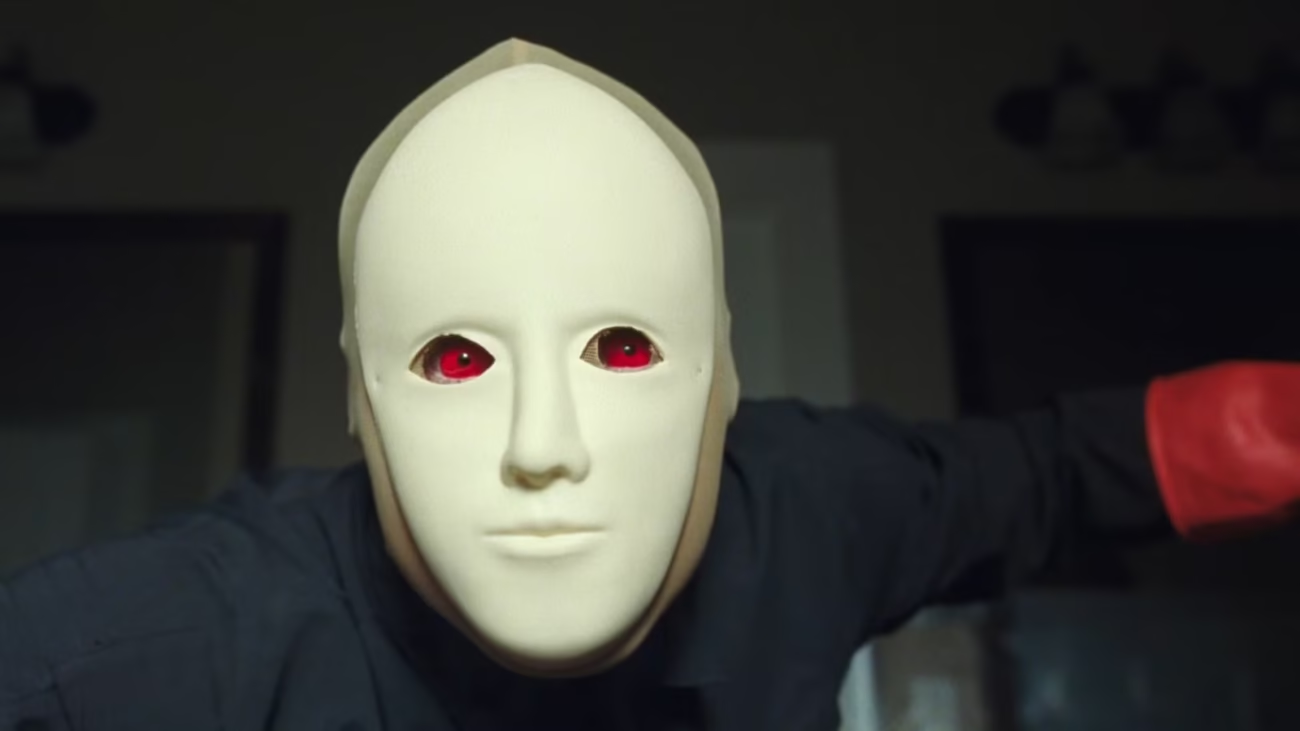
You already know what doom-scrolling feels like. That specific, slightly shameful trance recipe videos you’ll never make, a Wikipedia rabbit hole that ends somewhere around a medieval plague, a clip of something you can’t quite categorize as real or fake. Your phone makes it easy. The internet makes it easier. And somewhere at the bottom of that scroll, the thinking goes, is something genuinely terrible. Faces of Death wants to live down there. The problem is it keeps flinching on the way.
Margot, played by Barbie Ferreira, works as a content moderator at Kino a TikTok surrogate thinly veiled enough to be legally safe and recognizable enough to be pointed. Her job is to watch what the rest of us aren’t supposed to see and decide what stays up. NDAs, office rules, a red light on her desk that goes on when a video crosses some invisible threshold. What the film gets immediately right is the specific texture of that workplace: the studied indifference of her coworkers, the bureaucratic language wrapped around deeply abnormal content, the casual cruelty of a boss who tells Margot, when she flags a clip she’s afraid might be real, that “DIY horror is trafficking right now, support the trend.” That line is genuinely chilling. The film is at its sharpest when it stays in that office.
It’s through this job that Margot stumbles onto the original Faces of Death the 1978 pseudo-documentary that marketed itself as banned in 48 countries, built entirely around the audience’s gnawing uncertainty about whether what they were watching was real. That uncertainty is the whole engine of the original film’s power, and it’s also the engine this new version is trying to run on: Margot begins to suspect that some of what she’s moderating isn’t staged. That the people dying onscreen are actually dying. It’s a strong premise. It connects the historical shock value of the source material to something genuinely contemporary the content moderation industrial complex, the numbing effect of algorithmic violence, the way platforms profit from exactly the material they claim to police.
Daniel Goldhaber directed this, which raised my expectations considerably. Cam was a tightly wound nightmare about identity and digital performance, and How to Blow Up a Pipeline was one of the more formally intelligent American films of the last several years — a thriller that actually had something to say and knew how to say it cinematically. Goldhaber is not a director who makes lazy choices. Which is part of why Faces of Death is so puzzling. He clearly understands the material. You can feel that understanding in the Kino sequences, in the way Margot’s colleagues are written people so thoroughly desensitized that her alarm reads, to them, as instability. Charli XCX shows up as a coworker who, when asked why she works at a content moderation center, shrugs and says it’s a thrill when a good one comes in, plus they have dental. It’s a perfect line. It lands because it’s true of a certain kind of person who exists in a certain kind of job, and the film earns it.
But then the serial killer shows up, and something shifts.
Dacre Montgomery plays Arthur, the killer and to be clear, Montgomery is doing genuinely committed work here. He chews through his scenes with an intensity that’s almost too much for the film around him, and there’s one bit where he logs into a second Reddit account to defend his own video from a commenter who calls it a student film, then signs off with “Maybe you’re next,” that is blackly funny and briefly perfect. He’s entertaining. But the decision to show us Arthur this early, this completely, deflates the film of exactly the thing it needs most: dread. You can’t be afraid of what you fully understand. Once Faces of Death becomes a procedural Margot investigating, Arthur killing, their confrontation inevitable it stops being horror and starts being a thriller, and not a particularly surprising one.
What it starts to resemble, increasingly, is a Scream movie. That’s not a dig at Scream, which has its own pleasures, but Arthur’s eventual motive his obsession with internet infamy, his need for an audience feels like it belongs in that franchise’s particular flavor of meta-horror, where the killer’s awareness of genre conventions is the whole point. That’s a legitimate mode. It’s just not what Faces of Death was supposed to be. The original film was transgressive precisely because it refused to give you the comfort of a narrative, refused to let you settle into the safety of genre conventions. This version replaces that discomfort with a fairly conventional horror movie architecture, and the seams show.
The marketing around this film was aggressive about its darkness trailers supposedly banned from YouTube, theaters allegedly refusing to display its posters. It’s a familiar move, and it raises expectations the film has no real interest in meeting. Nothing here warrants that kind of warning. Which would be fine, if the film were content to be what it actually is: a well-made, occasionally sharp horror thriller with a genuinely interesting first act and a more generic second and third. But it keeps gesturing toward a transgression it never commits to, keeps promising a darkness it never quite enters.
There’s a specific irony in a film about the shallowness of social media becoming, in its own way, shallow more interested in the idea of confronting something disturbing than in actually doing it. Faces of Death has the right instincts and the right director and two lead performances that are doing more than the material requires. It just needed to be braver. It needed to go further down the scroll and stay there, instead of climbing back out into the light where it’s safe and familiar and, ultimately, a little forgettable.
Faces of Death opens in theaters April 10.
