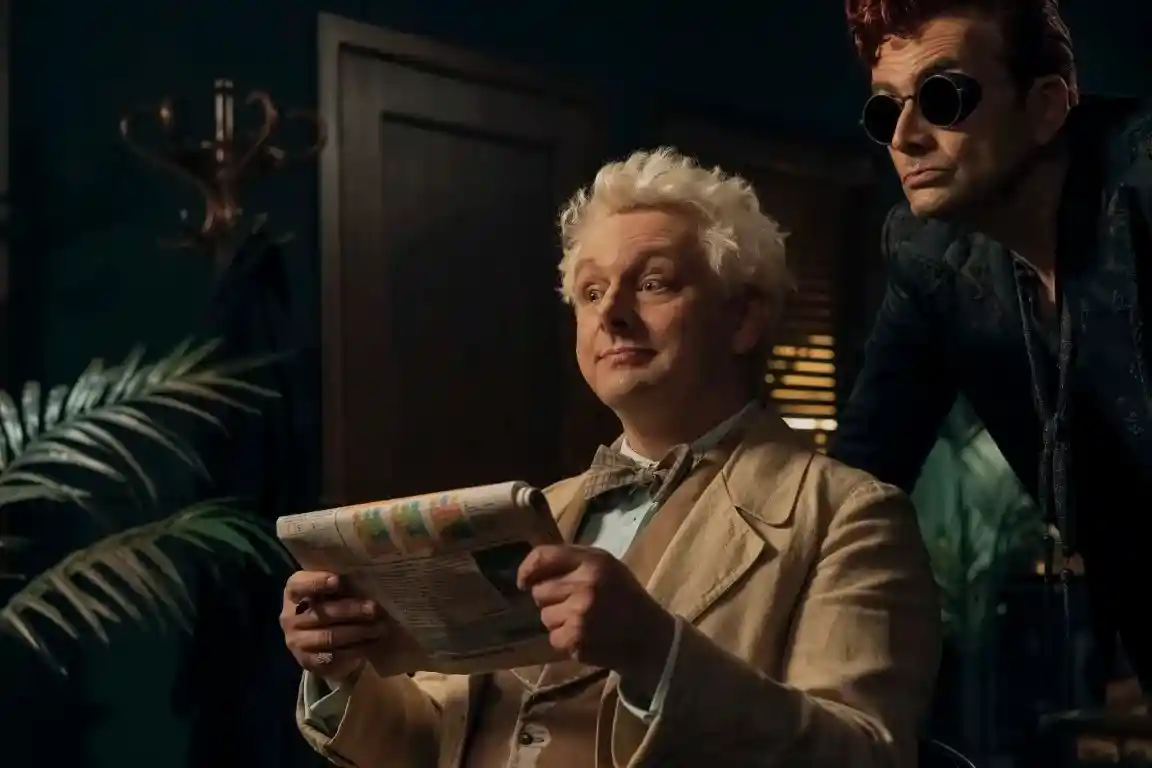
Review of Good Omens: The Finale on Prime Video, with parental guidance
Series Finale: 96 min. Director: Rachel Talalay. Starring: Michael Sheen, David Tennant
Crowley is asleep in a filthy alley when we find him again. Slouched against brickwork, bottle finished, the bookshop dark behind him like a house that’s stopped breathing. He looks less like a demon who retired and more like a man who got his heart broken and hasn’t quite decided what to do next.
It’s forty seconds of screen time, no dialogue, and I haven’t shaken it. That’s the whole show in a single image all the theology and the cosmic stakes and the end-of-the-world plotting mattering far less than this one creature who learned to feel things and now has to live with that.
Let me say upfront what this finale is not: it’s not the ending Good Omens deserved. What was planned as a full six-episode final season got crushed, by the misconduct allegations against creator Neil Gaiman and the subsequent chaos of paused production, into a single ninety-six-minute episode.
Characters who mattered Jon Hamm’s Gabriel, Miranda Richardson’s Shax, others simply aren’t here. Entire story threads get compressed into scenes that feel like outlines of scenes. There’s a bit involving Aziraphale in disguise that clanks along like a joke that ran out of runway. You feel the missing hours the way you feel a word that’s been cut from a sentence the shape of the gap is still there.
And yet. The thing is, it still works. Not in spite of the constraints but in some strange way almost because of them everything extraneous has been stripped away, and what’s left is the one thing this show has always been about. Two beings who were supposed to be enemies, standing in the wreckage of everything they almost had, figuring out if they can find their way back to each other.
“Sheen does something with a soft smile that should be classified as an unfair advantage. He conveys entire histories with a half-turn of his head.”
The plot, such as it is: Aziraphale has been installed as Supreme Archangel in Heaven and is quietly trying to steer the Second Coming away from fire-and-brimstone and toward something more universally liveable. Crowley is in London. Drunk, unshaved, barely functioning.
Then Jesus given a physical body in preparation for his return and played by Bilal Hasna with exactly the right combination of radiance and bewilderment wanders off from Heaven without explanation. The Book of Life goes missing at the same time. Aziraphale needs Crowley’s help. Crowley is not enthusiastic. This is more or less where the show started, and the show knows it.
What I didn’t expect was how uncomfortable the reunion would be. Not in a bad way. In the way that real estrangement is uncomfortable when two people have genuine, irreconcilable reasons for the choices they made, and neither of them is simply wrong. The show doesn’t paper over that. It sits in it.
Director Rachel Talalay, who has done some of the sharpest work in modern Doctor Who, keeps the camera close on both of them in those scenes. There’s one exchange in particular, quiet and almost domestic in its misery, where you realise neither Sheen nor Tennant is performing emotion so much as just having it, right there on screen.
Tennant has always been the more visibly expressive of the two Crowley’s feelings arrive on his face before he’s decided to let them. But Sheen does something with a soft smile that should be classified as an unfair advantage. He conveys entire histories with a half-turn of his head. There’s a moment late in the episode where Aziraphale has to make a choice, and Sheen plays it with this terrible, quiet certainty the expression of someone who knows exactly what they’re giving up and is choosing it anyway. I kept thinking about it on the walk home.
Recommended: The Terror: Devil in Silver Season 3 Parents Guide
Talalay also does something quietly smart with Whickber Street itself. The neighbourhood around the bookshop has declined in Aziraphale’s absence. It looks used-up, unloved. It’s an obvious metaphor, and the show deploys it without apology, and it works anyway, because the show has earned the right to its sentimentality. This is, after all, a story that has always argued that the physical world messy, temporary, resistant to categorisation is the thing most worth saving. Heaven is pristine and cold. Hell is bureaucratic and dim. Earth is a shambles. That’s why they love it.
Is this the ending the show deserved? No. Is it the ending the show got, made with everything its cast and crew had left in them? Yes. And there is something unexpectedly moving about that about a group of people who could have walked away, who didn’t, who finished the thing even when finishing it meant working under the worst circumstances imaginable.
The finale holds to the same idea the whole series has held: that love, chosen deliberately in the face of every reason not to, is its own kind of defiance. The bookshop lights come back on. Crowley looks up. It’s enough. Just barely, and genuinely it’s enough.
Good Omens Season 3 Parents Guide
Violence & Intensity: Very mild. Supernatural confrontations exist but nothing is graphic or frightening in a conventional sense. The emotional weight grief, longing, the cost of choices made — is more likely to affect sensitive viewers than any physical danger on screen. This is drama, not action.
Language: Light throughout. A few mild expletives consistent with earlier seasons. The show’s preferred weapon is dry wit, not profanity. Accessible to most teens without concern.
Sexual Content: No nudity. The love story between Aziraphale and Crowley two male-presenting celestial beings is the emotional spine of the episode. It’s handled with warmth and restraint: charged looks, a referenced kiss from Season 2, yearning rather than anything explicit. Parents should know this queer relationship is not subtext; it’s the point of the whole series.
Drugs & Alcohol: Crowley is visibly drinking to cope an empty bottle next to him in the alley, alcohol as shorthand for a character in emotional freefall. It reads as sad rather than glamorous, but it’s present and deliberate. No drug use.
Themes & Context: The show plays extensively and playfully with Christian theology angels, demons, the Second Coming, Jesus as a character, Heaven and Hell as competing bureaucracies. It’s gentle satire, not mockery, but families with strong religious convictions may want to watch alongside younger viewers and discuss. The irreverence is affectionate in spirit if not in letter.
Age Recommendation: 14 and up comfortably. Thoughtful 12–13 year olds who’ve followed the series with family should be fine. The show’s sensibility rewards emotional maturity more than any specific age.
Good Omens has always been a show about learning to care for things that weren’t meant to matter to you. That’s probably the best thing to tell a young viewer before they press play.
Premieres May 13 on Prime Video.
Recommended: Man on Fire (2026) Parents Guide