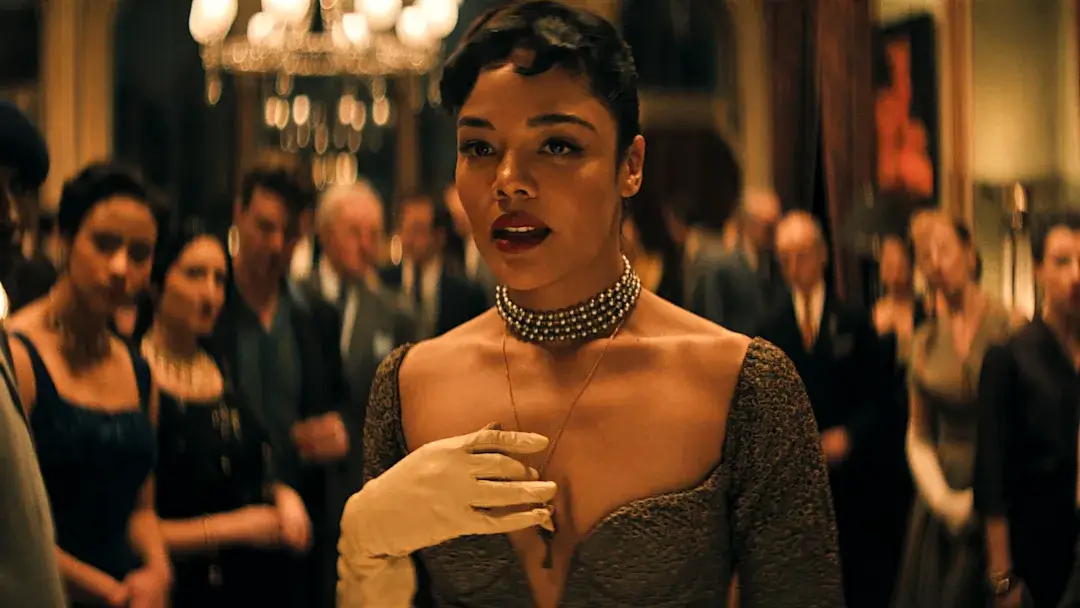
Hedda is Rated R by Motion Picture Rating (MPA) for sexual content, language, drug use and brief nudity. Given the content and tone, this film is best suited for older teens and adults.
Hedda (2025) Movie Review
Writer-director Nia DaCosta’s latest work, Hedda, reimagines Henrik Ibsen’s 1891 classic Hedda Gabler with a daring queer twist. Set in early 20th-century England, the film reunites DaCosta with Tessa Thompson, the fierce lead from her breakout debut Little Woods. Thompson embodies Hedda newly married, socially ambitious, and spiritually restless a woman whose hunger for status has driven her mild-mannered academic husband George (Tom Bateman) deep into debt. Hedda, the illegitimate daughter of the late General Gabler, loves her pistols almost as much as she loves emotional manipulation.
The couple returns from a lavish honeymoon abroad to an estate that’s far beyond their means. Their financial survival now hinges on George securing a professorship and a university endowment. So, Hedda plans a party ostensibly to help him and invites a carefully curated guest list: George’s superior, Professor Greenwood (Finbar Lynch, measured and sly), his young wife Tabitha (Mirren Mack), and a throng of Hedda’s free-spirited friends. But the soirée takes a turn when Eileen Lovborg (Nina Hoss), a fellow scholar and recovering alcoholic and, crucially, Hedda’s former lover arrives.
DaCosta divides her adaptation into five acts, each marked with title cards a modern stylistic nod to filmmakers who structure their narratives like novels. The psychological unraveling is mapped with care, but DaCosta’s decision to open the film with a scene from the final act robs the night of some suspense. By hinting too early that death is circling Hedda’s door, she removes the slow-burn dread that should accumulate naturally as the champagne flows and the masks slip.
Also Read: Regretting You (2025) Parents Guide
The screenplay brims with allusions to Hedda’s erotic past and appetite for chaos. She’s a woman who has likely seduced half the room gender be damned and Thompson plays her with a predator’s poise. She sizes people up, spots their weaknesses, and pulls the strings with surgical precision. These charged exchanges, peppered with sly sapphic humor, are what light up the film. At its Toronto International Film Festival premiere, audiences reacted audiblybursts of laughter, gasps of shock, and even one lone man’s stunned “wow” after a particularly jarring moment of revelation.
Technically, the film wobbles. The editing lacks rhythm, and Sean Bobbitt’s cinematography, surprisingly, feels flat. The lighting during the central party sequence is murky, blurring the elegance of the setting. The dance scenes, which should intoxicate, instead feel stilted, undercut by awkward framing and disjointed cuts that fail to capture the vitality of the jazz they accompany.
Thompson, working in a deliberately clipped British accent, gives a commanding if mannered performance, and she’s matched by Hoss’s simmering intensity and Poots’s fragile warmth. But DaCosta’s framing often betrays them refusing intimacy where it’s most needed.
Also Read: Harlan Coben’s Lazarus (2025) Parents Guide
There is, however, one moment when the film’s form and feeling finally synchronize. When Eileen first enters the party, Hedda spots her across the dance floor, and in that instant, Thompson’s eyes ignite with longing. DaCosta stages the moment with a slow, floating double dolly shot a clear homage to Spike Lee that captures the rush of forbidden desire with cinematic grace. For a few fleeting seconds, Hedda achieves the operatic emotion it’s been reaching for all along.
If only the rest of the film sustained that electricity. Hedda is full of fascinating ideas about repression, gender, and the performance of desire but too often, those ideas remain trapped inside their own formal conceit. Like the decaying manor where the action unfolds, DaCosta’s film feels haunted by the ghost of something grander: the promise of greatness just beyond reach.
Detailed Content Breakdown for Parents
Violence & Intensity: The film contains several moments of intense psychological tension, manipulation and threat. According to reviews, there are firearms involved (Hedda uses guns in the narrative) and a setup that turns a social evening into something dangerous. The violence is not cartoonish, but it carries real stakes and can feel disturbing.
Language : While detailed lists of exact words are not readily published, the R-rating includes “Language”. Expect adult tone, some profanity, emotionally charged dialogue and possibly slurs or demeaning remarks in the context of manipulation and social power plays.
Sexual Content / Nudity: The film features sexual tension, implied sexual relationships (including a queer dimension), and brief nudity is listed in the rating info. Scenes of intimacy may be stylised, but adult in nature parents should be aware this is not light romance.
Drugs, Alcohol & Smoking: There are party settings, likely alcohol use (social drinking) and behaviours tied to a decadent evening. One article mentions Hedda thrusting drinks into the hands of a recovering alcoholic. Smoking or drug use isn’t flag-raised in the major summaries I found, but the atmosphere suggests adult indulgence.
Scary or Disturbing Scenes: The high-tension manipulations, the presence of firearms, and the unraveling of relationships may be emotionally disturbing. The stylised glamour gives way to darkness; younger children may find the mood oppressive or unsettling.
Positive Messages / Role Models: On the positive side, the film offers strong performances, a powerful central character (Hedda) exploring female agency and desire. It asks questions about ambition, identity, and the consequences of choices. For older teens, it may prompt good conversation about social expectations, power, manipulation, and authenticity.
Parental Concerns
- Because of the mature themes (sexuality, manipulation, guns, violence, drinking), this is not a “family movie” in the sense of younger children sitting in and enjoying it with minimal supervision.
- Hedda’s character engages in morally ambiguous, even destructive behaviou she is not a straightforward “role model” and indeed part of the film’s tension comes from her unsettling choices. Parents need to be ready to discuss complexity: this is not a simple heroic tale.
- The mood and visuals lean dark, luxe, and intense some scenes may unsettle sensitive viewers.
Filed from the film’s premiere at the Toronto International Film Festival. “Hedda” opens in theaters October 22, 2025, before streaming on Prime Video beginning October 29.