Anniversary is Rated R by Motion Picture Rating (MPA) for language throughout, some violent content, drug use and sexual references. I’d recommend this film for ages 15+
“Anniversary” a film Directed by the Polish filmmaker Jan Komasa (Suicide Room, Corpus Christi) and written by Lori Rosene-Gambino, who co-developed the story with him, Anniversary comes from a pair of artists who seem to understand America with a clarity that many American filmmakers have lost. Komasa, raised in a country that endured both Nazi and Soviet occupation, knows the scent of creeping authoritarianism and he’s spent his career examining what it does to the human soul. At first glance, the title seems literal: the 25th wedding anniversary of Ellen (Diane Lane), a Georgetown political science professor whose liberal views are both her pride and her curse, and her husband Paul (Kyle Chandler), a chef-turned-restaurateur whose Washington, D.C. dining room has become a salon for the city’s elite. Their restaurant’s profits fund private schools and polished futures for their four children three already out of the nest.
Also Read: Die, My Love (2025) Parents Guide
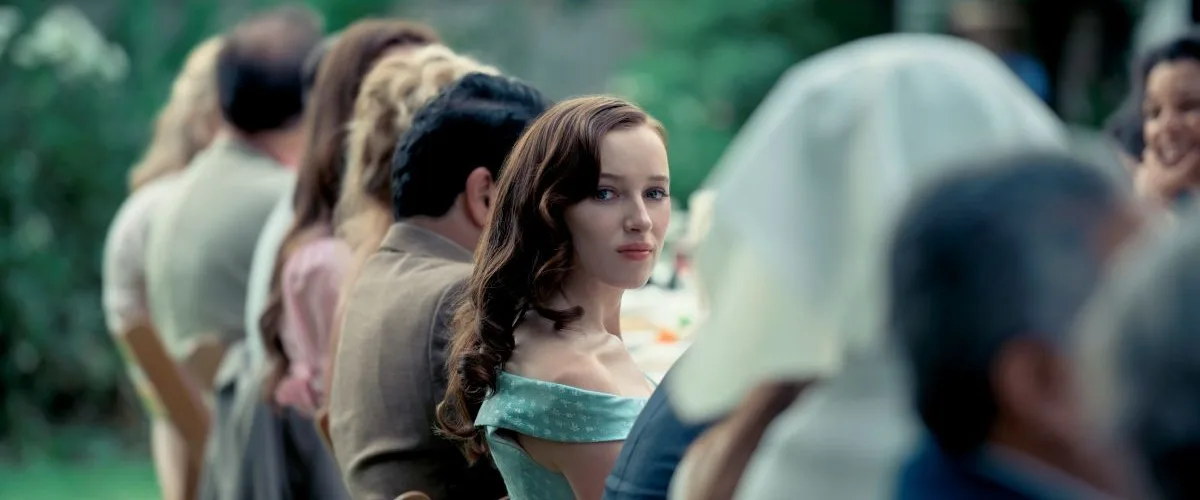
But Komasa isn’t interested in one anniversary. He’s tracing the fault lines across several, over a span of five years, ending with the couple’s 30th. Around their table, the family grows, fractures, and mutates in sync with a country sliding into the grip of a homegrown tyranny. The real turning point arrives when Liz (Phoebe Dynevor) walks through the door a former student of Ellen’s with a grudge and a glow. Liz, once humiliated in class by her progressive mentor, has reinvented herself as a right-wing celebrity-in-the-making. Her book, The Change: A New Social Compact, thick as a brick and twice as heavy-handed, is about to launch her into stardom. And, as fate or malice would have it, she’s dating Ellen and Paul’s son, Josh (Dylan O’Brien), a failed novelist whose rejection letters sting even more knowing that his mother is now a minor media celebrity herself, defending academia from claims of “liberal indoctrination.”
Liz is all surface charm her smile soft, her tone empathetic, her eyes tuned to camera angles. But you can sense the hollowness. Paul, ever the peacekeeper, insists that politics stay outside his house, which sounds noble until you realize it’s also a form of denial. It’s never clear where his heart truly lies. Maybe he’s a progressive who values civility over confrontation. Maybe he’s just tired. Their youngest daughter, Birdie (McKenna Grace), a scientifically minded teenager studying viruses, seems apolitical though her fascination with infection feels like more than coincidence.
Recommended: Shelby Oaks (2024) Parents Guide
The older sisters are far easier to read. Anna (Madeline Brewer), a queer comic, wields politics and pain as twin engines for her art. Cynthia (Zoey Deutch), an environmental lawyer, channels her idealism through her work, though her partner Rob (Daryl McCormick) one of the few nonwhite characters struggles with his own quiet compromises. You can feel Komasa’s empathy for all of them. They’re trying to be good people in a world that keeps changing the rules. But as the film reminds us, righteousness is fragile. Comfort, money, and ego can erode conviction faster than we’d like to believe.
The film’s favorite metaphor disease turns out to be chillingly apt. Liz’s The Change spreads through the culture like a virus disguised as medicine. It preaches “unity” and “common sense,” all while smuggling in nationalist talking points: a redesigned flag, talk of a “third” political movement that is really one-party rule, and the fingerprints of corporate think tanks that echo real-life groups like the Heritage Foundation. The rhetoric feels familiar because, well, it is. You can almost hear the cable news clips. And as the movement swells outside, Ellen’s family begins to crumble inside, each argument at the dinner table echoing the unrest beyond their walls.
In movies like this, every family gathering hides a landmine. Here, it’s Liz and Josh announcing their engagement during Ellen and Paul’s anniversary celebration. You can feel Ellen’s stomach drop, even before her face tightens into a polite smile. To her, Liz isn’t just a bad match for her son she’s a Trojan horse. Ellen suspects Liz’s real mission is vengeance: infiltrate, convert, destroy. Whether she’s right or paranoid hardly matters; the tension is real, and it’s electric. Liz is a villain in the story’s moral architecture, sure but Komasa wisely doesn’t make her a cartoon. She’s a person wounded by humiliation, driven by the same fragile pride that fuels every demagogue who ever rose to power after being laughed off a stage.
Ellen’s polite dismissal of Liz at that party becomes the spark. Liz’s parting gift a neatly wrapped copy of The Change lands like a small bomb in paper and ribbon. It says everything without words: You doubted me. Now I have your son, and soon I’ll have the influence you only dreamed of.
From there, the power struggle turns personal. Liz becomes pregnant with twins, no less and soon takes Ellen’s place as Georgetown’s rising star. Josh basks in the glow, his arrogance metastasizing. He’s no longer the uncertain writer but a zealot with expensive suits and a cruel smile. Watching him needle his sisters and intimidate family members feels like watching someone you love vanish into propaganda one of the film’s most painful truths.
As time passes, the domestic melodrama mirrors the nation’s descent. Language becomes a weapon words like “sedition” and “terrorist” are tossed around like bullets. We see how power, once unrestrained, takes on its own feral logic. There’s even a subplot that recalls that viral meme: “I never thought leopards would eat MY face,” sobs woman who voted for the Leopards Eating People’s Faces Party.” The movie understands this tragic irony all too well.
By the time the story reaches its harrowing final stretch, morality has curdled into survival instinct. People sell each other out for safety or status. Neighbors vanish. Friends whisper about who’s been “disappeared.” The scariest scenes aren’t violent; they’re quiet people thanking their tormentors for mercy that never existed. Komasa knows, as survivors of real dictatorships know, that tyranny’s cruelty isn’t only in the acts of domination, but in forcing the victims to pretend they’re grateful.
And the film’s most haunting quality? It feels less like speculation than observation. Shot in 2023, between political storms, Anniversary imagines a near-future America that’s chillingly plausible. The filmmakers didn’t so much predict the future as map the coordinates of where we’re already heading. You watch it, and you feel that creeping dread: this isn’t prophecy it’s reportage.
What the film recalls, at its best, are the great political dramas about life under dictatorship movies set in Argentina, Chile, Uganda except Komasa removes the historical buffer. There’s no safe distance here. You feel it pressing against the now. It’s as if The Official Story or Missing had been shot in your own backyard. Anniversary isn’t a warning so much as a reflection: this is what we could become if we keep confusing cruelty for strength.
It was made the indie way financed through scattered funds, shot quietly in Ireland, where no one would riot over a defaced American flag. You can almost imagine the relief of being able to shoot such scenes without fear of backlash. But it’s hard to picture the same film being funded now, in this climate. The world has shifted again, and art this politically charged feels almost subversive. And that, oddly enough, gives Anniversary a kind of hopefulness. It’s proof that artists are still willing to risk something to tell the truth.
Komasa and Rosene-Gambino don’t leave us in despair. Even amid the suffocating fear, there’s a flicker of resilience the stubborn, human refusal to surrender. The movie ends not with triumph, but with endurance. It reminds us that hope, however tattered, is still an act of resistance.
Detailed Content Breakdown for Parents
Violence & Intensity: There are moments of real tension and threat. Scenes include intimidation, domestic conflict, political unrest, suggestions of shooting or stabbing, and a suicide bombing is referenced (though not all shown in graphic detail). The intensity of the political thriller framework means that the mood remains dark and unsettling at times.
Language: Strong language appears throughout the film. Expect multiple uses of the f-word, s-t, d-k, d-khead, hell, “motherf-r,” and other such exclamations. The tone is serious and adult: characters engage in heated arguments, betrayals, manipulation and ideological conflict.
Sexual Content / Nudity: There is no heavy nudity, but sexual references and situations are present: kisses, married couple flirting, sounds of sex occurring in an adjacent room, implications rather than explicit depiction. Also, a scene shows adult drinking and some pressure among young adults, though not explicit sexual acts shown in graphic detail.
Drugs, Alcohol & Smoking: some scenes show young adults smoking marijuana (with peer pressure), characters drinking heavily at a party (including straight from the bottle), prescription pills visible and discussed (indicating dependence or emotional distress). Alcohol is present in adult social settings; smoking and drug use appear with older teens/young adult characters.
Parental Concerns
- Although this isn’t full‐blown horror or graphic violence, the themes are heavy: authoritarian takeover, betrayal, ideological radicalization, and family breakdown. Younger children may feel anxious, confused or uncomfortable.
- The strong language and scenes of drug use and drinking may be inappropriate for younger viewers or ones sensitive to adult themes.
- Some of the psychological tension and distress (disappearance, surveillance, coercion) may be disturbing.
- Because the film is built around ideological conflict, it may provoke questions or require parental guidance to contextualize the themes (for example, what to do when beliefs are challenged, how privilege and power operate).
- The presence of sexual content is mild but suggestive; it’s not graphic but enough that you might want to have a chat with your teen about what’s happened.
- The trauma of loss of freedom and trust in institutions may feel bleak, so younger or more sensitive viewers may benefit from a post‐film conversation.
Release Date: October 29, 2025 (U.S. theatrical release)
