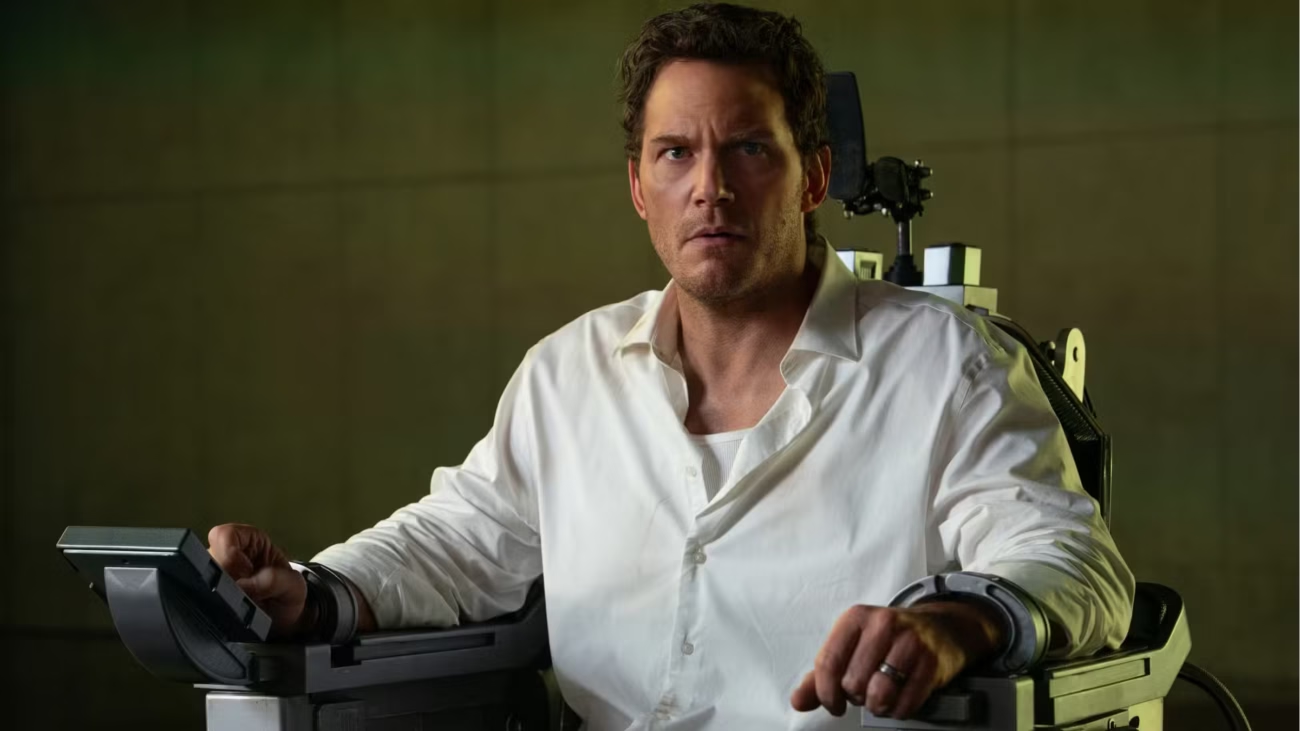
At the start of Mercy, with Chris Pratt flailing his way through a near-future nightmare, it briefly looks as though director Timur Bekmambetov might be gearing up to make some pointed if fairly obvious observations about mass surveillance, government overreach, and the ever-expanding reach of artificial intelligence. Instead, by the time the film stumbles to the end of its baffling 100-minute runtime, it has effectively swung in the opposite direction. Rather than interrogating the dangers of this technology, the film seems to quietly celebrate it, as if Bekmambetov and writer Marco van Belle simply couldn’t resist how slick and impressive all this tech looks on screen.
That’s a shame, because Mercy isn’t devoid of craft. The action is kinetic and physical in a way that’s genuinely engaging, and the 3D presentation actually feels purposeful rather than gimmicky. There’s also an interesting attempt to mimic the tactile immersion of virtual reality gaming. But all of that stylistic energy ends up in service of something intellectually hollow: a worldview that feels reactionary, simplistic, and, at times, unintentionally ridiculous.
It doesn’t help that much of the film consists of watching Chris Pratt literally strapped to a chair. Reportedly, Pratt requested to be physically restrained during filming, a choice that comes across less like Daniel Day-Lewis-level dedication and more like a frat-house understanding of method acting. Credit for commitment, perhaps, but the result doesn’t work. Pratt still feels miscast, even while giving it his all, as Detective Chris Raven (yes, really), a supposedly elite LAPD officer accused of murdering his wife, Nicole (Annabelle Wallis). His only hope of survival: prove his innocence within a rigid 90-minute window imposed by the court.
The setting is 2029, and this world has embraced a new justice system known as the Mercy Court. Chris and Nicole were once vocal supporters of it, which makes his predicament all the more bitterly ironic. The system is overseen by an AI judge named Maddox, embodied by Rebecca Ferguson, who somehow manages to be the most emotionally resonant presence in the film despite playing a machine. Maddox functions simultaneously as judge, prosecutor, defense, and executioner, delivering verdicts with calm efficiency and carrying out death sentences when the algorithm deems it necessary. Ferguson threads the needle beautifully, blending uncanny artificiality with flashes of something almost human, an irony the film never seems fully aware of.
The premise alone raises a dozen fascinating ethical and political questions. The film simply isn’t interested in exploring them. We’re expected to accept, without much scrutiny, that this system has been widely adopted, that it operates outside traditional legal safeguards, and that it has only executed 18 people so far, yet is credited with reducing violent crime by an implausible 65%. We’re also asked to believe that the LAPD would willingly subject one of its own star detectives to this experimental, highly publicized process without extraordinary protections. Even for dystopian sci-fi, the logic is shaky.
Chris awakens already strapped into the mechanical chair, disoriented, hungover, and alone. There are no human officials in sight. Maddox begins the proceedings by showing him a promotional video for the Mercy Court itself, an awkward but transparent way to dump exposition. We’re also told that Los Angeles has devolved into a nightmare city of uncontrollable crime, with “red zones” where unhoused people are corralled alongside drug dealers and violent criminals, creating what amounts to open-air containment camps. The imagery feels less like thoughtful speculation and more like a fever dream ripped from reactionary cable news.
Still, the film insists its focus is personal rather than societal. Chris is devastated to learn that Nicole is dead. Maddox lays out the case against him: he’s relapsed into alcoholism, prone to rage, emotionally absent from his daughter Britt (Kylie Rogers), wracked with guilt and PTSD over the death of his partner (Kenneth Choi), and neglectful of his recovery support system, including his sponsor Robert (Chris Sullivan). There’s footage of him arriving home, audio of a vicious argument with Nicole, and a narrow window of time in which the murder occurred. The evidence looks damning.
Yet Chris maintains his innocence. In the Mercy Court system, there is no attorney to advocate for you; you must argue your own case. It’s a grotesque inversion of due process, but the film shrugs this off as just another feature of its crumbling democracy. Stranger still, despite being on trial for murder, Chris is permitted to continue coordinating police activity remotely with his partner Jaq (Kali Reis), essentially conducting raids over FaceTime. The world-building collapses under even light scrutiny.
Once the trial begins in earnest, Chris is informed that his likelihood of being found guilty is 98%. To avoid execution, he must reduce that probability to 92% by introducing a reasonable doubt. This metric-driven approach to justice further underlines how detached the system is from any recognizable legal philosophy, yet the film treats this not as a horror, but as a tense game-like challenge.
And that’s where the discomfort sets in. By the time the credits roll, it’s hard to escape the impression that the film’s sympathies lie firmly with authoritarian control: militarized policing, suppression of dissent, omnipresent surveillance, and AI governance are presented less as cautionary dangers and more as necessary tools. You can disagree with that perspective and many will but it’s deeply unsettling to see it delivered with so little self-awareness.
Ironically, Mercy becomes more entertaining once it leans fully into the procedural mechanics of Chris digging through digital evidence. Bekmambetov, who previously experimented with screen-based storytelling in Profile and the Unfriended films, shows real ingenuity in visualizing cloud-based searches and data navigation as something dynamic and cinematic. There are moments where the film genuinely feels like it’s expanding the language of digital-era filmmaking.
But those moments are squandered on a story that doesn’t hold up under scrutiny. Why does the 90-minute time limit remain fixed even when new evidence emerges? Why does the system supposedly designed to pursue truth feel so inflexible? And perhaps most laughable of all is the film’s suggestion that an AI can be trained into genuine empathy, as though emotional intelligence were just another software update away.
In the end, Mercy feels like a technological showcase wrapped around a politically muddled, narratively flimsy core. There’s talent on display, both in front of and behind the camera, and flashes of innovation that hint at a better movie struggling to emerge. But if the film’s ultimate message is that we should embrace surveillance, algorithmic justice, and ever-greater concentrations of power in the hands of machines, I’d rather not be strapped into a chair and forced to watch that future unfold.
Mercy 2026 Parents Guide
Violence & Intensity: There are shootings, physical fights, and tense pursuit sequences (including rooftop chases and high-speed hoverbike action). Characters are threatened with execution by the A.I. justice system, which creates a persistent atmosphere of dread. Some images of blood appear after acts of violence, though gore is not extreme. Emotional intensity is high: panic, desperation, and psychological pressure drive much of the film, and the idea of a machine deciding life or death can be unsettling, especially for younger teens.
Language: Strong language is used intermittently. Expect multiple uses of common profanities (including the F-word and S-word). The tone is often harsh and confrontational, especially during moments of crisis. No repeated use of slurs, but the dialogue reflects the gritty, stressed-out emotional state of the characters.
Sexual Content / Nudity: There are references to a strained marriage and emotional intimacy between spouses, but no explicit sexual scenes. No nudity. The relationship material leans more toward melancholy than sensuality.
Drugs, Alcohol & Smoking: The main character struggles with sobriety, and relapse is implied. Alcohol use is discussed and shown in context. There are references to addiction recovery, sponsors, and guilt around substance abuse. Teen smoking appears briefly. The material isn’t glamorized, but it is present and emotionally heavy.
Age Recommendations: While rated PG-13, Mercy feels best suited for older teens (15+) and adults. Younger viewers may find the themes of surveillance, execution, addiction, and psychological pressure confusing or distressing.
Mercy opens exclusively in theaters on January 23, 2026
