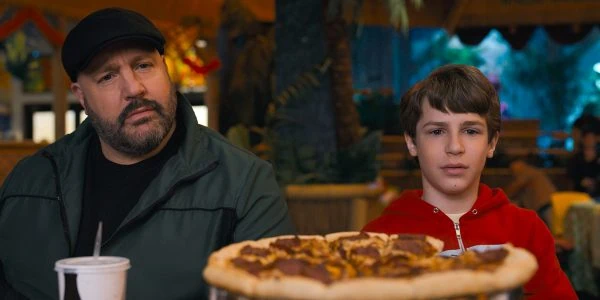
Playdate is Rated PG-13 by Motion Picture Rating (MPA) for strong language, violence/action, sexual material, some drug references, and smoking.
Ever been on a playdate you desperately wanted to leave but couldn’t, because your kid was having fun and you were stuck talking to the world’s most annoying dad? That’s exactly what watching Playdate feels like. It’s the cinematic equivalent of being trapped in a small talk nightmare with someone who keeps laughing at their own jokes.
Directed by Luke Greenfield (yes, the Let’s Be Cops guy brace yourself), Playdate stars Kevin James and Alan Ritchson as two stay-at-home dads whose kids become friends. What begins as an awkward but promising setup for a buddy comedy about fatherhood spirals into one of the most bizarre tonal train wrecks of recent memory a half-baked mix of slapstick, toxic masculinity satire, and sci-fi lunacy. By the end, I was left wondering if Greenfield secretly hates his audience, his cast, or both.
The Story
Brian (Kevin James) is having one of those midlife meltdowns that’s supposed to be funny but mostly just feels sad. He’s just been fired from his accounting job, and in a fit of desperation to look like a capable dad, he decides to stay home and handle parenting duties while his wife Emily (Sarah Chalke, doing her best with scraps) goes to work.
Then he meets Jeff (Alan Ritchson), another stay-at-home dad though Jeff’s story is a little darker. He’s a disgraced U.S. soldier trying to “reconnect” with his son CJ (Banks Pierce) by channeling all his unresolved trauma into aggressive playtime and Navy SEAL-style parenting. The guy’s basically a walking energy drink.
Their kids Brian’s son Lucas (Benjamin Pajak) and CJ hit it off instantly, and the dads agree to set up a playdate. What follows isn’t bonding or comedy. It’s a slow-motion disaster, as if the filmmakers asked, “What if every scene felt like a social experiment that went wrong?”
The movie tries so hard to find humor in gender roles and parenting differences that it ends up digging its own grave. Lucas loves dancing flamboyantly, proudly and the movie treats this as a running gag, as if it’s 2005 and homophobic jokes are still currency. His videos, posted to a TikTok knockoff called Dik Dok, are used for cheap laughs rather than actual character development. It’s not edgy; it’s just embarrassing.
Brian, meanwhile, is the picture of suburban insecurity. He lies to his wife, tries to toughen up his son, and leans on Jeff to teach him how to “man up.” You could imagine this working if the script had any empathy a buddy comedy where a soft-hearted dad and a macho ex-soldier find common ground could’ve been fun! But instead, everything is played so broadly, so lazily, that it feels like watching an improv session where no one’s funny and everyone’s shouting.
Just when you think you’ve figured out Playdate a tired, mismatched-dads comedy with bad jokes it swerves into full-blown science fiction. Out of nowhere. No warning. One minute they’re arguing over juice boxes; the next, Alan Tudyk shows up dressed like Elon Musk, spouting off about experimental technology and cosmic nonsense.
Apparently, there’s some kind of high-concept twist that explains Jeff’s behavior and ties into government secrets or alien tech or… honestly, who cares? The movie treats its sci-fi subplot like a magic trick, except the magician forgets how to do the trick halfway through.
Paul Walter Hauser shows up (uncredited, probably on purpose) and delivers the only genuinely funny moment in the entire film. It’s brief, self-aware, and fleeting like spotting a single clean dish in a sink full of dirty ones. And then it’s back to chaos.
The tone becomes impossible to pin down. Are we watching a parody? A satire? A fever dream? Greenfield seems convinced he’s making Ghostbusters meets Step Brothers, but what he delivers is Daddy Day Care with a head injury.
Greenfield once claimed he prioritizes character in his films. Watching Playdate, that’s either a flat-out lie or proof that he doesn’t understand what “character” means. Brian isn’t a person; he’s a collection of sad-dad tropes and pratfalls. Jeff is a parody of every macho archetype ever written, but without the charm or irony.
Even the kids are written like props they exist solely to set up the next painfully awkward scene. There’s no rhythm, no warmth, no believable interaction between anyone. Every attempt at heart is drowned out by crass jokes or overlong slapstick sequences that play out like someone yelling “See? This is funny!” at you until you give up and nod just to make it stop.
You could forgive the script if the direction brought some spark but Greenfield’s comedic instincts are, frankly, nonexistent. He drags out every gag until it collapses under its own weight. Jokes that might’ve been passable if cut in half go on for minutes, draining any energy from the room.
And when the movie shifts gears into action territory, it’s even worse. The chase scenes look like outtakes from a bad streaming original. The effects are cheap, the editing is confused, and the score feels like it was lifted from a free YouTube sound library. You can almost hear the movie begging you to care but it’s hard to care when you’re too busy cringing.
If Playdate reminds me of anything, it’s what happens when studios try to mash together their past hits and hope nobody notices. It wants to be Step Brothers, The Adam Project, Stranger Things, and The Hangover all at once but it has none of the charm, wit, or heart of any of them.
It’s like watching Stranger Things if all the kids were replaced by dads who complain about Wi-Fi speeds and make bad lawnmower jokes.
Even Kevin James, who can be genuinely funny in the right role, looks lost here. Alan Ritchson tries he really does and there’s a version of this movie where his self-aware meathead energy could’ve worked. But the writing gives him nothing. It’s like watching talented actors try to build a house with wet cardboard.
By the time Playdate hits its finale a ridiculous, effects-heavy sequence that tries to pull heartstrings it never earned you’re not laughing, you’re not entertained, you’re just… tired. It’s not the fun kind of bad movie you can enjoy with friends. It’s the kind of bad that makes you question how this got greenlit, filmed, edited, and released without anyone saying, “Wait, is this actually funny?”
Comedy doesn’t have to be cruel. Sci-fi doesn’t have to make perfect sense. But both need purpose and Playdate has none. It’s tone-deaf, soulless, and aggressively unfunny, like a dad joke stretched into a two-hour endurance test.
If you’re a diehard Kevin James fan, maybe you’ll find a moment or two of comfort in his familiar awkwardness. If you’re an Alan Ritchson completist, you’ll probably wish you weren’t. For everyone else: skip it. Take your kids to an actual playdate instead. You’ll laugh more, learn more, and your brain won’t melt in the process.
Detailed Content Breakdown for Parents
Violence & Intensity: There are several action-sequences: chases, some gunfire, physical fights, and a moment where a woman is tased by a child and then hit by a truck (so the tone tilts unexpectedly dark). The violence is stylised rather than ultra-graphic, but it’s not trivial.
Language: Frequent use of coarse language and adult humour. There are jokes that lean on outdated gender/masculinity tropes.
Sexual Content / Nudity: Mild. Some suggestive jokes and innuendo. No explicit nudity reported.
Drugs, Alcohol & Smoking: Some references to smoking and minor drug/alcohol mention; not the central focus, but present.
Parental Concerns
The tonal inconsistency: a movie that starts light but turns unexpectedly intense. That could surprise younger viewers.
Outdated jokes about gender/masculinity and bullying of a child for non-“tough” interests may strike some as problematic.
The violence, though stylised, may feel harsher than what some expect from a “family film.”
Frequent language and crude humour may be off-putting for younger or more sensitive viewers.
Rating: ★☆☆☆☆ (1 out of 5)
Release date: November 12, 2025 (United States)