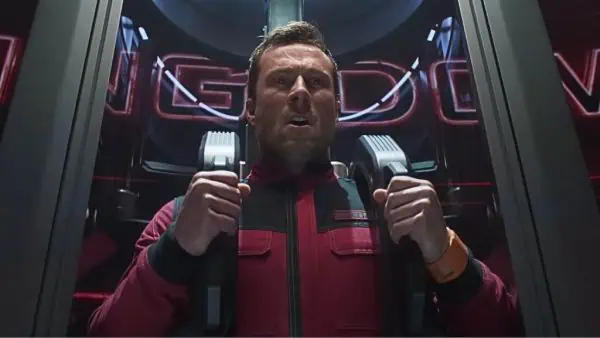
The Running Man is Rated R by Motion Picture Rating (MPA) for strong violence, some gore, and language.
The Running Man Movie Review
Ever wondered what it would feel like to be hunted on live TV while the rest of the world watches and profits from your potential death? That’s the central thrill and moral jolt behind Edgar Wright’s remake of The Running Man, a reimagining of Stephen King’s dystopian novel. From the first frame, Wright’s film hits the ground running literally and rarely lets up, hurtling the audience through one high-octane sequence after another. It’s exhausting, exhilarating, and occasionally overwhelming, the kind of film that makes nitpicking plausibility feel almost unfair because it’s too busy keeping your adrenaline up.
At the heart of it is Ben Richards, played by Glen Powell with a coiled, restless intensity. Ben isn’t a criminal he’s a fundamentally good man trapped in a world designed to grind people like him down. He lives in a tiny apartment with his wife Sheila (Jayme Lawson, quietly commanding in her every scene) and their baby daughter, whose chronic illness is made worse by a health system that’s painfully slow and staggeringly expensive. Sheila works herself ragged in a murky, vaguely defined establishment that might be a strip club or worse, trying to make enough money to keep the family afloat while Ben, recently fired from multiple jobs due to insubordination and anger issues, struggles to find work in a society that rewards privilege and punishes principle.
Ben’s frustration is visceral, and Powell channels it well. He’s a man whose moral compass drives him to defend the weak in a society that seems to have no ethical center, and his anger feels entirely justified. Wright and co-writer Michael Bacall make sure we feel the weight of his world: the endless bureaucratic hurdles, the constant fear of financial ruin, the creeping sense that no matter how hard you work, the system is rigged to crush you. It’s bleak, but it gives Ben’s decision to enter The Running Man a televised death game for huge cash prizes real stakes.
The titular game show is a spectacularly twisted invention. Contestants, called Runners, have thirty days to survive while assassins, known as Hunters, track them relentlessly. Citizens are encouraged to turn them in through an app, making the whole ordeal a participatory, voyeuristic nightmare. Hosted by the ostentatious Bobby T (Colman Domingo), the show is rigged and merciless, yet oddly glamorous its glitzy sheen masking a lethal cruelty. The show’s creator, Dan Killian (Josh Brolin), sees potential in Ben precisely because he’s unpredictable, mercurial, and defiant of authority. Ben is presented at first as a sort of “welfare villain,” echoing 1980s stereotypes: lazy, ungrateful, and endangering his family by not following the system. It’s a clever inversion, as the audience is primed to hate him while simultaneously rooting for his survival.
Once in the game, Ben taps into a network of allies: a guns and equipment dealer played by William H. Macy, a pro-Runner podcaster (Daniel Ezra), and a tech-savvy avenger (Michael Cera) obsessed with punishing those who wronged his father. Each character is vividly drawn in the few moments they appear, but Wright’s lightning-fast pacing often leaves their arcs feeling rushed. The emotional impact is there, but it’s fleeting: Cera’s dilemma choosing between survival and vengeance is a gut punch that lands but doesn’t linger, as the story surges relentlessly forward.
This is quintessential Edgar Wright filmmaking. The information-delivery montages have the sharp rhythm of Hot Fuzz, the fight choreography and chase sequences are cut for maximum impact by Wright’s longtime editor Paul Machliss, and the soundtrack, curated by Kirsten Lane, punctuates the action with perfect timing. Wright’s trademark visual flair snap zooms, inventive angles, kinetic transitions makes even exposition feel alive, and his love for detail is everywhere: from the grimy dystopian streets to the technologically saturated, morally bankrupt media spectacle of The Running Man.
Yet for all its style and energy, the film sometimes suffers from its own ambition. The supporting characters, while compelling in concept, often feel like sketches racing past us; Ben himself is largely defined by anger and righteous indignation, with moments of humor sprinkled in, but the emotional range can feel narrow. You can’t help imagining how someone with the sardonic charm of Bruce Willis or the cartoonish gravitas of Schwarzenegger might have drawn audiences deeper into the character’s headspace. Powell is talented and engaging, but the film’s relentless pace doesn’t always give him or the audience room to breathe.
The remake also updates the dystopia in fascinating ways. Unlike the neon-lit, lurid sets of the 1987 version, Wright’s society is technologically advanced, economically corrupt, and morally decayed. The American Dream is exposed as a shabby illusion: citizens toil endlessly for survival while elites siphon wealth upward. Ben’s happiest memory a simple trip to the park with his daughter, tasting ice cream for the first time is a piercing counterpoint to the oppression surrounding him. The film also doesn’t shy away from the broader social critique: it champions living wages, affordable healthcare, housing, and union protections, while lambasting corporate greed and government inaction.
But here’s the rub: for all its social commentary, the movie occasionally feels like it’s trying too hard to be topical. The citizenry, whipped into frenzy by Bobby T, often seems more like a tool than a living, reacting population; the impact of Ben’s rebellion on the masses isn’t convincingly shown. The tension between escapist action and pointed critique is never fully resolved, leaving the audience exhilarated yet intellectually unsatisfied.
Still, when it’s firing on all cylinders, The Running Man is a thrill ride. The chases, fights, and moments of dark humor hit with precision, and Wright’s technical mastery is a joy to behold. The film delivers excitement, style, and moments of genuine emotional resonance, even if some character beats don’t land as fully as they could.
Ultimately, The Running Man is a film of contradictions: thrilling yet rushed, smart yet occasionally superficial, exhilarating yet emotionally uneven. It’s a showcase for Edgar Wright’s craft and vision, a commentary on a cruel society, and a pulse-pounding adventure all at once. You’ll leave the theater breathless, entertained, and maybe a little frustrated but you won’t forget the ride.
Who should watch it: Fans of dystopian action, stylish filmmaking, and high-energy thrillers will find plenty to love. Those hoping for deep character study or nuanced social critique might wish for more. Think of it as a roller coaster: you’ll scream, laugh, and gasp, even if you wish it slowed down long enough for the scenery to really sink in.
Content Breakdown for Parents:
Violence & Intensity: The movie features frequent, intense action sequences: armed hunts, chases, explosions, some blood and injury. Contestants are aggressively pursued; scenes often show realistic fear, peril and violence. It doesn’t shy away from the brutality of its game-show premise. According to parental guides, “strong violence, some gore” is mentioned.
Language: The film includes rough profanity strong language is noted in the MPAA descriptor. Slurs or hateful speech are not prominently flagged in reviews, but the intensity suggests coarse dialogue is frequent.
Sexual Content / Nudity: There is no major nudity flagged in the parental guide. Some implied or suggested adult themes (e.g., the wife’s difficult job, possibly seedy surroundings) but no explicit sexual scenes highlighted in major reviews.
Drugs, Alcohol & Smoking: While the world is morally degraded, major drug-use or heavy alcohol consumption aren’t central to the plot in the flagged notes. Parents should still be aware of adult settings (night club/strip-club type atmosphere) and possible drinking.
Release date: November 14, 2025 (United States)