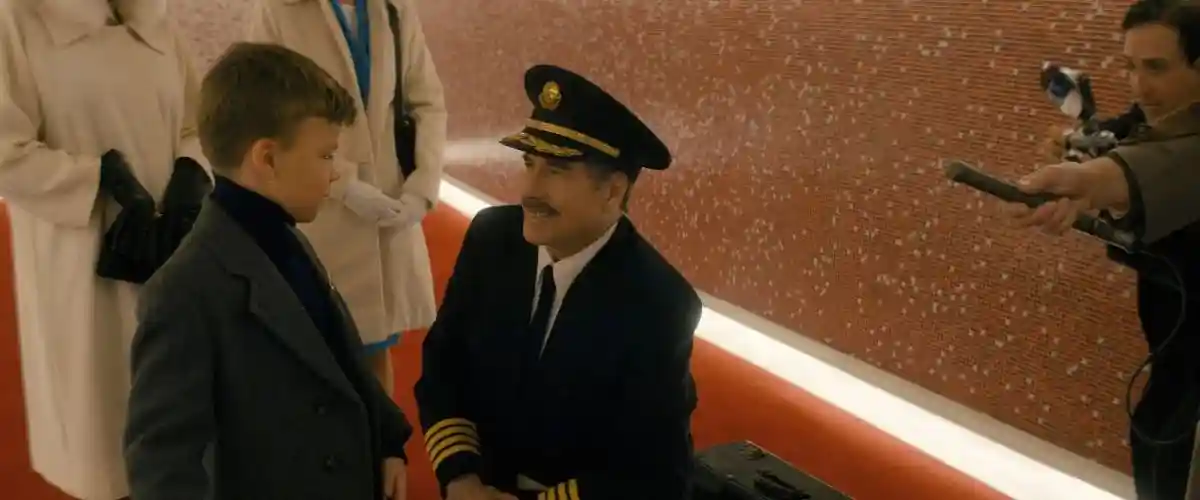
John Travolta made this film for himself. That’s both the most honest thing about it and the problem.
“The love in this film is real. Completely, embarrassingly real. But love alone has never held a frame together, and Travolta, for all his gifts, can’t quite figure out how to let the camera feel what he feels.”
Before he introduces the film at Cannes, John Travolta admits it’s basically about what matters to him in this life. He says it with a kind of disarming openness, not false modesty, not Oscar-speech humility. He means it.
And watching Propeller One-Way Night Coach, his directorial debut, you believe him entirely. The problem is that “what matters to me” is not, by itself, a film. It’s a starting point. Somewhere between the feeling and the screen, Travolta lost the thread.
The story is his own adapted from a children’s book he wrote in 1997 and it follows a boy named Jeff who is taking a cross-country propeller flight with his mother, Helen, as they relocate to Los Angeles. Jeff is the kind of child who reads airline timetables for pleasure.
He loves the whole grammar of air travel: the announcements over the intercom, the geometry of the gate, the in-flight meal arriving on its small plastic tray. When his mother says they’re skipping the new jets and taking a multi-stop propeller route instead, Jeff doesn’t mind at all. He’s in paradise.
Highly Recommended: Obsession Parents Guide
Travolta narrates over all of it. That’s where things start to quietly unravel. His voice is warm, his feeling is genuine but he won’t stop telling us how wonderful everything is. He describes Jeff’s wonder. He annotates Jeff’s delight. He essentially stands between the audience and the film’s own images, pointing at them, whispering, you feel that, right? You feel that? The irony is that the images are often quite lovely.
Cinematographer Paul de Lumen shoots the Art Deco airports in bright, committed colors, the whole film has a handsome, illustrated-book quality that suits its origins. But a handsome image and a felt one are different things, and Travolta, by narrating over every beat, keeps accidentally smothering what he’s trying to share.
“He describes Jeff’s wonder. He annotates Jeff’s delight. He essentially stands between the audience and the film’s own images, pointing at them — whispering, you feel that, right?”
Young Clark Shotwell plays Jeff, and he’s not well directed here. Some of his readings feel coaxed into the wrong emotional key, not quite stiff, not quite natural, just slightly off-center from where they need to land. It’s hard to hold this against a child actor when the script gives him so little room to breathe on his own.
Travolta narrates so much of Jeff’s inner life that the boy on screen rarely gets to have one himself. He’s a figure for memory to project onto, not quite a person. Kelly Eviston-Quinnett is fine as Helen, but fine is all the film asks of her.
What stings is how good the premise could be. A propeller flight with multiple stops means multiple airports, multiple waiting lounges, multiple strangers drifting through for a scene before disappearing. That’s a beautiful structural gift, America in transit, glimpsed in layovers.
Travolta gestures at this: there’s a man being taken to a mental facility, there’s a boy Jeff meets on the last leg who shares his obsession. Both appear and vanish so quickly they feel like placeholders for scenes that were supposed to be written. The film hints at the version of itself that might have worked, then moves past it without stopping.
The one performer who actually comes alive is Ella Bleu Travolta, playing a stewardess named Doris whom Jeff immediately and completely falls for. She’s warm in a way that doesn’t feel performed, easy on screen in the way that only some people are. You wish the film spent more time in her company. So does Jeff, honestly, and that, at least, feels true.
Highly Recommended: The Punisher One Last Kill Parents Guide
Before the screening, Cannes played a clip reel of Travolta’s career. Saturday Night Fever. Grease. Pulp Fiction. Watching it in that theater was something, a reminder that this man has genuinely moved people, again and again, across decades. Thierry Frémaux gave him an Honorary Palme d’Or, and Travolta said it meant more to him than his Oscar. He didn’t seem to be performing when he said that either.
Propeller One-Way Night Coach is what happens when someone who has spent their whole life transporting other people to extraordinary places tries to take you somewhere deeply personal, and discovers that the route only fully makes sense to them. Travolta has been carrying this story since 1997. He knows every mile of it.
That’s exactly why he couldn’t see where it was thin. Some memories are so yours that giving them to a stranger requires a kind of violence, a willingness to crack them open and let the cold air in. He wasn’t willing. Maybe he shouldn’t have to be. But then perhaps it should have stayed a book.
Propeller One-Way Night Coach Parents Guide
Rated G — General Audiences
Violence & Intensity: None whatsoever. Gentle in tone throughout.
Language: Completely clean. No profanity, slurs, or harsh dialogue.
Sexual Content / Nudity: None. A boy’s innocent crush on a stewardess is the full extent of it.
Drugs, Alcohol & Smoking: Possible period-accurate background smoking (1950s–60s setting). Nothing depicted approvingly or with detail.
One Scene to Know about A man is briefly shown being escorted, presumably to a psychiatric facility. It lasts seconds and carries no distress or dramatisation but parents of sensitive children may want a heads-up.
Suitable for all ages. Younger children may drift during the slower passages. Best enjoyed by families with a genuine love of aviation or Americana, not a crowd-pleaser for restless kids.
Filed from the Cannes Film Festival. Premieres on Apple TV+ — May 29, 2026.