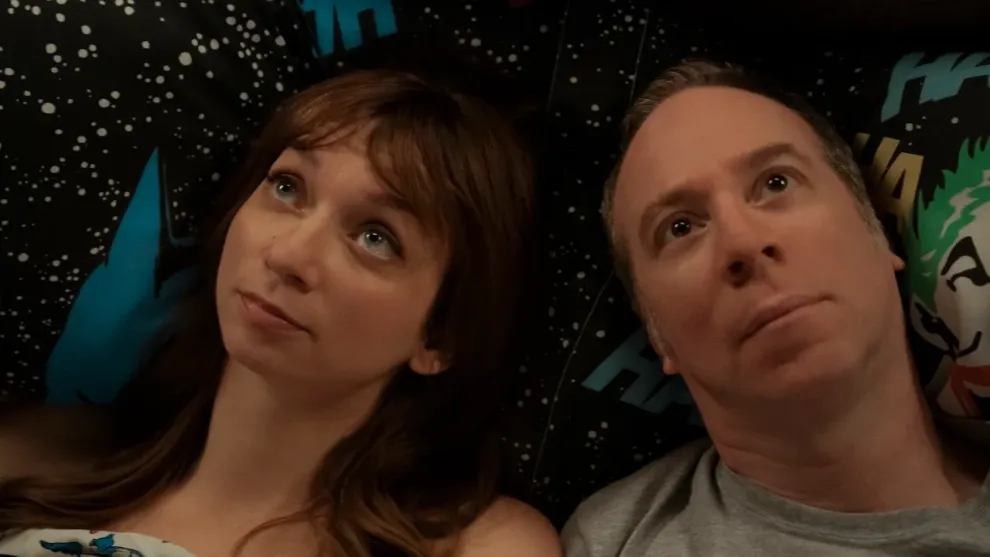
Stuart Bloom spent twelve seasons of “The Big Bang Theory” as the guy everyone forgot was in the room, the comic bookshop owner who dated Sheldon’s mother and existed mostly as a punchline about loneliness. Now he’s flung across the multiverse fighting for his life, and somehow that promotion still feels like an afterthought. That, in a sentence, is the whole problem with “Stuart Fails to Save the Universe.”
Chuck Lorre and Bill Prady have brought in Zak Penn for this one, and to their credit, they didn’t take the easy road. Seven years after the flagship ended on CBS, with “Young Sheldon” and “Georgie & Mandy’s First Marriage” keeping the franchise alive on broadcast TV, they could have built another grounded, multi-cam hangout show and called it a day.
Instead they blew the whole format open: first sequel in the franchise’s history, first real departure from grounded sitcom storytelling, first time any of this has lived on a streamer instead of network television.
Kevin Sussman’s Stuart gets pulled into a multiversal disaster after Sheldon, Leonard, and Howard’s Vari-state Quantum Entanglement Device gets destroyed, and he’s dragged along by John Ross Bowie’s Barry Kripke, Brian Posehn’s Bert Kibbler, and Lauren Lapkus’s Denise. I respect the swing. I just wish the show did more with the landing.
It moves fast, I’ll give it that. The premiere doesn’t waste a single scene getting Stuart, Denise, Bert, and Barry into the multiverse; it just drops them in and lets them start running. In an industry that recycles the same handful of premises on a loop, there’s something almost admirable about a spinoff willing to gut its own format this completely. But ambition and execution are different animals, and “Stuart Fails to Save the Universe” keeps confusing one for the other.
Here’s the strange part: viewers who never cared for “The Big Bang Theory” might actually get more out of this than the die-hards will, since the show barely bothers tying itself to the original series in any way that matters. The comic bookshop shows up as a home base. The Pasadena gang gets referenced here and there.
But none of it lands with any weight, and that’s the double-edged sword at the center of this whole project. Coming off “Young Sheldon,” a show that had to rush its own ending just to protect the mothership’s continuity, I understand the appeal of finally cutting the cord and letting a spinoff exist on its own terms.
And visually, the show does take advantage of that freedom. Every episode ships the characters to a completely different universe, and some of those worlds are genuinely striking, a real visual upgrade from anything the franchise has attempted before.
None of what happened in “The Big Bang Theory” actually matters here, and the reverse is just as true: nothing in this show is going to change how you feel about the original sitcom. That’s the sentence I kept returning to as I worked through the season, because it captures exactly what’s missing. The cameos are there. Familiar faces from the flagship pop in as promised, and for anyone who’s missed the Pasadena gang since the show went off the air, there’s a small hit of nostalgia every time one shows up. But those appearances don’t carry any real emotional or narrative weight. They’re not earning anything. They’re just there because the actors were available and the audience will recognize them, which is a thinner reason than a show like this needs.
The bigger issue is the comedy itself, which hasn’t evolved to match the show’s bigger ambitions. Jokes land with a soft thud more often than not, and stripped of the multi-cam setup’s physical rhythm, the timing that made the original series work just isn’t there to fall back on. Ten half-hour episodes isn’t much room to build anything either, and it doesn’t help that these four characters were never given much depth to begin with. ,
They barely interacted in the original series. “Stuart Fails to Save the Universe” had a real opportunity to build a group dynamic from scratch and make it the emotional spine of the show, and it mostly skips that step in favor of chasing the next universe.
By the end of the season, the randomness that defines the show, one strange new world after another, still hasn’t added up to anything. There’s no throughline, no sense that the chaos is building toward something specific, at least not yet. That makes the show a hard sell beyond “these are actors you already know,” which is a shaky foundation for a season order, let alone a second one.
The Stuart and Denise relationship gets more attention here than it ever did in the flagship, which is a dynamic worth exploring, but ten episodes spent mostly on multiversal chaos isn’t enough time to properly rebuild that connection. If anything, the detour dilutes it rather than deepens it.
So “Stuart Fails to Save the Universe” ends up stuck in an uncomfortable middle ground. It doesn’t lean on the original series enough to satisfy longtime fans looking for continuity, and it doesn’t spend enough time building its own characters to fully win over anyone coming in fresh. What it does have going for it is a genuinely strong finale, one that finally figures out how to use its own premise in a way that feels purposeful instead of scattered, and that’s enough to make me curious about a second season, assuming Warner Bros. and HBO Max give it one.
Worth remembering: “The Big Bang Theory” wasn’t a hit out of the gate either. CBS made them redo the pilot before it even got picked up. But television doesn’t offer that kind of patience anymore, especially on streaming, where a shaky first season can be the only season. Whether this show gets the chance to grow into the good idea buried inside it is genuinely an open question, and right now I couldn’t tell you which way it’s going to break.
Parental Guidance
Rating: TV-PG
Violence & Intensity: Mild sci-fi peril consistent with a comedic multiverse-adventure premise. No graphic violence; action sequences are played for laughs rather than tension. Nothing likely to disturb younger viewers.
Language: Occasional mild language typical of a network-adjacent sitcom transitioning to streaming; nothing approaching strong profanity.
Sexual Content / Nudity: Minimal. Some light innuendo and romantic subplot material (Stuart and Denise’s relationship), consistent with the flagship series’ tone. No nudity.
Drugs, Alcohol & Smoking: Little to none depicted on screen; social drinking may appear in passing but isn’t a focus.
Age Recommendations: Suitable for most ages 10 and up, and a comfortable watch for existing “Big Bang Theory” fans of any age. Younger kids unfamiliar with the franchise likely won’t follow the humor or character references, but there’s nothing in the content itself that requires an adults-only viewing.