There’s a moment early in She Dances where a father and daughter are driving together for the first time in what feels like forever, and the silence between them isn’t awkward so much as it’s loaded with the kind of quiet that has years of unsaid things packed into it. Steve Zahn, playing Jason with the particular looseness he’s always had and rarely gets to use this well, glances in the rearview mirror at his daughter and looks like a man trying to remember how to speak a language he once knew fluently. It’s a small moment. It does more work than most of the big ones.
This is Rick Gomez’s first feature as a director, co-written with Zahn himself, both first-timers in these roles, which might explain why the film feels less like a product than something these two actually needed to make. The premise sounds like a pitch: divorced dad, estranged teenage daughter, road trip to a dance competition in Kentucky. The grief underneath it, a son, a brother, gone, sounds like the kind of thing movies use as decoration. She dances doesn’t decorate with it. It keeps pressing on it, the way you do with a bruise you can’t quite believe is real.
Jason’s daughter, Claire, played by Audrey Zahn, is heading to a competition, and when her grandmother lands in the hospital, Jason gets called back into fatherhood like a reserve soldier who’d quietly hoped the war was over. He shows up. That’s the movie, essentially. A man showing up and discovering how badly he’d failed at it, and how badly he wants to stop failing.
What makes this work, and it does work more than it doesn’t, is that Gomez resists the gravitational pull of formula. Yes, there’s an underdog competition structure. Yes, there’s a villain, a hyper-competitive peer the girls nickname “Dolph,” a Rocky IV joke that lands cleanly, and yes, there are dance sequences that understand technique without fetishizing it. But the competition is the backdrop. The real match is happening in the car, in motel rooms, in the space between two people who love each other and don’t quite know how to say it anymore.
Audrey Zahn is a genuine discovery here, and I don’t just mean because she can dance. She plays Claire with a teenager’s instinct for self-protection and a child’s persistent hope that her father might actually be worth letting in. That guarded but wanting tension is hard to fake. She doesn’t fake it. The chemistry between her and Zahn is the kind that can’t be manufactured, and Gomez is smart enough not to manufacture it. He just lets them be.
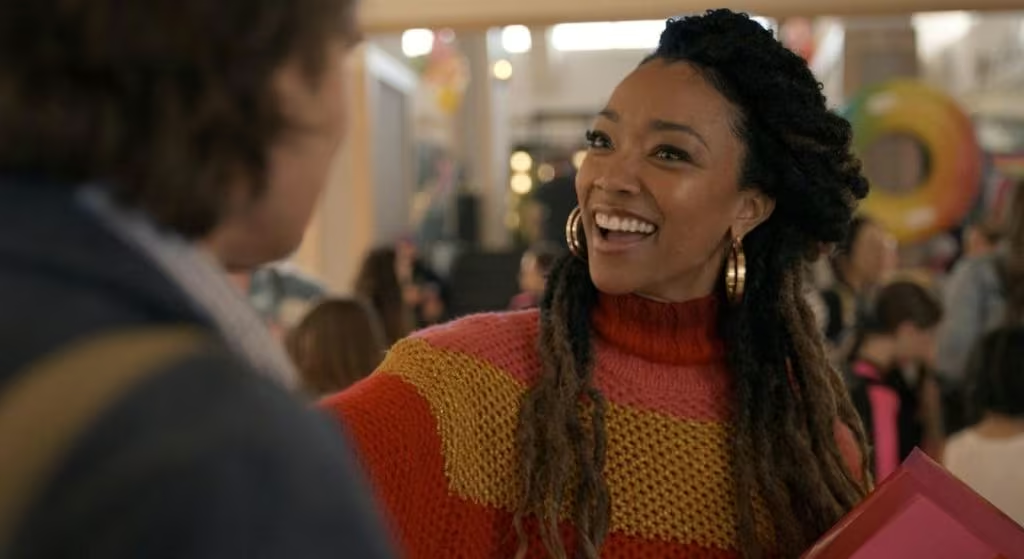
Mackenzie Ziegler, as Claire’s best friend Kat, more than holds her own. She and the younger Zahn have a rapport that feels genuinely unscripted, the kind of easy shorthand that takes years to build. Ethan Hawke drops in as Jason’s business partner Brian, enthusiastic about a bourbon distillery deal that represents exactly the kind of small-stakes adult ambition that feels real. Sonequa Martin-Green, as the girls’ coach, does more with her scenes than the screenplay technically asks of her. And Wynn Everett, playing one of the cheerfully tipsy “Dance Moms” Jason encounters at a motel, steals her scenes without making them feel stolen.
Gomez uses split-screen early on to establish the parallel lives of Jason and Claire, a choice that could feel gimmicky and instead feels precise, like a visual argument for why these two need the same physical space to find each other again. The film isn’t showy after that. It earns its quieter instincts.
Steve Zahn has spent years being the funniest person in movies that didn’t always deserve him. Here, he gets to be funny and sad at the same time, which is harder and closer to how people actually are. Jason changes a tire with his daughter. Fumbles with a road trip playlist. Overreacts to a boy flirting with Claire in a diner. He’s ridiculous and recognizable and real in the way that only a performer who’s been trusted really trusted can be.
She Dances isn’t trying to be anything larger than what it is. That restraint is its own kind of ambition. The ending lands with a softness that doesn’t cheat the weight of everything that came before it, and I kept thinking afterward about that rearview mirror glance. How much a father can love someone and still not know how to reach them. How the reaching is the whole point.
She Dances Parents Guide
Rated PG-13 by the MPA for some language and drug references.
Violence & Intensity: There’s nothing here that will make anyone flinch physically. The film’s tension is entirely emotional: a grieving father, a daughter carrying her own quiet loss, a relationship that has to be rebuilt from near nothing. The death of a son and brother hangs over the whole story, and while it’s never depicted, the weight of it is real and present. Younger or more sensitive children may find the grief harder to sit with than any action ever could be.
Language: Mild and occasional. The kind of language you’d hear on a family road trip that’s gone slightly sideways, a frustrated word here, a teenager rolling her eyes there. Nothing remotely approaching slurs or sustained profanity. The MPA’s note on “some language” is accurate and shouldn’t alarm anyone. This isn’t a film that reaches for edge through words.
Sexual Content / Nudity: There’s a moment where a young man hits on Claire at a restaurant, and Jason’s paternal instincts kick in with more enthusiasm than grace. That’s essentially the extent of it. The film has no nudity, no intimacy beyond what you’d expect from a story about a dad trying to reconnect with his teenage daughter. Completely clean on this front.
Drugs, Alcohol & Smoking: This is where the PG-13 earns its second note. Jason is in the process of buying a bourbon distillery, so alcohol exists as a backdrop to his adult life, but not glorified. More visibly, a group of “Dance Moms” at a motel is introduced as cheerfully, enthusiastically tipsy, played for warm comedy rather than cautionary drama. It’s affectionate rather than instructive, but parents of younger children will want to know it’s there.
Age Recommendations: She Dances is genuinely a film for families, the kind that works best when a parent and a teenager watch it together and then don’t quite know what to say afterward, which is exactly the point. Children under ten may lose patience with the emotional quietness of it all. Thirteen and up, comfortably. Probably more meaningful at fourteen or fifteen, when the distance between parents and kids starts feeling like geography.
