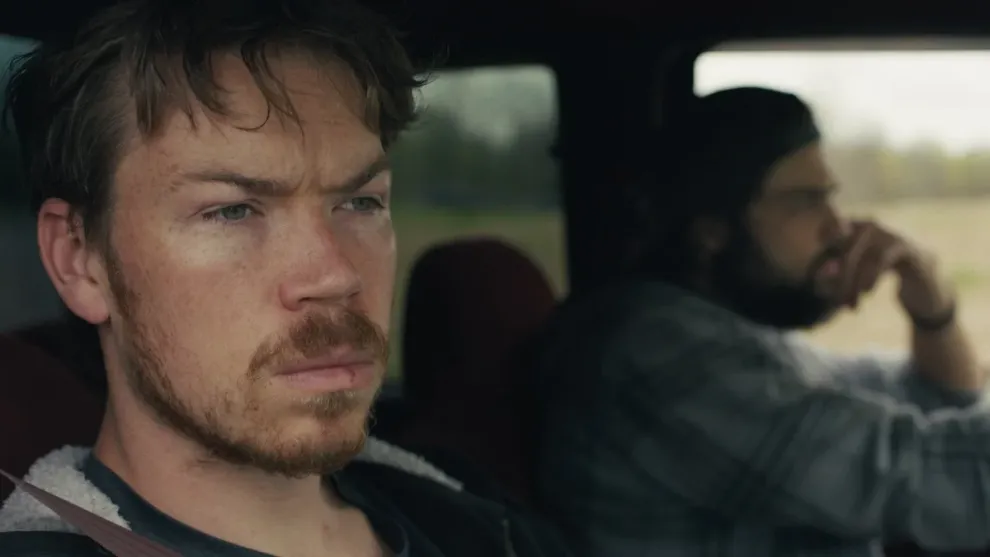
Cody sits in a court-mandated drug program meeting at the start of “Union County,” physically present but emotionally adrift, as if he’s still deciding whether recovery is something he truly wants. The room is quiet, the camera refuses to blink, and then the calm is shattered by the arrival of his foster brother Jack, who bursts in with chaotic energy and barely contained desperation. From this first sequence, Adam Meeks’ debut feature makes its priorities clear: this will be a film about process, not spectacle; about lived experience, not tidy redemption arcs.
Will Poulter gives the best performance of his career as Cody, an Ohio man inching his way toward sobriety with a mixture of shame, exhaustion, and fragile hope. Noah Centineo’s Jack, by contrast, is volatile and restless, a human spark that threatens to ignite everything around him. Their bond, complicated, tender, and increasingly strained, becomes the emotional spine of the film. They love each other, but love alone is not enough to save them, and Meeks never pretends otherwise.
“Union County,” expanded from Meeks’ earlier short film of the same name, widens its scope without losing its intimacy. The director populates the film with nonprofessional actors drawn from a real county drug court program, and that choice fundamentally shapes the movie’s texture. Scenes don’t feel staged so much as observed. Conversations stretch on without obvious dramatic beats. Awkward pauses remain uncut. The effect is not just realism for its own sake, but an immersion into the rhythms of people trying, failing, trying again, and occasionally surprising themselves by surviving.
The filmmaking mirrors this philosophy. Alongside cinematographer Stefan Weinberger, Meeks opts for patient, unfussy compositions that recall documentary more than drama. There are no flashy camera moves to signal importance, no manipulative score to tell us when to feel. Instead, we watch people talk during smoke breaks, struggle through shifts at new jobs, eat lunch in near silence, sit through meetings that are equal parts tedious and essential. This restraint becomes the film’s greatest strength. By refusing to sensationalize addiction, “Union County” achieves something far more powerful: trust.
Other films on similar terrain often resort to frantic editing or exaggerated breakdowns, as if suffering must be amplified to be meaningful. Meeks goes the opposite direction. He lets scenes unfold in real time, letting us experience the slow accumulation of pressure, the small victories that feel enormous, and the subtle warning signs that precede collapse. When moments of crisis do arrive, they don’t explode out of nowhere; they creep in, almost imperceptibly, before overtaking everything.
What’s remarkable is how consistently authentic the film feels. Every interaction, the joking with coworkers, the uneasy camaraderie in meetings, the quiet temptation of relapse rings true. Even the most dramatic turns are grounded in behavior rather than plot mechanics. This careful accumulation of detail gives the film a profound emotional credibility. You don’t feel like you’re watching a story about addiction; you feel like you’re temporarily living inside it.
Poulter’s performance anchors this effect. Cody is not verbose, not prone to speeches about his inner turmoil, yet every flicker of his face communicates volumes. His guilt, his exhaustion, his fleeting moments of joy, and his stubborn determination all coexist without ever feeling overplayed. Even in silence, he’s legible, deeply human, and painfully familiar.
Meeks approaches his characters with unwavering compassion but no illusions. The world they inhabit is indifferent at best, hostile at worst, and the systems designed to help them are fragile, overstretched, and imperfect. And yet, the film refuses to succumb to despair. In small gestures, in shared meals, in moments of connection that almost go unnoticed, “Union County” locates a quiet kind of grace. Salvation here is not grand or cinematic; it’s incremental, precarious, and hard-won.
The question the film circles how we confront the so-called “deaths of despair” never receives a simple answer, because Meeks understands that none exists. Healing does not happen within the neat confines of a single narrative. But by observing the people who, every day, try to hold themselves and each other together, “Union County” offers something arguably more valuable than solutions: recognition. In watching these lives with such care and humility, the film suggests that this is where change begins.
Union County 2026 Parents Guide
Union County is NOT Rated R by the Motion Picture Association (MPA).
Violence & Intensity: The film contains intense emotional situations and moments of crisis tied to addiction and relapse. There are no graphic fight scenes or blood, but the tension can feel very real and sometimes distressing, particularly in sequences where characters confront personal danger or make choices with serious consequences.
Language: Mature language is present, including some strong profanity. The dialogue reflects real-life speech in high-stress situations, occasionally including crude or emotionally charged words, but it is always grounded in realism rather than gratuitous shock value.
Sexual Content / Nudity: Sexual content is minimal and largely implied. There are no explicit scenes or nudity; any references to sexual behavior are brief and contextual, primarily as part of character backstory or interpersonal relationships.
Drugs, Alcohol & Smoking: Drug use is central to the story, depicted through court-mandated programs, recovery attempts, and relapse moments. Alcohol and smoking appear in passing, but the focus is always on the struggle with addiction rather than glamorizing substance use. The film’s approach is sober, serious, and educational in tone.
Age Recommendations: Recommended for older teens and adults due to the film’s mature themes, realistic depictions of addiction, and emotional intensity. Younger viewers may find the material upsetting or difficult to process, though there is no overtly graphic content.
