Cal McMau, in his directorial debut, has made a prison picture that barely lets you breathe and more impressively, he’s found a way to make this grim, familiar territory feel newly urgent. Working from a script by Hunter Andrews and Eoin Doran, McMau never once opens the door to the outside world. We’re trapped in there with these men. And what makes “Wasteman” stick with you isn’t the violence, though there’s plenty of that. It’s the way McMau watches faces. He holds on David Jonsson’s eyes long after another director would have cut away. You can almost see the thoughts calcifying in real time.
Taylor has been inside for thirteen years. That’s a lifetime of small accommodations. He’s the prison cook, sometimes the barber, a man who’s learned that invisibility is a form of safety. But safety in this world comes with strings. He runs favors for gangsters Paul (Alex Hassell) and Gaz (Corin Silva), and in return they feed him drugs. Not for a high, exactly. More like a muffler. Something to quiet the noise in his head so he can make it through another day. You might remember Jonsson from other roles where he’s had to carry quiet desperation, he’s doing something more lived-in here, less performative. Then Dee arrives. Tom Blyth plays him as a low-level criminal with an alpha’s instincts and none of the wisdom that should come with self-preservation. Immediately, he’s running goods out of his cell, stepping on toes, making noise. Taylor is rattled. You can feel it in the way he holds his posture, like a man bracing for a car crash he can’t avoid.
And yet, strangely, they find something like friendship. Taylor starts talking about his upcoming release. About his fourteen-year-old son, Adam (Cole Martin), whom he hasn’t really raised. There’s a scene where he shows Dee a photo, McMau doesn’t sentimentalize it, doesn’t milk it. Just lets Jonsson’s face do something vulnerable for a moment before the walls go back up. That restraint matters. Because what comes next is predictable in shape but not in weight. Paul and Gaz respond to Dee’s encroachment with an act of violence that feels less like a warning and more like a promise. Taylor is now the meat in a sandwich he never asked for. Hostility on both sides. A release date hovering somewhere in the distance like a cruel joke.
Here’s where McMau does something I genuinely didn’t expect. He keeps cutting to smartphone footage the prisoners filming each other, documenting their own chaos. At first I thought it was a gimmick. But it grows on you. That digital rawness gives “Wasteman” an intimacy that traditional cinematography can’t quite replicate. You’re not watching these men from a safe remove. You’re in the frame with them, jittery and close, watching trouble hunt. Taylor isn’t a gangster. He’s useful — steady hands, keeps his head down, but he’s not looking for war. He just wants his drugs and his quiet and eventually his son. But Dee won’t stop pushing. And Gaz and Paul won’t stop squeezing.
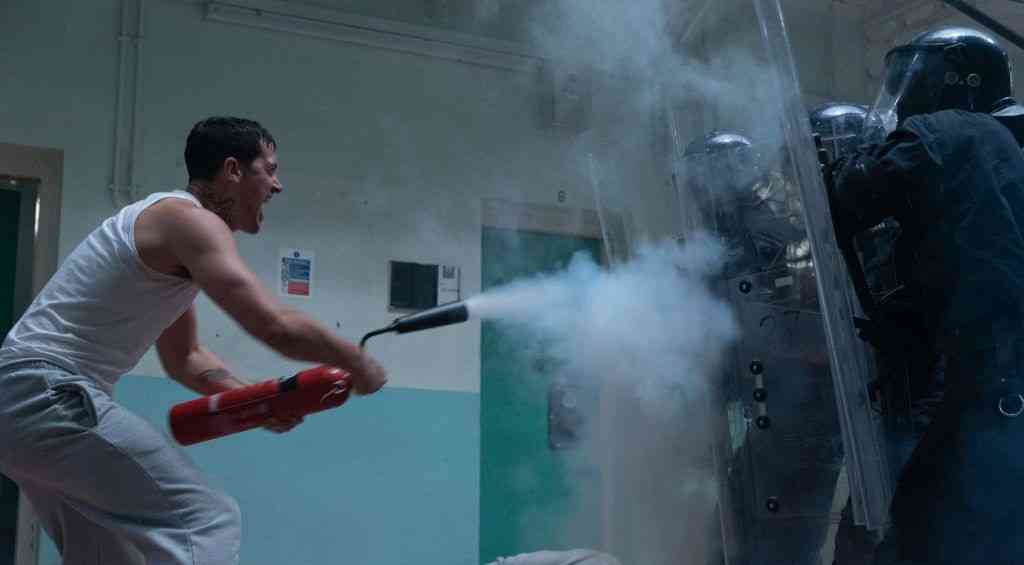
The script puts Taylor in an impossible position: loyalty to Dee, who gave him a smartphone to call Adam, or loyalty to the old guard who control his supply. There’s a wayward drone shipment of drugs that tightens everything like a vise, I won’t spoil how, but the real tension isn’t the plot mechanics. It’s watching a decent man who’s done bad things try to stay upright while the floor keeps tilting. Jonsson is extraordinary here. He barely raises his voice. Everything comes through in grimaces, in the way his jaw sets, in the micro-expressions of a man calculating odds he knows are stacked against him. Blyth has the flashier part, Dee is a shapeshifter, all charm and menace by turns, but he’s smart enough to show you the need beneath the bluster. There’s humanity in both performances, which is what makes the film’s mid-movie riot scene land so hard. McMau stages it with chaos, sure, but also with purpose. Understaffed guards. Overwhelmed prisoners. And Taylor somewhere in the middle, just trying not to get swept away.
“Wasteman” rarely lets up. It lives in a state of agitation that becomes almost exhausting by the final act and I mean that as qualified praise. This isn’t a movie you enjoy. It’s a movie you endure alongside its protagonist. The sense of doom builds organically, not because the script is forcing twists but because every choice Taylor makes narrows his options further. He’s in unwanted debt. He’s running out of time. And McMau has the confidence to just sit with that discomfort, frame after frame, face after face.
Wasteman Parents Guide
Let me be direct with you: this is not an easy watch. “Wasteman” hasn’t been rated by the MPA, which means you can’t rely on that familiar R badge to guide you. But if it were rated, there’s no chance it lands anywhere softer than an R. Maybe NC-17 for sheer emotional brutality. Here’s what you’re actually dealing with.
Violence & Intensity: There’s an act of violence early on between Dee and the established gangsters that made me flinch in my seat, and not because it’s gory. Because of how casually it happens. How expected. You feel the weight of men who’ve learned that hurting someone is just another form of conversation. The mid-movie riot scene is chaotic and genuinely frightening, understaffed guards, prisoners surging, and the camera refuses to look away. Taylor gets beaten. He gets threatened. There’s a constant sense that any scene could tip into something you can’t unsee. No one is safe here, and the movie wants you to feel that in your chest.
Language: The F-word is everywhere. So is casual degradation. Slurs get thrown around not for shock value but because the film is honest about how men like this talk when there are no women, no authorities, no consequences. It’s rough. It’s authentic. And if you’re sensitive to aggressive, hostile language as a tone, not just individual words, this movie bathes in it. Every conversation feels like it could turn into an argument. Every argument feels like it could turn into a fistfight.
Sexual Content / Nudity
Here’s the surprising part: almost nothing. “Wasteman” isn’t interested in sex. It’s interested in power, and in this world, power doesn’t express itself through intimacy. There’s no nudity I can recall. No sexual situations. A few crude references in dialogue, the kind of locker-room talk you’d expect, but nothing shown. The film is too clenched for that. Too worried. Taylor can’t afford desire. He can barely afford to breathe.
Drugs, Alcohol & Smoking
This is central to the plot, so pay attention. Taylor uses drugs specifically what appears to be some form of opioid or strong sedative to quiet his mind. We see him take them. We see him slightly altered, calmer, escaping his own head for brief moments. The gangsters control the supply, which is how they control him. There’s no moralizing about it. The film doesn’t lecture. But it also doesn’t glamorize. The drugs are a leash. A transaction. You also see prisoners smoking cigarettes constantly — that old prison currency and there’s a drone shipment of drugs that goes wrong and tightens the vise on everyone. Alcohol appears maybe once or twice in the background. This isn’t a party movie. It’s a movie about dependency as survival.
Age Recommendation: I wouldn’t take anyone under 17 to this. Maybe mature 16-year-olds who’ve already seen films like “Shot Caller” or “A Prophet” and handled them. But here’s the thing: the violence isn’t the only barrier. It’s the hopelessness. The way the film sits inside a man’s dread for two hours without offering much relief. A younger viewer might just be bored or disturbed. An older teenager with some emotional armor might find something real in it, Taylor’s love for his son, his quiet fight to get out, but you’d need to talk with them afterward. This isn’t a movie you shake off in the parking lot.
