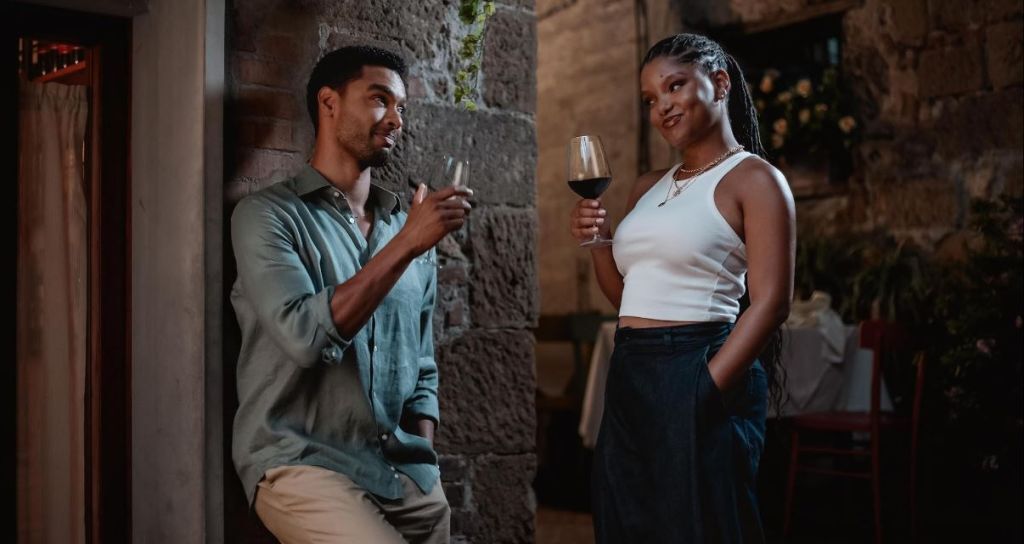
I’ll be honest, I almost didn’t go. The title alone had me skeptical. You, Me & Tuscany sounds like a Hallmark movie someone accidentally greenlit with a real budget, and I sat down with my arms essentially already crossed. Twenty minutes in I’d uncrossed them. By the time Halle Bailey walked through that village square in an ochre dress, tilting her head up toward the light like she was the only person who’d ever noticed the sun before, I’d stopped taking notes altogether.
That’s the thing about a good romantic comedy. It ambushes you.
The setup is as old as the hills and the film knows it: Anna, played by Bailey, is a house-sitter and I mean that in the full psychological sense. She wears a client’s clothes, walks a client’s dog, sleeps in a client’s bed. She’s a woman who has learned to live inside someone else’s life because her own got too heavy to carry after her mother died. A brief, impulsive romance with an Italian stranger named Matteo gives her an excuse to use an old airline ticket and whatever’s left in her checking account, and off she goes to Tuscany. She ends up at his family’s villa. His family assumes she’s his fiancée. She doesn’t correct them. And somewhere in the middle of all this, she falls for his cousin, Michael, played by Regé-Jean Page, doing his Regé-Jean Page thing, which is to say: extremely handsome, slightly guarded, warming up slowly like a radiator.
I’ve seen some version of this story probably a dozen times. Only You, While You Were Sleeping, half a shelf of ’90s rom-coms that were made back when Hollywood understood that not every movie needed to be an event. What screenwriter Ryan Engle gets right is that the premise doesn’t need reinventing. It needs executing. And mostly, it gets executed well. The Costas, Matteo’s sprawling, generous, wine-soaked Italian family take Anna in with the kind of warmth that feels a little theatrical until you realize the film isn’t trying to be realistic. It’s trying to be comforting. There’s a difference.
Highly Recommended: Faces of Death (2026) Parents Guide
The village of San Conessa is gorgeous in the way that makes you genuinely annoyed you don’t live there. Cinematographer Danny Ruhlmann shoots it in that perpetual late-afternoon gold that feels less like actual light and more like memory, the way places look when you’re already missing them. Anna’s villa would make Nancy Meyers feel competitive. None of this is subtle. The film knows exactly what it’s selling.
What it’s also selling, though it doesn’t quite say so directly, is belonging. Anna keeps calling everything a fairy tale, and she’s right, but there’s a specific ache underneath that word when she uses it. She’s not just charmed by the scenery. She’s terrified she doesn’t deserve it. That’s where Bailey does her best work, not in the big scenes but in the small, unguarded ones, the way she laughs a half-second before she’s supposed to, or goes quiet when the Costas get loud around the dinner table, absorbing the fact of a family like something she’s not sure is real. I kept watching her face when she thought no one in the scene was looking at her. That’s where the performance actually lives.
Page I have slightly more complicated feelings about. He’s magnetic in the way that certain actors are magnetic, you can’t quite explain it, you just keep looking at him, but the character, a vineyard owner with repressed feelings and a tragic backstory, is asking a lot from the actor and the actor is doing his dignified best. He’s better when he’s allowed to be funny. There’s a scene where the Costas get him to sing a Mario song, yes, that Mario, and something in him just unlocks. He’s loose and self-deprecating and actually charming rather than merely handsome. Bailey later reprises the same bit and absolutely levels him. She levels the whole room. That gap, between what Page gives and what Bailey pulls out of thin air, tells you where this film’s engine really is.
The film does something a little interesting with the fact that Anna and Michael are the only Black people in a very white Italian village, and then almost immediately stops doing it. One line of acknowledgment, a shrug, and back to the love story. I’m not sure that’s the wrong call, this isn’t the movie for that conversation, and forcing it would’ve been worse, but it sat with me a little. Your mileage may vary.
What doesn’t vary is how good Bailey is when the material is simply hers to carry. She was handed an impossible task in The Little Mermaid and made the most of it. Here she’s free, and you can feel it. She makes you believe in Anna’s hunger for a life that fits her, in the specific joy of a woman who has been running in place suddenly finding ground under her feet. The Costas’ dinner table, the rolling barrels, the wine, the chaos, watching Anna let herself be absorbed by all of it, finally, is the film’s real love story. The one with Michael is almost secondary.
It’s a light film. It knows it’s a light film. Some critics will hold that against it, and some weeks I might too. But I didn’t, not this time. Sometimes you need a movie that just wants you to feel good about being alive, not in spite of the world right now, but sort of stubbornly, defiantly, in the middle of it. You, Me & Tuscany is that movie, give or take a mildly underwritten male lead and a third act that goes about five minutes longer than it needs to.
Walk in with low expectations. Leave wanting a plane ticket.
You, Me & Tuscany Parents Guide
Rated PG-13 by the MPA for some strong language and sexual material.
This is a romantic comedy, which means the entire machinery of the film runs on attraction, longing, and the slow build toward two people finally admitting what the audience has known since the second act. Parents should understand going in that the PG-13 rating is earned honestly not pushed, not skirted, but genuinely there.
On violence and intensity, there’s essentially nothing to report. Nobody throws a punch. Nobody’s in danger. The most intense thing that happens is an awkward family dinner where a lie is about to unravel. If your kid scares easily, this is probably the safest film they’ll see all year.
The language lands: A handful of stronger words scattered through the runtime, mostly in moments of frustration or comic exasperation. Nothing sustained, nothing targeting. The tone of the film is warm throughout, nobody’s being cruel with their words, and the humor never punches down.
The sexual content is the category that earns the rating its keep. Anna has a romantic night with Matteo early in the film, the encounter is implied rather than shown, but the film is clear about what happened and doesn’t pretend otherwise. There’s flirtation throughout, some kissing, and a general air of adult desire that the film handles with more suggestion than explicitness. No nudity.
Michael owns a vineyard, the Costas drink at dinner, and alcohol is woven into the social fabric of nearly every gathering. It’s celebratory rather than reckless, nobody’s stumbling or suffering consequences, but it’s present and normalized. No smoking or drug use worth noting.
For age recommendations: the content itself is manageable for most kids twelve and up, but the honest truth is that younger viewers probably won’t find much to hold them. The film is built for people old enough to understand what it means to be adrift, to want a life that fits, to feel the specific pull of belonging somewhere. Teenagers, particularly older ones, will get considerably more out of it than an eight-year-old will. It’s a grown-up story told gently. Nothing here should alarm a sensible parent, but this one’s really for the adults in the room.
Highly Recommended: The Christophers Parents Guide
