The Drama is rated R for sexual content, some violent and bloody imagery, pervasive language, and brief drug use though the weight of that rating comes less from frequency and more from how unsettling certain moments feel when they land.
It’s harder than we like to admit to distinguish love from infatuation. The difference only reveals itself over time through friction, through strain, through the quiet erosion or strengthening that comes with real intimacy. Romantic comedies have long circled that uncertainty, often staging relationships that wobble under the pressure of some absurd disruption. In The Drama, Kristoffer Borgli leans into that instability, aiming for something darker and jagged than the genre typically allows.
At the center are Emma (Zendaya) and Charlie (Robert Pattinson), an engaged couple whose fragile equilibrium is shattered when Emma confesses a disturbing episode from her past. What follows should feel like a psychological unraveling a test of love under pressure, but Borgli never quite gets a handle on the weight of what he’s introduced. The film gestures toward big, volatile ideas love versus illusion, moral hypocrisy, the racialized perception of violence but those ideas don’t deepen. They curdle. What’s left is something visually overworked yet thematically undernourished, a film that keeps circling its own provocations without ever landing on them.
There’s a kind of smug immaturity running through The Drama, which feels especially disappointing coming after Borgli’s previous feature, Dream Scenario. That film, with Nicolas Cage drifting through a satirical nightmare of public perception, had a sharper sense of its own absurdity. Here, Borgli seems to want something more sincere, he wants us to invest in Emma and Charlie, to see them as complicated, wounded people worth rooting for. At the same time, he frames anyone who judges them as hypocritical or morally shallow. But that raises an uncomfortable question: how can a film ask us to empathize so deeply when it barely understands the people at its center?
Highly Recommended: She Dances Parents Guide
You can feel that uncertainty from the very beginning. The opening “meet-cute” stretches across the first ten minutes, as Charlie recounts the story to his friend Mike (Mamoudou Athie) while drafting a wedding speech. The memory plays out in a loud, almost aggressively casual coffee shop. Emma sits reading; Charlie watches her from across the room with a kind of awkward intensity that borders on intrusive. When she steps away, he rushes over, snaps a photo of her book—The Damage, a fictional title by the equally fictional Harper Ellison, and quickly googles enough about it to fake familiarity. It’s a flimsy gambit, and the film knows it.
Their first exchange is clumsy, even uncomfortable. Charlie doesn’t realize he’s speaking into Emma’s deaf ear. He stumbles. He recovers poorly. And yet Emma gives him another chance, indulging his half-formed charm. It’s the kind of moment that, in another film, might feel endearing. Here, it mostly raises questions. Why him? Why her? What do they actually see in each other? The film never quite answers. You’re left searching for the connective tissue—what draws them together, what might pull them apart, and finding mostly empty space.
To Borgli’s credit, the film seems aware of that hollowness. These are people who talk about “vibes” more than anything concrete. There’s a telling conversation over coffee between Emma and Rachel (Alana Haim), Mike’s wife, where Emma admits she had never been in love before the age of 28. It’s a quiet confession, but it opens a much larger question: is this relationship real, or is it just proximity dressed up as passion? Even Emma doesn’t seem sure.
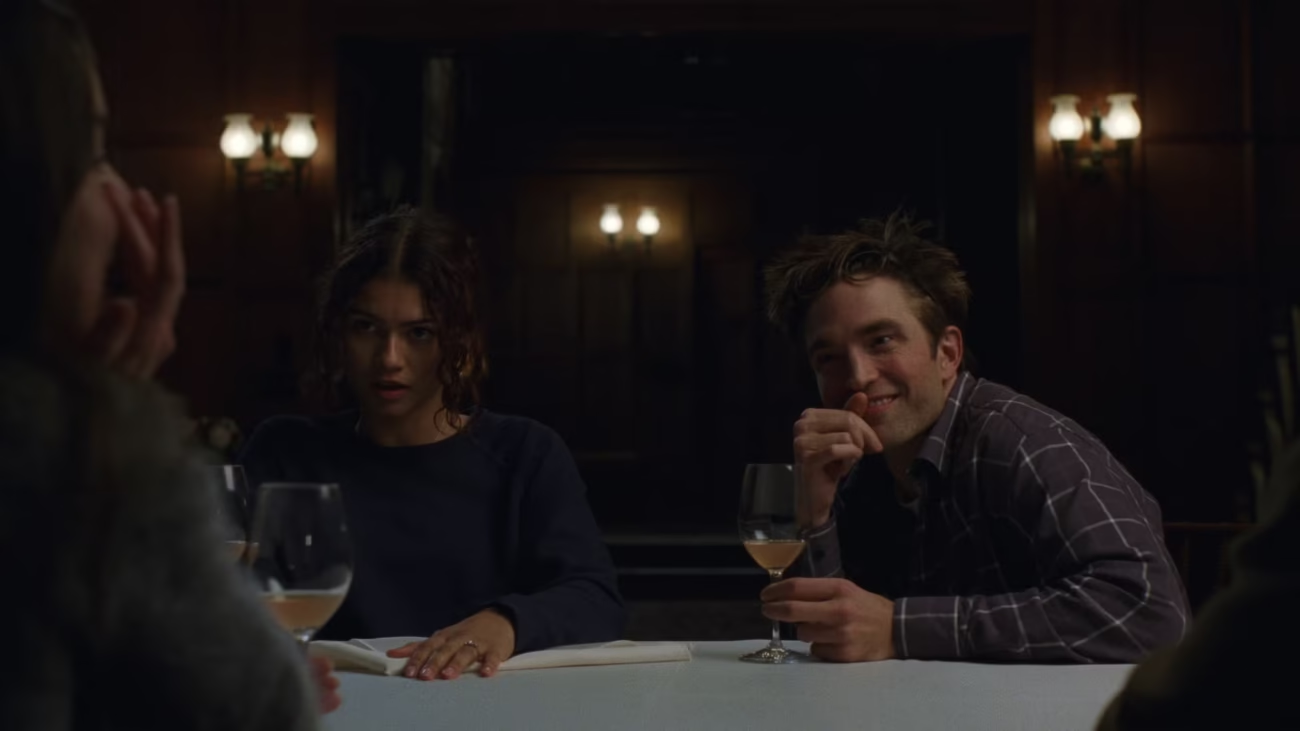
The film tries to answer by pushing the group into a moment of forced honesty. During a night of drinking, Rachel proposes a game: everyone must confess the worst thing they’ve ever done. It starts almost playfully. Mike admits to using his partner as a shield during a dog attack. Rachel recounts locking a boy in a closet. Charlie alludes to some adolescent cruelty online. Then Emma speaks—and the mood shifts instantly.
Her confession is not just dark; it’s destabilizing. As a teenager, she stole her father’s rifle with the intent to commit an act of violence. Borgli withholds certain details, but the implication is enough. The room turns. You can feel it—the sudden recalibration of how everyone sees her. Rachel’s friendliness hardens into something sharper, almost hostile. Charlie recoils, visibly shaken. And from that point on, the film hangs on a single question: can he still love her?
It’s here that the film brushes up against something genuinely compelling, and then frustratingly pulls away. Zendaya approaches Emma with a kind of inward precision. If her performances in Euphoria or Challengers thrived on heightened emotion, here she works in restraint. She listens more than she speaks. She carries regret in the way she holds herself, her body slightly folded in, as if bracing against an unseen cold. There’s a fragility there that feels earned, almost tactile. You can read entire thoughts flickering across her face.
And yet, the character itself feels oddly underwritten. There’s a sense that Emma is either conceived without a full awareness of her identity or retrofitted into it. Her Louisiana backstory hints at deeper layers, about how Black women are perceived, about the thin line between vulnerability and threat in the public imagination but the film never interrogates those ideas. It gestures toward them, certainly. You can feel the weight of what’s missing. But Borgli doesn’t follow through.
That absence becomes more glaring as the story unfolds. The film seems to flirt with questions about how race and gender shape our understanding of violence, about the way Black women are often forced into rigid archetypes, docile or dangerous, sympathetic or monstrous. There’s also an undercurrent about desire, about how white men may project their own narratives onto Black women. These are complicated, volatile ideas. They require care, curiosity, and a willingness to sit in discomfort. Borgli, for reasons that are hard not to notice, seems unwilling or unable to engage them.
Instead, the film retreats into stylistic flourishes that feel increasingly hollow. The editing leans heavily on L-cuts, chopping off dialogue mid-thought, as if to underline the characters’ inability to communicate. It’s an interesting idea at first, you can sense the disconnection—but it quickly becomes repetitive, especially when the conversations themselves lack substance. Nonlinear sequences intrude without much purpose, bending reality into dreamlike fragments that don’t reveal much about Emma or Charlie beyond what we already know.
One sequence, in particular, lands with a thud: an adult Charlie tenderly interacting with a teenage version of Emma. It’s meant to be unsettling, perhaps even Freudian in its implications, but it mostly feels misguided,another example of the film reaching for provocation without fully understanding its impact. The more Borgli leans into surrealism, the less grounded the story becomes. And the less grounded it feels, the harder it is to care.
Even the sound design, which initially adds an intriguing layer, blending overlapping conversations, shifting between Emma’s muted auditory perspective and Charlie’s clearer one, loses its effectiveness over time. Like so many elements in the film, it promises depth but delivers diminishing returns.
Then there’s Charlie. Pattinson has built a career out of playing damaged, morally ambiguous men, often finding unexpected depth in characters who might otherwise feel thin. He brings some of that instinct here. You can sense Charlie’s discomfort, his self-interest, his quiet panic. But the script doesn’t give him much to work with. Beyond a vague sleaziness, there’s no real arc. His reaction to Emma’s past doesn’t push him toward introspection or revelation. It just… lingers.
That’s perhaps the film’s most persistent flaw: its characters don’t evolve so much as they orbit a set of ideas that never fully take shape. Mike and Rachel feel less like people than narrative devices, their reactions calibrated to keep the tension simmering without ever boiling over. Charlie, for all Pattinson’s effort, remains frustratingly opaque. And Emma, despite Zendaya’s nuanced performance, is left carrying thematic weight the film refuses to unpack.
By the time The Drama reaches its conclusion, there’s a sense of emotional imbalance. The ending arrives without the accumulation it needs, it feels less like a culmination and more like a gesture. You’re left with the impression of a film that wants to say something urgent about love, morality, and perception, but never quite finds the language.
The Drama Parents Guide
Violence & Intensity:There isn’t constant physical violence, but the film carries a psychological heaviness that lingers. Emma’s confession centered on a teenage plan involving a rifle casts a long, uneasy shadow over everything that follows. You don’t see explicit acts play out in detail, but the implications are stark enough to disturb, especially as the story revisits fragments of her past in disjointed, dreamlike flashes.
Language: Characters speak the way people sometimes do when they’re trying to sound honest but end up exposing more than they intend. There aren’t prominent slurs, but the tone can turn cutting, especially as relationships fracture. Arguments sharpen, judgments slip out, and the language becomes another tool for quiet cruelty rather than outright confrontation.
Sexual Content / Nudity: There are suggestive conversations, references to intimacy, and moments that imply physical connection without lingering graphically. One particularly uncomfortable sequence—blurring timelines and perceptions—introduces a charged interaction that feels more psychologically provocative than explicitly sexual. Nudity is minimal, but the emotional framing of these scenes may feel more mature than what’s shown on screen.
Drugs, Alcohol & Smokin:. There is also brief drug use, though it’s not heavily emphasized. Substance use here feels less like a focal point and more like a quiet accelerant for the characters’ unraveling.
Age Recommendations:. While it lacks the relentless explicitness of some R-rated dramas, its themes—moral ambiguity, emotional volatility, and the unsettling gray areas of human behavior—require a level of emotional and intellectual maturity. Older teens might follow the narrative, but the film’s psychological weight and unresolved tensions make it far better suited for adults.
Highly Recommended: The Faithful: Women of the Bible Parents Guide
