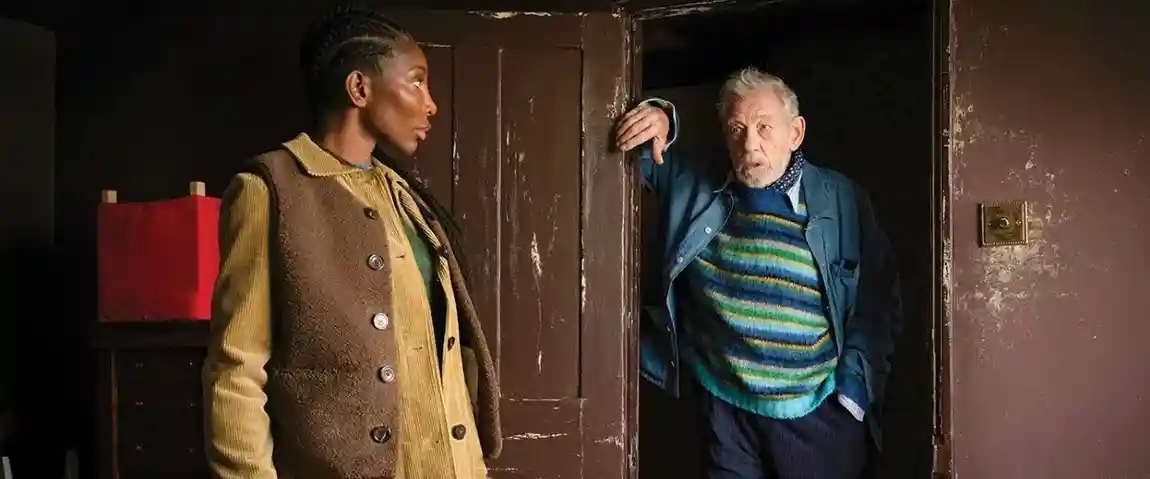
The Christophers is Rated R by Motion Picture Rating (MPA) for language.
Steven Soderbergh’s “The Christophers” slips into place so smoothly you might not notice, at first, how sharp its edges are. On the surface, it’s about a dying painter and a scheme to profit from his unfinished work. But the deeper you go, the more it feels like a story about damage, creative, familial, emotional, and the strange ways people try to reclaim what they think they’re owed.
Julian Sklar, played by Ian McKellen, was once a sensation. In the 1960s, he moved through London like a force of nature stylish, provocative, impossible to ignore. Now he barely leaves his home, which is split into two adjoining townhouses, as if even his living space reflects a life divided between who he was and who he’s become. His relevance has thinned into something faintly humiliating: paid video messages for fans, a judging role on a reality show where real artists size up amateurs. The art world, predictably, has drifted elsewhere.
Highly Recommended: Pretty Lethal Parents Guide
And yet his name still carries a certain charge, largely because of “The Christophers,” a series of portraits depicting the same beautiful young man. Two sets are known. The third if it exists has taken on a kind of mythic status. People aren’t really arguing about the quality of the work anymore; they’re arguing about the possibility of more. It’s the idea of the thing that matters, which feels like exactly the sort of irony Soderbergh enjoys letting sit quietly in the background.
Enter Julian’s children, Barnaby and Sallie. They’re in their forties now, products of a period in Julian’s life he kept hidden, and they carry that history with them in ways that aren’t hard to spot. They’ve already made, and spent money off his art, but it hasn’t filled whatever gap he left behind. Their plan is simple in theory and queasy in execution: hire a skilled young artist to ingratiate herself with their father, gain access to his unfinished work, and secretly complete it so it can be “discovered” and sold after his death.
That artist is Lori Butler, played by Michaela Coel. She’s not just talented, she’s precise, disciplined, the kind of painter who can step into someone else’s style without leaving fingerprints. Years ago, she appeared on the very show Julian judges and was dismissed by him with casual cruelty, a moment he doesn’t even remember. Now she’s running a food truck, her restoration business having quietly collapsed, and the money they offer is hard to ignore.
But money isn’t the whole story. You can feel something else pulling her in, curiosity, maybe. Or a need to get closer to the kind of artist she once admired before learning to see through him. Coel plays all of this without insisting on it. She lets Lori think, observe, hold back. There’s a steadiness to her that makes the character convincing even when the script doesn’t fully open her up.
That’s where the film falters a bit. Barnaby and Sallie, for all their obvious flaws, are given space to feel contradictory. They’re selfish, yes, but also wounded in ways that don’t entirely fade with age. You can hear it in the way they talk about their father, see it in the way they avoid confronting him directly. Their scheme isn’t just greedy, it’s evasive. It lets them “win” without risking the kind of emotional exposure they’ve spent a lifetime dodging. And somehow, against your better judgment, you understand that.
Lori, though, is kept at a slight distance. She’s the film’s anchor in many ways, the one moving between all these fractured relationships, but she isn’t given quite the same interior weight. There’s a familiar pattern there, one the film never fully escapes. Still, Coel does a lot with what she has. She makes you believe in Lori’s focus, her restraint, the way she can stand in Julian’s presence without being overwhelmed by it.
And Julian, well, he’s the kind of character actors must dream about. McKellen plays him as both grand and faintly ridiculous, a man who has spent so long performing himself that he doesn’t quite know how to stop. He drops aphorisms like they’ve been rehearsed for decades, each one polished to a shine. Some of them are genuinely funny. Some are a little exhausting. All of them feel true to who he is.
“I was once in a throuple,” he says at one point, almost offhandedly, “back when it was called infidelity.” It’s a perfect line for him, witty, self-aware, just a bit self-mythologizing. Later, when he admits he’s been reading Lori’s art blog, he adds, “Never underestimate the Internet prowess of a man who has spent decades Googling himself.” You can feel the audience leaning in during moments like these. Soderbergh knows to keep the camera still and let McKellen do the rest.
Highly Recommended: Mike & Nick & Nick & Alice Parents Guide
What’s impressive, as always with Soderbergh, is how lightly all of this is handled. The film is carefully constructed, but it doesn’t feel fussy or overworked. The plotting hums along, yet the emphasis stays on people, their habits, their defenses, the things they can’t quite say out loud. Even at their worst, the characters aren’t reduced to punchlines. They’re observed with a kind of patient curiosity.
By the time the film settles into its final movements, you start to realize it isn’t really about the scam at all. It’s about authorship, who gets to claim it, who gets erased from it, and what it means to “finish” something that was never yours to begin with. There’s also a quieter question underneath: whether any of these people are capable of facing each other honestly, without the buffer of money or art or performance.
“The Christophers” doesn’t push that question too hard. It lets it linger, unresolved. And maybe that’s right. Life, after all, rarely offers the kind of clean conclusions movies sometimes pretend to find.
What stays with you instead are the smaller things: Lori watching more than she speaks, Barnaby and Sallie circling around their own hurt, Julian holding court in a close-up that feels both intimate and slightly unreal. And McKellen, especially, delivering a line, pausing just long enough, reminding you how much pleasure there still is in simply watching someone inhabit a character completely.
The Christophers Parents Guide
Violence & Intensity: There’s no physical violence, but there’s a lot of emotional strain. The tension comes from strained family relationships, resentment, and manipulation. Some scenes feel uncomfortable because of how people talk to each other or what’s left unsaid. It’s the kind of intensity that might go over a younger child’s head but still isn’t meant for them.
Language: There’s frequent swearing throughout, and it feels natural to the characters rather than forced. The tone can also be cutting, there’s sarcasm, insults, and a kind of intellectual cruelty in the dialogue, especially from Julian.
Sexual Content / Nudity: No nudity or explicit scenes, but there are a few casual references to sex and past relationships. Nothing graphic, just adult conversations that younger viewers probably don’t need to hear.
Drugs, Alcohol & Smoking: There’s some drinking, mostly in social settings. It’s not excessive or a major focus, just part of the characters’ lifestyle. No significant drug use.
Age Recommendations: I’d say this is best for older teens and up, around 16+ at minimum, and even then, it really feels like a film made for adults. Not because it’s shocking, but because it’s quiet, talk-heavy, and emotionally complex in a way younger viewers likely won’t connect with.
Highly Recommended: Faces of Death (2026) Parents Guide
