Carney has been making films about musicians for twenty years. Once came out in 2007 I saw it in a half-empty art house on a Sunday and was still thinking about it on the bus home. Begin Again I liked less than I wanted to. Sing Street I loved more than I expected.
Power Ballad feels like the natural place a filmmaker arrives after all that: quieter about its ambitions, less desperate to move you, more interested in the specific gravity of a life half-lived the way you planned.
Paul Rudd plays Rick Power yes, Power, like a discount superhero alias, and the film knows exactly how ridiculous that is a wedding singer in his fifties who fronts an Irish cover band called The Bride & Groove. He used to make original music. He gave it up for a woman he loved, and they built something small and real together: modest house, teenage daughter, a cover of “Mr. Brightside” he can play in his sleep.
Rudd is one of those actors who makes this kind of role look effortless, which is its own kind of deception. Watch the way he holds himself during the band’s first performance there’s a professional slouch to it, the posture of a man who stopped standing quite straight somewhere around 2009 and has quietly made his peace with that.
Then a pop star steals his song.
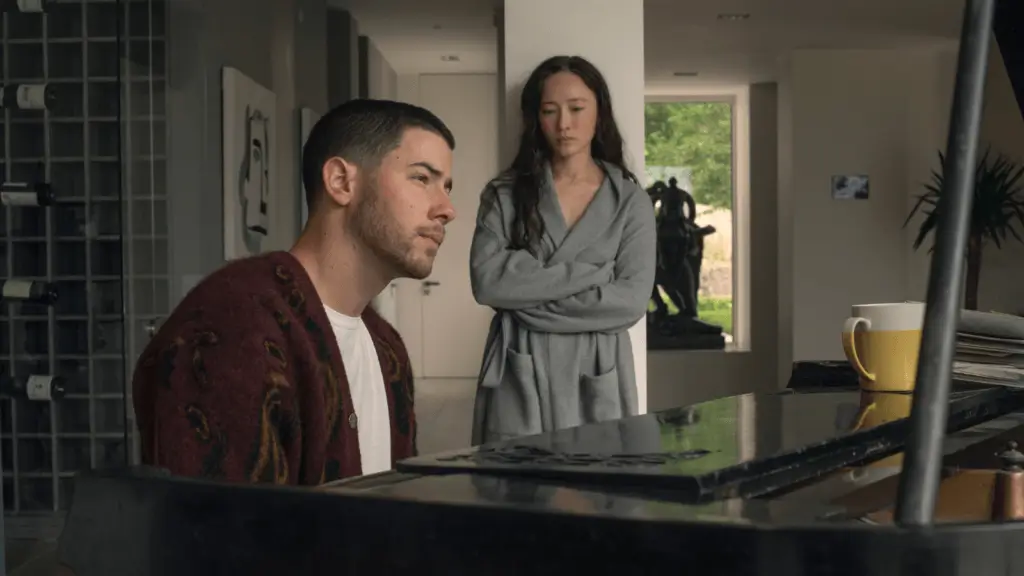
The pop star is Danny, played by Nick Jonas. I’ll be honest: when I saw Jonas’s name attached to this project, I braced myself. I was wrong to. He plays Danny as a man genuinely confused by his own behavior someone who did something expedient and is now busy constructing reasons why it wasn’t wrong.
There’s a scene where Danny tells Rick, with what sounds like real feeling, that Rick just doesn’t understand how hard it is. He means every word. That’s what makes it land like a punch rather than a villain’s monologue. Danny isn’t lying. He just has absolutely no idea what he’s saying.
Jack Reynor plays Danny’s manager, and Reynor has after Midsommar apparently committed himself to playing men who are well-dressed and morally threadbare. He’s very good at it. The manager knows exactly what he’s doing. He never pretends otherwise.
Highly Recommended: I Love Boosters (2026) Parents Guide
What Rick actually wants, when the film strips everything back, is not money. Not a career revival. Not even an apology. He wants people to know he wrote the song. The reasons behind that want are where Power Ballad does its most interesting work quietly, without making a speech about it. He wrote it for someone specific, the someone matters enormously. Carney eventually shows you who, and then this is the film’s one real failure of nerve lets the moment pass almost too quickly. He gets nervous about sentiment at exactly the wrong time.
Rick’s daughter Aja, played by Beth Fallon, gets the film’s single best exchange. He plays her the song. She listens, unimpressed. He asks what teenagers actually want their songs to be about these days. She doesn’t look up. “Revenge,” she says. The audience I saw this with laughed not a polite laugh, the real kind, the kind that’s also recognition, that’s also just slightly rueful. Twenty years of pop music history compressed into one word from a sixteen-year-old. Carney knows that’s gold. He leaves it alone.
Peter McDonald plays Sandy, Rick’s most loyal bandmate, the friend who shows up when called and asks fewer questions than he probably should. It’s the thankless role the best friend, the Greek chorus of one, the man who exists largely to keep the protagonist company during his worst decisions. McDonald makes it warmer than it has any right to be.
I’ve been trying to work out why the film holds together as well as it does, given that its central metaphor isn’t exactly hidden. Danny takes Rick’s song without credit or permission. AI systems get trained on artists’ work without credit or permission. Carney connects those dots clearly enough that you’d have to be actively looking away to miss them.
And yet it doesn’t feel like a pamphlet, because Carney doesn’t let the metaphor eat the characters. Danny is not a symbol. He’s a specific person who did something shabby and wants to feel good about himself anyway. Rick is not a martyr. He’s a specific person trying to reclaim something that belongs to him while making a genuine mess of everything around it.
Highly Recommended: Passenger 2026 Parents guide
Power Ballad is not Once. Nothing Carney makes will ever be Once again that film had the electricity of a director discovering mid-shoot what he was capable of, and you can’t manufacture that twice. But this is a film that knows its own size and doesn’t apologize for it. Small story. True feelings.
Power Ballad (2026) Parents Guide
Rating: PG-13 not officially rated at the time of this writing, but that’s where it lands.
Violence & Intensity: None worth noting. The conflict is professional and emotional, a stolen song, a legal standoff, a man slowly unraveling under pressure. Nothing physical, nothing disturbing.
Language: Mild to moderate. A few sharper words scattered through, mostly in moments of frustration. No slurs. The tone is warm more often than it’s coarse.
Sexual Content / Nudity: Minimal. A long-term marriage is depicted with affection. Nothing explicit, nothing that needs explaining afterward.
Drugs, Alcohol & Smoking: This is the one parents of younger teens should know about. Rick and Danny get high together cannabis, explicitly, in a scene that’s pivotal to the plot and treated casually, without consequence or commentary. Social drinking runs throughout, mostly at weddings and industry gatherings. No addiction storyline.
Age Recommendation: Comfortably 13 and up. The film’s real subject what it costs to make something real, and what it means when someone takes it, will hit harder the older you are. There’s nothing here that locks out a sharp teenager, but the people in the seats who’ll feel it most are the ones who’ve already made a compromise or two they still think about.