The first thing I do when the lights go down is take off my watch.
Not because I’m worried about the time. Because I don’t want to know. A good movie makes time stop. A bad one makes you check your wrist every twenty minutes, and that tiny mechanical movement the tilt of the head, the glance down is the audience’s most honest review. You can’t fake that. You can’t, you can only feel the difference between a film that holds you and a film that lets you go.
I’ve been doing this long enough that I have rituals. I sit in the same row every time. Third from the back, center-left. Not because I’m superstitious. Because I want the screen to fill my peripheral vision. I want to forget there’s a wall on either side of me.
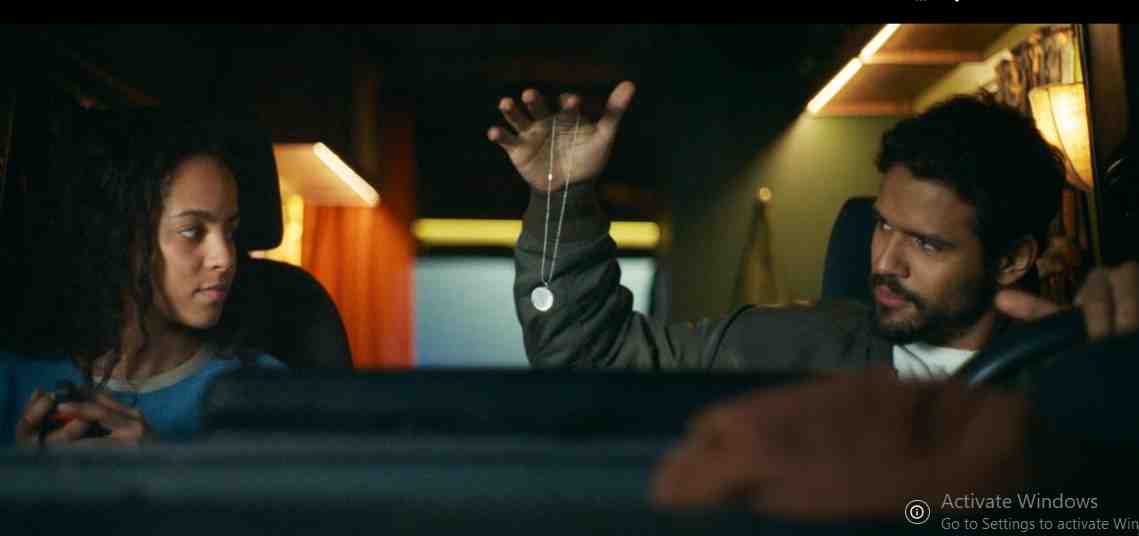
Tyler and Maddie Jacob Scipio and Lou Llobell are a few weeks into what they imagined would be the trip that sorted things out. You know the logic: buy a van, escape whatever it is that’s pressing down on you, find yourself somewhere on the road between here and there.
They’re believable together in the way that matters, which is to say you sense the history between them without needing it explained. When the film starts scaring you, you care what happens to them. That’s rarer than it should be.
The accident comes early. A highway. A vehicle. A driver who doesn’t make it. Øvredal shoots it without letting you look away and without lingering, it’s over before you can settle into watching it, which is the point. Life does that. You don’t get the slow-motion version. And when Tyler and Maddie drive away, shaken and quiet, you think: okay, that’s the inciting trauma. The psychological wound the film will probe.
You’re wrong. What drives away with them is something else entirely.
The Passenger, given physical shape by Joseph Lopez in what is genuinely one of the more unsettling pieces of performance-and-design work in recent horror, is a creature of American mythology. The phantom hitchhiker. The stranger at the edge of the parking lot. Every piece of folklore ever attached to the dark miles between cities, given form and given hunger.
Øvredal has described building this thing’s mythology carefully, rooting it in the roads and back highways the way a ghost is rooted to a house. It works. The Passenger doesn’t feel like a concept. It feels like something that exists, that has always existed, that you somehow didn’t know about until now.
What I didn’t expect was Melissa Leo.
I know her work. I’ve watched her pull The Fighter apart from the inside with her bare hands, that performance so raw it was almost uncomfortable to be in the room with it. But Diana the character she plays here, whose exact position in this story I’ll leave you to discover requires something different. Restraint as a form of menace.
There’s a scene where she sits across from Maddie and speaks in an entirely normal register about entirely abnormal things, and Leo delivers it with this quality of perfect stillness, the way very still water is unsettling precisely because water is supposed to move. I kept thinking about that scene afterward. Still am.
Scipio surprised me. The Bad Boys films didn’t ask much of him beyond physicality and charm, and he delivered both, but Tyler needs something rawer. There’s a moment I won’t frame it exactly where he looks into a rearview mirror and what’s looking back at him has changed the world he’s living in, permanently, and Scipio lets that land on his face without any of the presentational panic that lesser actors reach for. It’s just fear. Plain and specific and real.
Lou Llobell carries more of the film’s weight than the marketing suggests. Maddie is the one who doesn’t stop thinking even when thinking stops being useful, and Llobell plays that quality the desperate, almost insulting rationalism of someone trying to apply logic to something logic was never designed for with an intelligence that keeps the film grounded when it could easily tip into pure spectacle.
The Pacific Northwest does what the Pacific Northwest does in horror, which is look beautiful in a way that doesn’t comfort you. The highways of Washington State the Enumclaw flats, the long straight miles through Grand Coulee carry their own quality of exposure. There’s nowhere to hide out there. The landscape has no sympathy. Christopher Young’s score understands this; he wrote Hellraiser, he wrote Sinister, and he writes here with the same instinct for sound that doesn’t scare you so much as make you aware of your own skin.
Øvredal is a Norwegian filmmaker working in an American genre, and that slight foreignness that off-by-one-degree perspective on what the American road means and what it’s supposed to signify gives Passenger an edge that a domestic director might not have found. The van life dream, that particular twenty-first-century fantasy of freedom through movement, comes in for a quiet dismantling. The open road isn’t liberation. It’s exposure. It’s the place where no one knows your name or your direction or when to expect you.
The film is not flawless. There are passages in the second act where the pacing loses its nerve a little, where the film seems to be deciding what kind of horror it wants to be rather than simply being it. And I had questions at the end about the mythology, about certain choices that the film didn’t feel interested in answering. Maybe that’s honest. Maybe that’s the point. The Passenger, in the film’s own logic, doesn’t explain itself.
But I’ve been on long drives before. Overnight ones, the ones where it’s just you and the headlights and the radio going in and out of signal. And there’s a particular moment on those drives around two or three in the morning, when the traffic has thinned to almost nothing where you become aware, in a way you don’t permit yourself during daylight, of how genuinely alone you are out there.
Passenger lives in that moment. All ninety-four minutes of it.
Passenger 2026 Parents guide
Rating: R strong violent content, some gore, language.
Violence & Intensity: The film opens with a graphic highway accident a driver dies on impact, and Øvredal doesn’t spare you the fact of it. From there the violence is predominantly supernatural in nature: the Passenger torments its victims psychologically and physically, warping reality around them as the film progresses.
The intensity is sustained rather than episodic this isn’t a film that jolts you and then lets you breathe. It builds and holds. Jump scares are present, at least one of which is genuinely effective. Sensitive viewers should be warned that the dread is cumulative; it doesn’t have an off switch.
Language: Moderate to strong profanity throughout, consistent with an R-rating and with how people actually speak when something terrifying is happening to them. No slurs.
Sexual Content / Nudity: None. The couple’s relationship is established and present, but the film isn’t interested in it romantically every scene is weighted toward survival. Nothing explicit.
Drugs, Alcohol & Smoking: Minimal and incidental. Van life as a setting carries its aesthetic associations, but nothing here is presented as significant to the story or glorified in any way.
Age Recommendation: 17 and up, without negotiation. The horror here is sustained, atmospheric, and built on a kind of dread that younger audiences and honestly some older ones will find genuinely distressing rather than enjoyable. Horror-literate older teens (16–17) with a parent who knows what they’re signing them up for. Everyone else: wait until you’re ready. The road will still be dark.
Highly Recommended: Remarkably Bright Creatures Parents Guide
