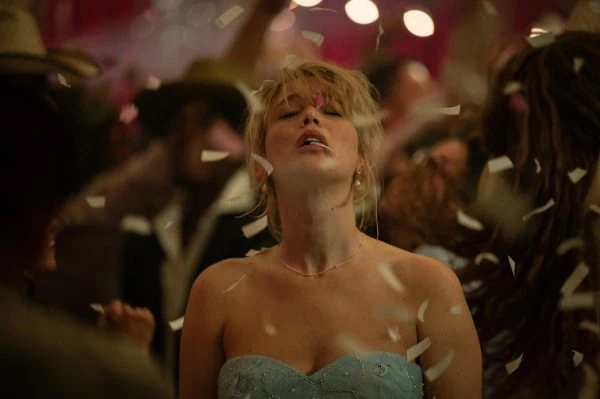
Die, My Love is Rated R by Motion Picture Rating (MPA) for sexual content, graphic nudity, language, and some violent content.
Die, My Love — Review
Lynne Ramsay’s Die, My Love isn’t simply a story of postpartum depression; it’s a plunge into something far darker, something buried deep within the human psyche, waiting for the right crack to break through.
It’s been eight years since Ramsay’s last film, You Were Never Really Here a work of trauma, silence, and disassociation so potent it left audiences hollowed out. If you remember the bruised stillness of that movie, its dreamlike sense of pain, prepare yourself Die, My Love takes that same impulse and burns it to a fever pitch.
We meet Grace (Jennifer Lawrence) and Jackson (Robert Pattinson) as they step into the faded promise of their new life together. They’ve inherited a house, a kind of American Eden left behind by a recently deceased relative. The place should feel like a refuge, but Ramsay knows how to seed unease in a frame a stray shadow, a pause too long, a character’s indifference to something that should matter. Jackson’s inability to recall or care about how his uncle died is the first small warning: this paradise is already spoiled.
The couple’s passion flares early. Ramsay films their bodies like a storm, colliding and consuming each other with a primal hunger. Grace, especially, seems driven by something beyond lust a restless, animalistic energy that hints at an interior fracture. When their child arrives simply “boy,” as if his very name is too much for her that energy turns inward. The birth doesn’t break her; it only awakens what was already sleeping inside.
Highly Recommended: Regretting You (2025) Parents Guide
Adapted by Ramsay, Alice Birch, and Enda Walsh from Ariana Harwicz’s 2012 novel, Die, My Love is a film that stares directly into the abyss of postpartum madness and refuses to blink. This isn’t the familiar narrative of a woman undone by motherhood it’s the portrait of a person who may never have been built to survive the quiet domesticity that motherhood demands. Grace isn’t possessed by external forces; she’s hollowed out by internal ones.
Cinematographer Seamus McGarvey renders Montana with a painter’s precision the kind of wide-open beauty that should soothe but instead exposes Grace’s alienation. Her violence, her erratic gestures, feel all the more brutal against that pastoral calm. Ramsay stages each eruption a fit of self-harm, an inappropriate outburst at a child’s birthday party with an almost unbearable intimacy. You don’t just watch her unravel; you feel the tension building in your own body.
There’s a scene in a grocery store that begins as awkward comedy a Curb Your Enthusiasm-style misunderstanding but slowly decays into cruelty, revealing just how tenuous Grace’s grip on ordinary human interaction has become. It’s an excruciating sequence, and Lawrence plays it like someone half-aware of her own collapse. Those fleeting glimmers of self-recognition the distant stare, the momentary softness are devastating.
It’s not hyperbole to call this the best work of Lawrence’s career. She’s feral, yes, but also painfully human. Her Grace is a study in contradictions: lust and loathing, rage and surrender, mania and numbness. She’s impossible to fully understand, and that’s exactly the point.
Highly Recommended: Hedda (2025) Parents Guide
Pattinson, meanwhile, occupies the unenviable role of the partner left circling her implosion. His Jackson is a man shaped by confusion and weakness the kind who mistakes avoidance for patience. His glove box full of condoms says as much about his restlessness as his empty reassurances do. Yet by the film’s end, he’s as broken as Grace, haunted by the same melancholy that permeates every inch of Ramsay’s world.
Sissy Spacek and Nick Nolte lend the film a haunting sense of generational fatigue. Spacek, with her gentle but knowing presence, sees Grace’s torment for what it is not madness exactly, but an inheritance of pain she’s powerless to cure. Nolte, playing her dementia-ridden husband, is a ghost of another kind a reminder that all love stories end in loss, one way or another.
Not every risk Ramsay takes lands. There’s a recurring subplot featuring LaKeith Stanfield as a mysterious, motorcycle-riding drifter a kindred spirit of sorts who shares a wordless, sensual connection with Grace. It’s gorgeously shot, all perfume-ad gloss and surreal longing, but dramatically thin. Still, even this misstep feels consistent with Ramsay’s vision a filmmaker less interested in coherence than in emotional contagion.
Also Read: Bugonia (2025) Parents Guide
What’s remarkable about Die, My Love is how it feels the sound, the texture, the pulse of it. Ramsay doesn’t want you to “understand” postpartum psychosis from a safe distance; she wants you to inhabit it, to lose your footing inside it. The editing (by Toni Froschhammer) and sound design merge into something hypnotic and punishing. Every wail, every silence, every breath becomes part of Grace’s distorted inner score.
By the time the film ends, you might feel wrung out frustrated, moved, maybe even angry. That’s by design. Ramsay’s work has always lived in discomfort, in the jagged spaces between empathy and horror. Die, My Love is no exception. It’s messy, magnificent, and at times infuriating a film that leaves bruises where others leave impressions.
Content Breakdown for Parents
Violence & Intensity: The film’s violence is psychological as much as physical. Grace experiences bouts of self-harm, destructive rage, and manic behavior. There are scenes involving blood, animal violence, and emotional cruelty that are distressing, though not gratuitously graphic. Ramsay’s direction leans toward suggestion and atmosphere the horror is mostly in what you feel, not what you see. Still, the intensity can be overwhelming, especially for viewers sensitive to mental illness or postpartum struggles.
Language: Frequent profanity, including repeated use of the F-word and other strong language. The tone is angry and chaotic rather than comedic or casual. There are no racial or homophobic slurs, but the verbal tension between Grace and Jackson is harsh and unrelenting.
Sexual Content / Nudity: The film opens with scenes of graphic, primal sex between Grace and Jackson shot in Ramsay’s usual raw, emotional style. Later, there’s nudity during moments of mental breakdown and one explicit encounter with another character (LaKeith Stanfield) that’s sensual but alienating. Nothing feels glamorized, yet these scenes are clearly intended for mature audiences.
Drugs, Alcohol & Smoking: Characters drink wine and whiskey in several scenes; Grace occasionally uses alcohol to numb her emotions. No drug use or smoking plays a major role.
Parental Concerns: Parents should know this film is not for teens or young viewers. The sexual content, emotional volatility, and self-harm imagery are intense and at times deeply uncomfortable. It’s a film meant to challenge, not comfort. Even adults may find it triggering if they’ve experienced postpartum depression or similar trauma.
That said, for mature viewers, Die, My Love can be a cathartic experience a reminder that empathy often begins where understanding fails.
Release date: November 7, 2025 (United States)