Hamnet is rated PG-13 in the U.S. for “thematic content, some strong sexuality, and partial nudity. Best suited for teens and above (13–adult), with parental guidance
Chloé Zhao’s Hamnet is a film that wants to be felt as much as seen. It glows with painterly beauty and pulses with sincerity, built around two magnetic performances Jessie Buckley’s raw, feral intensity and Paul Mescal’s inward, tremulous sensitivity. Both are actors who seem carved for awards-season montages, and Zhao, knowingly or not, frames them that way. Everything about Hamnet from its Shakespearean lineage to its solemn, aching tone announces itself as an “important” picture, one aching to be recognized as such. It’s the kind of film that arrives draped in prestige before you’ve even settled into your seat.
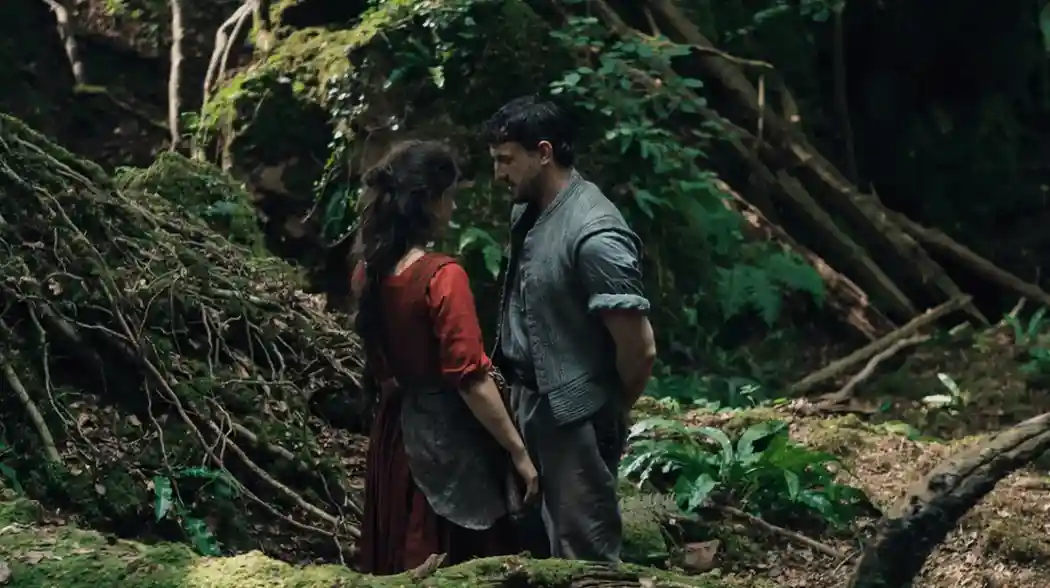
The film opens with angelic choirs and a roving camera gliding over a forest so lush it nearly hums. The first image of Agnes (Buckley) feels elemental she lies among the mossy roots of a giant tree, beside a bottomless pit that might as well be her soul’s metaphor. She’s an herbalist, a seer, one of those intuitive beings who seem to commune directly with the earth. When Will Shakespeare (Mescal) spots her from a window, he’s tutoring her brothers to pay off his father’s debts. Desire strikes him like lightning. Before he knows her name, he’s kissing her; before we can catch our breath, they’re tumbling into the woods for a hurried tryst, trading lines that later surface in his plays. It’s the sort of wink you expect in a lesser musical biopic—those moments when someone blurts out a future hit lyric.
Also Read: Alpha (2025) Parents Guide
Naturally, neither family approves. Will’s mother (Emily Watson) finds Agnes disreputable, “a witch’s daughter,” while Agnes’ brother Bartholomew (Joe Alwyn) dismisses Will as a “pasty-faced scholar.” The lovers persist anyway, and Zhao gives their intimacy a lived-in warmth, their banter a casual modernity that cuts through the period trappings. Before long, three children arrive offscreen and bloodless despite the cinematic screams of childbirth, a reminder that Zhao’s appetite for realism has its boundaries.
Soon, Will’s creative restlessness pulls him toward London, leaving Agnes behind in the countryside, raising their children and watching the seasons drift by without him. You feel her ache, that quiet mixture of devotion and isolation. When he finally brings the family to Stratford-upon-Avon, success has already begun to shape him into someone else. And then comes the blow that defines everything: the death of their son, Hamnet (Jacobi Jupe). The boy’s loss becomes the crucible from which Shakespeare’s most immortal work Hamlet is born. The connection is literalized in an opening title that reminds us Hamnet and Hamlet were once the same name.
From there, Hamnet unfolds with a rhythm that feels both inevitable and wearying. Every emotion is pitched at the same trembling register, every expression seemingly drawn from a single exposed nerve. Buckley, magnificent as always, gives a performance that feels sculpted from pure feeling. Her Agnes is ungoverned by propriety, guided by instinct, and unafraid of rawness. She grieves in a way that borders on the animal a wail so physical you half expect the theater walls to shake. It’s an Oscar moment if ever there was one, though you wish it didn’t feel designed as such.
Mescal, meanwhile, continues to inhabit variations of the same beautiful sadness that’s defined his recent roles Aftersun, All of Us Strangers, The History of Sound. He’s tender, yes, and bruised, but his familiar quietude risks blending into type. Together, he and Buckley are luminous yet predictable, two stars caught in a performance orbit we can see coming from miles away. The surprise, instead, comes from young Jacobi Jupe, who carries a startling gravity in his scenes, mirroring the lost innocence that his brother (played by Noah Jupe) later resurrects onstage as Hamlet.
For all its emotional reach, Hamnet can’t escape its own contrivances. Zhao’s aesthetic—once so attuned to unadorned human truth in The Rider and Songs My Brothers Taught Me—now feels self-conscious, even performative. There’s grandeur in every image, but little revelation. Żal’s digital cinematography, shot on the ALEXA 35, lends the film a strangely anachronistic sheen modern, hyperreal, a world scrubbed too clean to feel tactile. Zhao wants us to sense the story’s immediacy, to collapse the centuries between Shakespeare’s grief and our own, yet the result is oddly distancing, like a museum exhibit bathed in soft light.
The final act should devastate. Agnes travels to London to watch the play her husband has written in their son’s name. She sits there, shattered, staring at the stage as Hamlet unfolds a woman witnessing her own loss performed for strangers. The potential for transcendence is there. But Zhao undercuts it by setting the moment to Max Richter’s “On the Nature of Daylight,” that beautiful but hopelessly overused piece of music that long ago lost its innocence. What should have been an unbearable catharsis instead feels like an algorithm’s idea of emotion.
Highly Recommended: Bugonia (2025) Parents Guide
Zhao’s pursuit of profundity has rarely felt so labored. Even her director’s statement laden with lines like “I had truly experienced what it feels like to live with an open heart in the eye of a storm” reads like the voice of the film itself: reaching, breathless, convinced that sincerity alone can summon depth. But sincerity isn’t the same as insight. Hamnet aches to make us feel the immensity of love, loss, and artistic rebirth, yet in pressing so insistently, it squeezes the air out of its own emotions.
In the end, you can admire Hamnet its ambition, its beauty, its yearning for transcendence without ever quite believing in it. Zhao is too talented to make a bad film, but this one feels like a masterpiece performed in quotation marks: lovely, mournful, and hollowly self-aware, as if haunted by the ghost of greatness it can’t quite summon.
.Detailed Content Breakdown for Parents
Violence & Intensity: There is no graphic violence. The film does not dwell on physical combat or gore. In the parental guide, violence is described as “mild.” The emotional intensity, however, is strong: the depiction of illness, suffering, and the anticipation of loss create tension. Scenes of a child in decline are emotionally distressing rather than physically graphic.
Language: Profanity is minimal to mild. There are no known slurs or hate speech reported in reviews or guides.The tone of dialogue is largely formal (fitting the historical setting), but raw in emotional moments.
Sexual Content / Nudity: The parental guide indicates “moderate” sexual / nudity, with “exclusive female nudity” in some scenes. These are not gratuitous or titillating: they tend to occur in intimate, emotional contexts (e.g. scenes of childbirth or vulnerability).No explicit sex scenes are reported.
Drugs, Alcohol & Smoking: The content guide marks these as mild. Any depiction is minimal or contextual (e.g. alcohol use in social settings), not glamorized or central.
Parental Concerns
- The death of a child is central to the plot for many parents, that is raw, painful material. Some children may find it too distressing.
- Scenes of illness, bodily vulnerability, and perhaps faint or unwell postures might emotionally unsettle younger viewers.
- The nudity (female) might surprise some viewers expecting an entirely “safe” family film.
- The pacing is contemplative and quiet; for children used to action or faster storytelling, it might feel slow or “dry.”
- Because the emotional weight is heavy, some may feel the film is too somber for a lighter night out.
Release Date: Limited theatrical release starting November 27, 2025 (U.S.), expanding December 12, 2025.