Sentimental Value is Rated R by Motion Picture Rating (MPA) for some language including a sexual reference, and brief nudity.
Joachim Trier’s “Sentimental Value” begins with two scenes that tell you, quietly but unmistakably, what kind of movie you’re about to watch. In the first, a child has written an essay imagining their house as a living being one that feels fullness when inhabited, and pain when its windows slam. It’s a moment of imagination and empathy, but also of melancholy: a home given a soul, burdened with the ache of memory. Then comes a woman, an actress, standing backstage moments before curtain, unraveling under the pressure of performing The Seagull. She tries to flee the theater before summoning the will to go on. Two kinds of shelter a home and a role both trembling under the weight of what they contain. Trier frames these not just as themes, but as living contradictions: history and expression, memory and art, the family we’re born into and the ones we invent.
Highly Recommended: Death by Lightning 2025 Parents Guide
This is Trier’s most overtly Bergmanesque work, yet it never feels imitative. If anything, it’s where he comes into his own as one of modern cinema’s true humanists a filmmaker unafraid of emotional mess, yet meticulous in how he shapes it. “Sentimental Value” moves with the stealth of great fiction, burrowing into you after it ends, when you start to realize the questions it’s been asking aren’t only about its characters, but about your own life.
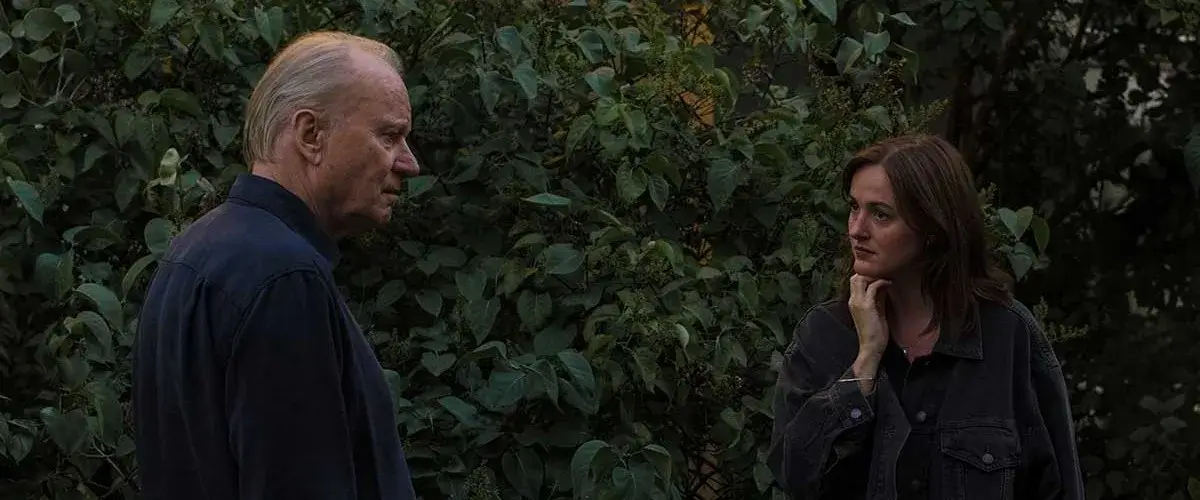
At the heart of the film is Nora, played by Renate Reinsve with a fragile brilliance that surpasses even her breakout in The Worst Person in the World. Early on, Nora’s mother dies, summoning her estranged father Gustav (Stellan Skarsgård, in a career-best performance) back into the orbit of her and her sister Agnes (Inga Ibsdotter Lilleas). Agnes, more conventionally settled with a husband and child, greets him with wary civility. Nora, by contrast, meets him with visible resistance the kind of discomfort that doesn’t announce itself but flickers through every movement. Trier never underlines what caused the rift; he lets it live in the pauses, the misfires of small talk, the way bodies tighten in the same room.
When Gustav tells Nora he’s written a film for her to star in, it lands less like an olive branch than a provocation. She won’t read the script. In one quietly devastating exchange, the two sit opposite each other, words clattering like brittle glass. Skarsgård and Reinsve perform a lifetime’s worth of emotional footnotes the way his tone carries authority that once inspired her, the way her silence carries years of unmet need. You can feel the history between them, every unspoken judgment pressing at the air.
Gustav drifts to the Deauville Film Festival, where an early work of his featuring a much younger Agnes screens to a modest audience. Among them is Rachel Kemp (Elle Fanning), a famous American actress who approaches him with that specific mix of admiration and hunger for connection that often defines artists on opposite sides of loneliness. She’s so taken by his old film that she invites him to dinner, and soon to collaboration. It’s no surprise when Rachel ends up taking the role originally written for Nora. What’s more unsettling and deeply Trier is the way Rachel begins to blur into the image of the daughter she’s replaced, even dyeing her hair to match Nora’s. Trier plays this not as a gimmick but as a ghostly meditation on identity the way art mirrors life until neither can see its reflection clearly anymore. A few shots evoke Persona directly, but the homage feels earned: the boundary between self and performance dissolving into something raw and searching.
Also Read: Predator: Badlands (2025) Parents Guide
Meanwhile, Agnes, an academic historian, becomes her own kind of detective, piecing together the truth about their grandmother’s suicide and the family’s buried trauma from the war. The deeper she looks, the more Gustav’s film-within-a-film reveals itself as a prism of inherited pain a confession, a rewriting, and perhaps an act of atonement. “Sentimental Value” doesn’t build toward catharsis so much as it accumulates it. You sense, scene by scene, that an emotional reckoning is coming, but when it arrives, it’s quiet a gesture, a shared look, the kind of release that refuses melodrama. Trier ends not with dialogue, but with silence. It’s perfect.
That sense of truth of life as actually lived defines every frame. Trier and his cast understand that family isn’t built from grand declarations but from small, mercurial exchanges. There’s a marvelous bit where Gustav buys his grandson wildly inappropriate DVDs, and Nora’s laughter exasperated, affectionate, helpless tells you more about their history than any flashback could. A cigarette follows. A brief smile. For a moment, decades of distance dissolve. It’s in these small mercies, these tiny reawakenings of warmth, that Trier finds his truest insights. Hollywood often mistakes dysfunction for drama; Trier knows that estrangement is more complicated that sometimes love and resentment occupy the same breath.
Read More: Little Amélie or the Character of Rain (2025) Parents Guide
It would be easy to talk only about the performances and writing both superb and overlook the film’s craft, but that would miss how intricately it all works together. Kasper Tuxen’s cinematography has a supple, restless grace; his camera drifts as if eavesdropping on the characters’ souls. Olivier Bugge Coutté’s editing, with its frequent fades to black, lends the story a literary rhythm, as if each cut were the turning of a page. Trier gives a film so dense with dialogue the gift of air visual momentum that keeps emotion from stagnating. Every formal choice feels like an extension of the story’s pulse.
Like Gustav’s film, Sentimental Value resists simple interpretation. It’s about his mother, yes, but also about his daughters, and by extension, himself. Trier aligns the family’s two women the actress and the historian as embodiments of art and memory, performance and inquiry. Together, they map the human need to translate experience into meaning. Fanning, so delicate yet direct, captures the ache of an artist striving to inhabit emotions she hasn’t lived. Her English-language monologue during rehearsal, heartfelt but slightly off-key, becomes wrenching later when she repeats it in its native tongue. Suddenly, it breathes as if the truth finally found its language.
That’s the heart of Trier’s film, really. To live fully, you must risk feeling everything. To make great art, you must survive it. And sometimes, to survive, you need art to carry what you can’t.
Content Breakdown for Parents
Violence & Intensity: No physical violence, but several scenes carry heavy emotional tension — raised voices, harsh arguments, and references to past trauma, including suicide and wartime suffering. Nothing graphic, but the emotional honesty might be overwhelming for younger teens.
Language: Moderate use of strong language, including several F-words and other mild profanity. The tone can be sharp and cutting, particularly in scenes between Nora and her father. No slurs or hate speech.
Sexual Content / Nudity: Some sexual situations are implied, including an affair between Nora and her married co-star. One love scene is sensual but brief and tastefully shot, without graphic nudity. Conversations about relationships and infidelity appear throughout.
Drugs, Alcohol & Smoking: Several characters smoke, and social drinking occurs frequently. Alcohol is used as emotional coping, though never glamorized.
Scary or Disturbing Scenes: Emotionally intense discussions about family death, suicide, and historical atrocities may unsettle sensitive viewers. No visual gore or horror imagery.
Positive Messages / Role Models: The film gently encourages empathy, forgiveness, and self-reflection. It’s about confronting pain rather than avoiding it and about how art can help us make peace with the past. Nora’s journey shows that healing doesn’t always mean reconciliation, but it does mean understanding.
Parental Concerns: Parents should know this isn’t an easy watch. It’s talky, intimate, and emotionally heavy, dealing with mental health, death, and regret. Teens expecting something fast-paced or romantic will likely lose interest. It’s more suited for mature viewers who appreciate art films or layered family stories like Manchester by the Sea or Pieces of a Woman.
“Sentimental Value” was reviewed from its premiere at the Toronto International Film Festival on September 5. It opens in theaters November 7, 2025.
