Death by Lightning is rated TV-MA by Motion Picture Rating (MPA) for mature audiences. This series is best suited for older teens (16+) and adults.
Death by Lightning — A Review
“Assassination can be no more guarded against than death by lightning, and it’s best not to worry about either.”
So wrote President-elect James A. Garfield in a letter to Treasury Secretary John Sherman, brushing off the notion that anyone might wish him harm. That one line, fatalistic and strangely serene, haunts every frame of Death by Lightning, Netflix’s haunting, intelligent historical drama about the man who spoke it and the one who took his life.
The series begins not in Garfield’s century but in ours or nearly so. It’s 1969, and Sly and the Family Stone’s “Everyday People” fills a dimly lit room at what was once the Army Medical Museum. As movers pack up relics from the past, a box tumbles open, and a jar dusted over by decades of neglect rolls across the floor. Inside is a brain. A worker squints, reading the faded label, and asks with the blunt curiosity of someone unburdened by history: “Who the f*** is Charles Guiteau?”
Highly Recommended: Put Your Soul on Your Hand and Walk (2025) Parents Guide
It’s a fair question. Even those who can instantly name Booth or Oswald often draw a blank on the man who shot President James A. Garfield in a Washington train station in 1881 — or on the name of Leon Czolgosz, who killed McKinley twenty years later. Guiteau has largely been lost to history, a footnote buried beneath the mythologies of greater tragedies. But it’s precisely that anonymity that makes Death by Lightning so absorbing.
Created by Mike Makowsky (Bad Education) and shepherded by executive producers David Benioff and D.B. Weiss (Game of Thrones), the four-part series is both brisk and thorough, dramatic yet deeply grounded. It’s the kind of show that makes you realize how little you knew about a piece of American history you assumed was settled a production filled with those “I was today years old when I learned…” revelations.
Yes, the story takes liberties; historical dramas always do. But what’s remarkable here is how much of it feels true not just in the sense of accuracy, but in spirit. Michael Shannon brings a rugged, wounded dignity to Garfield, while Matthew Macfadyen plays Guiteau as a delusional schemer whose madness is almost pitiable, almost. Both men are riveting. You can feel them leaning into the moral weight of their roles, mining not just the facts of history but the emotional currents beneath them.
After that eerie prologue, the series proper drops us into 1880. Guiteau sits in New York’s grimly named prison, “The Tombs,” trying to charm his way past a skeptical parole board. He preens, he declaims, he sweats through his monologue: “Are we not a nation built wholly from rogues and migrants and freethinkers?” It’s a grand statement, and you can see the madness flickering beneath it. From the start, the show makes clear this is not a misunderstood visionary, but a man whose mind has turned on itself.
Also Read: Predator: Badlands (2025) Parents Guide
Cut to the Garfield farm in Mentor, Ohio. A different world entirely quiet, sun-warmed, almost bucolic. Garfield, his wife Lucretia (the always luminous Betty Gilpin), and their children live a life of modest happiness, untouched for the moment by the venom of Washington. That illusion shatters with the arrival of the day’s mail. “It’s a letter from John Sherman,” Garfield says, and Lucretia, curious, asks, “General Sherman’s little brother?”
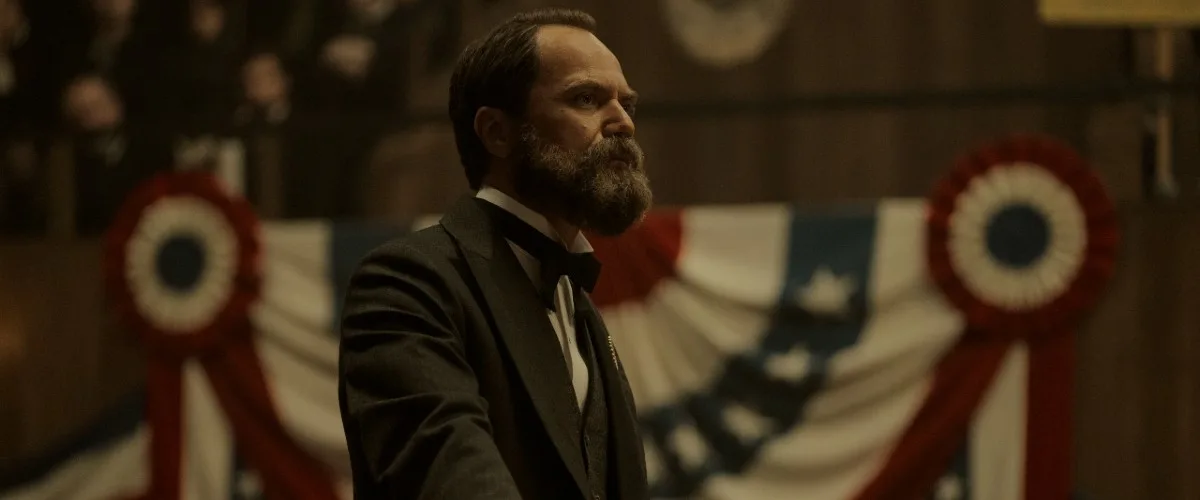
It’s a bit of expositional dialogue that winks at its own function, but the moment works partly because the show knows that politics in the 1880s requires footnotes. Soon Garfield is on his way to Chicago for the Republican National Convention, where he’s meant only to nominate Sherman, not replace him. What follows is one of the series’ best sequences sharply written, politically canny, and, surprisingly, very funny.
As the ballots drag on thirty-six of them Garfield’s reluctant charisma catches fire. The crowd lifts him up like a man carried by fate rather than ambition. Shannon commands the screen, booming in that inimitable voice, “We should join together in lifting into the firmament of the Constitution those immortal pillars of justice and truth.” It’s theater, yes, but Shannon makes it pulse with conviction.
Also Read: Hallow Road (2025) Parents Guide
Director Matt Ross and cinematographer Adriano Goldman give the show a sense of stately realism. The sets, filmed in Budapest doubling for Chicago and Washington, are handsome if slightly too polished the kind of beauty that occasionally reminds you you’re watching Budapest. But there’s texture here, a lived-in grime that keeps the Gilded Age from gleaming too brightly. The linear storytelling is a relief in an age of fragmented flashbacks; when Death by Lightning does look back, it does so with purpose, not as a gimmick.
And the ensemble! Shea Whigham is delightfully odious as the corrupt Senator Roscoe Conkling; Bradley Whitford, sly as ever, plays political fox James G. Blaine; Vondie Curtis-Hall brings Frederick Douglass a quiet authority that radiates wisdom; and Nick Offerman, bless him, turns Vice President Chester Arthur into a kind of drunken, blustering tragicomic figure a man who bellows, “Music! Fighting! Sausages!” as if trying to drown out his own uncertainty. It shouldn’t work, but it does, hilariously and somehow tenderly.
At its heart, though, the series belongs to Macfadyen’s Guiteau a man forever circling power, trying to convince himself he deserves to be near it. His encounters with Blaine and Garfield are small masterclasses in humiliation; you can see the sweat on his brow as he realizes he’s merely tolerated, never taken seriously. He’s the man in the room who doesn’t know he’s the joke. And that wound festers until it becomes fatal.
Also Read: Violent Ends (2025) Parents Guide
Death by Lightning doesn’t just recount a murder; it examines the psychology of irrelevance of the desperate soul who believes that infamy can substitute for greatness. It remembers Garfield as a good man who never sought the presidency and might have become a truly great one had history been kinder. And it remembers Guiteau as what he was: a broken man, a mirror held up to the worst of human vanity, convinced that by taking a life, he could give his own meaning.
By the time the final shot fades, you can feel the echo of Garfield’s own fatalism that lightning strikes without warning, that history, like weather, shows no mercy.
Content Breakdown for Parents
Violence & Intensity: Moderate to strong. The assassination scene is portrayed with realistic gunfire and aftermath, including Garfield’s suffering and medical treatment. It’s not gratuitous, but the emotional weight and brief glimpses of blood may disturb sensitive viewers. There’s also tension in several political confrontations and moments of mental breakdown.
Language: Frequent use of strong language, including several f-words and period insults. It feels true to the characters and tone rather than excessive, but parents should be aware of rough dialogue in both political and personal exchanges.
Sexual Content / Nudity: Minimal. A few mild references to marital intimacy, but nothing explicit. The series focuses more on ambition and ideology than romance.
Drugs, Alcohol & Smoking: Frequent social drinking, cigar smoking, and party scenes typical of the Gilded Age. Vice President Chester Arthur is often shown drinking heavily at gatherings. No drug use depicted.
Scary or Disturbing Scenes: The assassination itself and Garfield’s slow decline may be upsetting. Guiteau’s erratic behavior, mania, and delusional outbursts are intense and sometimes unsettling. Occasional imagery (such as the preserved brain from the opening scene) might startle younger viewers.
Parental Concerns: While gorgeously acted and intelligent, this isn’t an easy watch. The pacing is deliberate, the tone somber, and the subject matter assassination, delusion, and death may feel heavy for kids or tweens. The language, violence, and psychological distress push it firmly into adult territory.
