Put Your Soul on Your Hand and Walk is not rated because it has not undergone the official rating process by the Motion Picture Rating (MPA)
Put Your Soul on Your Hand and Walk — Review
When faced with the ongoing annihilation of the Palestinian people, our minds struggle to process the deluge of numbers the dead, the displaced, the disappeared. The statistics multiply until they numb us. But numbness, as Sepideh Farsi’s film reminds us, is itself a privilege. To feel overwhelmed by images is to be spared the bombs that produce them. To watch the suffering of others from a distance is to exist in a kind of moral insulation one that lets us treat the unfathomable as data points rather than individual human lives. Farsi’s Put Your Soul on Your Hand and Walk cuts directly through that insulation. It’s not merely a documentary, but a profoundly personal record an act of witnessing that insists on the singular, the irreplaceable. What emerges feels like historical sonder captured on screen: the unbearable realization that every face in the footage has a story as intricate as your own.
Recommended: I Love LA (2025) Parents Guide
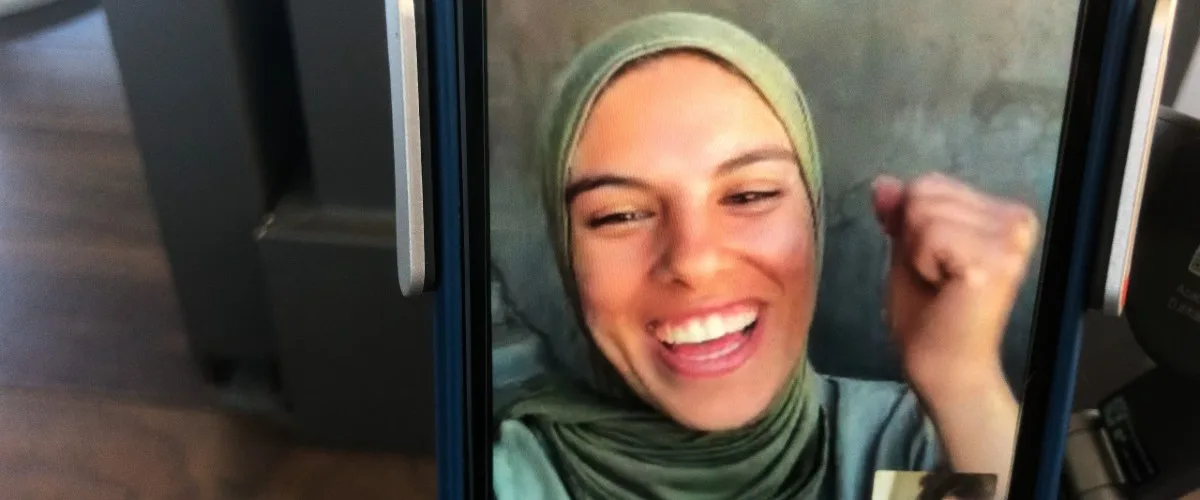
The film orbits around Farsi’s tender, virtual friendship with a 24-year-old photojournalist named Fatma Hassona. Their connection unfolds across WhatsApp video calls grainy, flickering conversations interlaced with Fatma’s own photographs and bursts of news from the so-called “war.” Yet the film’s heart belongs wholly to Fatma: to her laughter, her quick wit, her irrepressible smile that greets each new call like sunlight through smoke. Farsi’s framing might offer historical context, but the emotional gravity is Fatma’s alone.
Farsi captures these encounters on her iPhone, and the imperfections the glitching signal, the pixelated faces, the static-ridden audio become part of the film’s visual language. Screen within screen within screen: layers of separation that might have rendered the exchange sterile instead heighten its intimacy. The distance, paradoxically, becomes connective. Fatma’s optimism her radiant grin, her habit of finding light in the static fills every fractured moment. When she giggles at the sound of the sea from Farsi’s side of the call, you can feel the ocean’s echo across continents, even as the hum of Israeli drones reminds her of the danger hovering above her own.
Also Read: Violent Ends (2025) Parents Guide
Every successful connection feels miraculous. Each time the call goes through, it’s as if defying gravity itself. And even as fatigue shadows Fatma’s eyes, her smile remains a fragile yet defiant act of self-possession. She speaks of days of relentless bombings; then, asked what it means to be Palestinian, she answers without hesitation: proud. The swiftness of her response cuts through like a pulse. Over the course of the film, her dreams once vast, stretching toward Tehran and Rome begin to shrink into something heartbreakingly small: the wish to taste chocolate again. Farsi’s lens, gentle but unflinching, reminds us that violence doesn’t only steal lives; it steals the future tense. It plunders the imagination, the simple luxury of having plans.
Even when she speaks of not leaving her home, knowing that snipers are stationed outside in Gaza, Fatma’s expression doesn’t falter. She smiles again as she scrolls through photos of the thirteen family members she’s lost the youngest barely a year old. Her cheer feels both luminous and unbearable, a defiance that borders on the impossible. Farsi, ever the realist, doesn’t puncture that light, but she questions it the way you and I might, watching through our screens. What words can bridge such distance? What comfort can possibly exist for someone living under the constant threat of annihilation? At times, all Farsi can offer are prayers sent across fiber-optic cables a kind of faith transmitted in pixels.
Fatma’s steadfast hope becomes the film’s most confounding and devastating presence. It inspires, but it also unsettles. You start to sense, almost against your will, the shape of an ending you don’t want confirmed. And when it comes, it lands like a collapse. Twenty-four hours after learning that Put Your Soul on Your Hand and Walk had been selected by Cannes nearly a year after their first call Fatma and her entire family were killed in a targeted airstrike. What began as a living conversation transforms, before our eyes, into elegy.
By the film’s close, the project has shifted from memoir to memorial. It becomes a record of mourning Farsi’s, ours, the world’s for a young woman whose laughter we’ve come to recognize, whose photographs and poems still shimmer with vitality even as we learn of her death. The film immortalizes her, yes, but in doing so, it exposes a deeper sickness in us: the helplessness of knowing that remembrance, while sacred, can never be enough.
It’s a privilege, again, to know Fatma in this way to see her as a full person rather than a faceless casualty. But that privilege is double-edged. Farsi’s film leaves you with gratitude, yes, but also with guilt, and a desperate sense of urgency. It insists that Fatma is not the only one that there are countless others still enduring, still smiling against the impossible.
Put Your Soul on Your Hand and Walk is not a film that ends; it lingers. It calls upon you, gently but unmistakably, to act to hold even a fragment of Fatma’s faith within your own despair. Farsi may not be able to halt the violence, but by preserving this connection, by refusing to let these voices vanish into abstraction, she performs a radical act of resistance. This is cinema as testimony, as love letter, as last prayer a reminder that to remember is not passive. It’s defiance.
Content Breakdown for Parents
Violence & Intensity: No graphic violence. The film includes a few emotionally intense scenes: a car accident (offscreen), dreamlike depictions of drowning, and one scene where Ari’s hands glow painfully as she loses control of her gift. The imagery is artistic and metaphorical rather than realistic, but it may unsettle sensitive viewers.
Language: Occasional mild profanity (“hell,” “damn”) and one stronger expletive used in a heated emotional moment. No slurs or hate speech. Tone is more emotional than aggressive.
Sexual Content / Nudity: A gentle romantic subplot between Ari and Kai includes brief kissing and hand-holding. No nudity or sexual situations.
Drugs, Alcohol & Smok: One scene shows adults drinking wine at a wake. No substance abuse or smoking depicted.
Scary or Disturbing Scenes: The dream sequences include shadowy figures, melting landscapes, and distorted faces that represent fear and regret. They’re more emotionally haunting than scary, but might be too intense for kids under 10.
Parental Concerns: The movie’s surreal, emotional tone might confuse or overwhelm younger children expecting a straightforward fantasy. The metaphors for death and trauma are meaningful but heavy. Teen audiences (13+) are more likely to connect with its introspective themes.
Release Dates:
- United States: November 20, 2025
- France: September 24, 2025
- United Kingdom: August 22, 2025
