There’s a moment about two-thirds through “Toy Story 5” where Jessie, mid-crisis, says something like “I don’t know who I am if nobody’s looking for me”, and I sat there in a dark theater full of seven-year-olds thinking, well, there it is, that’s the whole movie, and also possibly the most honest sentence Pixar has put in a kids’ film since Sully figured out a door wasn’t a door at all.
That’s the moment I stopped watching this as another Toy Story sequel and started watching it as a movie about what happens to anyone, toy, parent, kid, cowgirl doll with abandonment issues dating back two decades, once their job stops needing them.
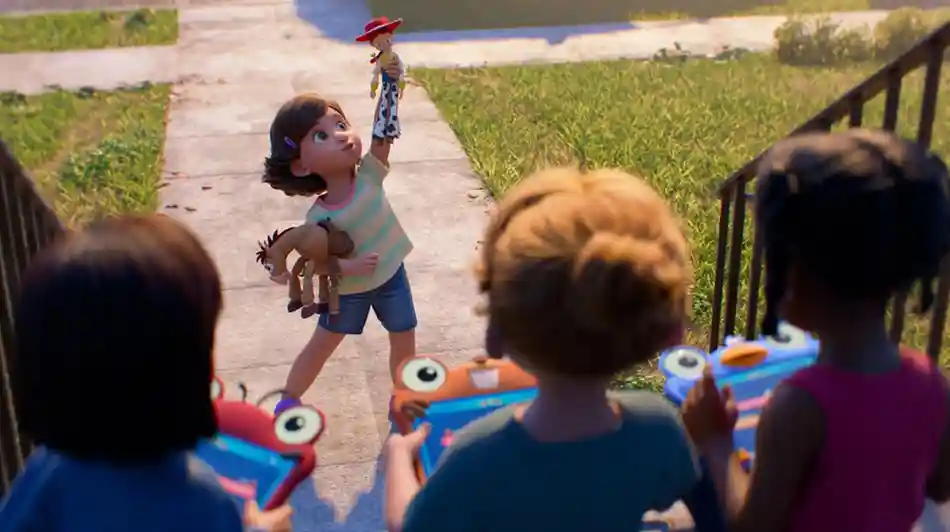
Because that’s the trick of this one. Honestly I see this movie as the “toys versus tablets” movie. Bonnie’s turning eight, the neighborhood kids have all aged into a frog-shaped device called a Lilypad, her parents buy her one too so she won’t be the odd kid out. Fine, that’s the pitch. But watch where the camera actually lingers, and it’s not on the tablet. It’s on Jessie, standing at the edge of every scene where Bonnie chooses the screen over her, wearing an expression Joan Cusack somehow gets a plastic doll’s face to hold. Woody got to leave. He rode off with Bo Peep three movies ago and handed the franchise’s grief to someone else. Jessie’s the one still standing in the room when the kid stops looking up.
What I didn’t expect is how little the movie cares about making the tablet evil. Greta Lee voices Lily with this bright, eager, slightly too-helpful energy, she’s not HAL 9000, she’s a customer service rep who genuinely believes she’s improving your life and that’s a smarter choice than a villain would’ve been, because the actual threat in this movie isn’t a device. It’s drift. It’s the slow, nobody’s-fault way a kid just stops reaching for the toy box one afternoon and doesn’t notice she’s done it. I’ve watched that happen in real living rooms. Pixar clearly has too.
The film earns its tears the unglamorous way not through a big sacrificial set piece like the incinerator in the third movie, but through accumulation. Bonnie, alone in her room, asking her Lilypad why none of the girls from dance invited her to something, and the tablet’s cheerful, useless non-answer.
Jessie watching from the dollhouse, unable to do anything, because what is a cowgirl doll supposed to do against a group chat. It’s a quietly brutal scene, and I think it’s the best thing in the movie precisely because nobody raises their voice or scores it dramatically. It just sits there and lets you feel embarrassed on Bonnie’s behalf, which is the particular flavor of cringe specific to being eight and slightly behind everyone else socially. I haven’t been eight in a long time and I still recognized it instantly.
Stanton and Harris know they’ve got something with this Jessie material, and to their credit, they let the comedy breathe around it instead of constantly undercutting the tone. The Forky-officiated spork wedding in the opening minutes is the kind of gag that only works if you trust kid-logic completely, and the film does, it doesn’t wink at the audience, it just commits, the way an actual eight-year-old would commit to the bit.
Conan O’Brien’s potty-trainer character is pure id, aimed squarely at the under-tens, and I clocked at least three kids near me laughing at a joke that did nothing for me, which I think is the correct distribution for a family movie to land its humor in.
Where it loses me a little is the back half, where the script seems to remember it has a plot to resolve and starts resolving it slightly too efficiently, Jessie’s reckoning with Emily gets the space it needs, but the stuff around Bonnie actually making a friend wraps up faster than the problem deserved, like the movie ran out of runtime before it ran out of things to say about loneliness.
And yes, there’s something a little rich about a film warning kids off screen addiction while Disney’s already got a tie-in tablet on shelves. The movie doesn’t address that irony. I don’t think it can.
But I keep coming back to that line. I don’t know who I am if nobody’s looking for me. That’s not a kids’ movie sentiment, not really, it’s a midlife one, dressed in a cowgirl hat. The trick of this franchise, thirty years on, was never the toys. It’s that it keeps finding adult fears small enough to fit inside a child’s bedroom, then asking a doll to survive them so the rest of us don’t have to say it out loud ourselves.
Toy Story 5 Parental Guidance
Rating: PG, for some thematic elements and rude humor.
Violence and Intensity: Mild by Pixar standards. The franchise’s usual close calls and rescue sequences are present, but nothing graphic. The emotional intensity around exclusion and loneliness lands harder than anything action-based.
Language: Very mild, occasional “shut up,” a couple of near-curses, and potty humor from a character voiced by Conan O’Brien.
Sexual Content and Nudity: None.
Drugs, Alcohol and Smoking: None.
Additional Notes for Parents: The film centers on a child being excluded by peers through online interaction and touches on casual cyberbullying with more honesty than most family films attempt. Kids who’ve felt left out socially, online or off, may feel this one more than expected. There’s also a thread about toys grappling with feeling replaced, carried mainly through Jessie.
Age Recommendation: Suitable for most ages, including young children, though kids around Bonnie’s age (7 to 10) will likely connect hardest with the social-exclusion material.
