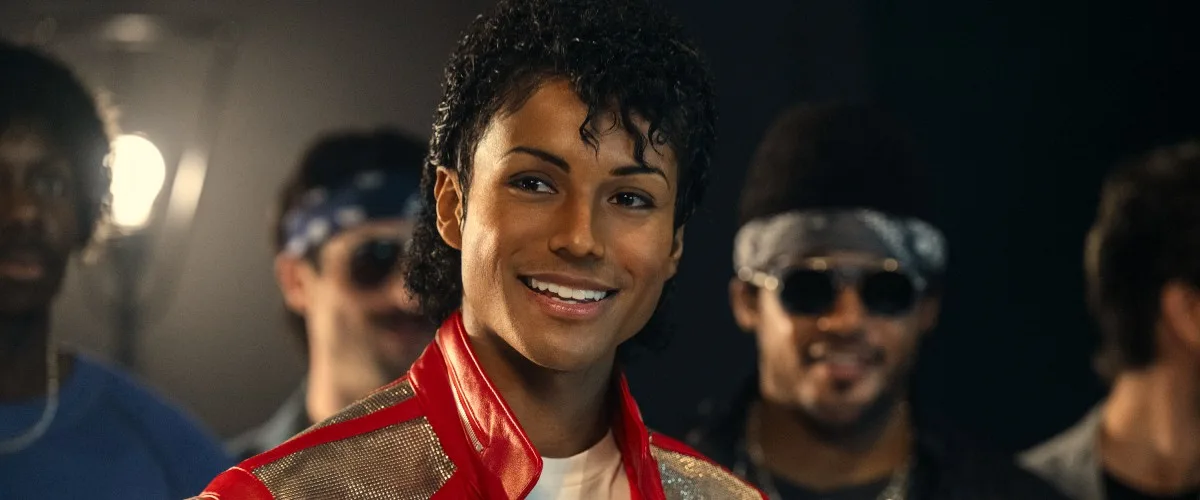
There’s a moment early in “Michael” that made me set down my notebook. Not because it was moving. Because it was telling. Young Michael, the one with the big eyes and the smaller voice, is practicing with his brothers in Gary, Indiana. His father Joe barks at him to make eye contact. And the boy can’t do it. He just can’t. Colman Domingo plays Joe with his chin out and his veins showing, and Nia Long’s Katherine sits there like a woman who learned long ago that looking away was the same as being strong. That scene has weight. Real weight. It’s the kind of moment a real movie might spend an hour unpacking.
“Michael” spends about ninety seconds on it before moving on to the next thing. And the next. And the next.
You feel it immediately when that gaudy Optimum Productions logo hits the screen, the one belonging to Michael Jackson’s former company. The ruse is over before the first frame of actual footage. Antoine Fuqua has cameras. He has microphones. He has the estate’s blessing and a pile of the greatest pop music ever recorded. What he doesn’t have is a movie. What he’s made instead is a filmed playlist with delusions of narrative, a Wikipedia page that cost forty times as much to produce and has half the courage to ask an uncomfortable question.
The Jackson siblings sit as executive producers—Jackie, Jermaine, Marlon, La Toya, and the man himself, posthumously signing off. You can feel their fingerprints on everything. The absence of Janet from this universe is weird enough to notice within the first half hour. The absence of any reference to Michael’s legal troubles is louder. But here’s the thing I kept turning over: those omissions aren’t what sinks the ship. The real failure is simpler and more damning. The film has no complex interest in Michael Jackson. None.
It runs from 1966 to 1988, a strict chronological march that forces choppy recreations and breathless leaps. Twenty minutes in, we’ve already gone from the Jackson 5’s first touring days to Motown discovery to early recordings. Fuqua doesn’t pause to let the ugliness settle—the fact that Joe sent his little boys to perform in adult clubs, that Michael sang about sex before he understood what the words meant. The director clearly wants to draw some connection between the child’s permanent state and the adult horrors he witnessed too young. But whatever initial intent existed has been sanded down to make room for the next song cue.
Jaafar Jackson plays his uncle, and here’s where I have to give credit where it’s due. He’s not bad. There are glimpses, real glimpses of something mournful and strange. Watch him when the conversation turns to his nose, that decision to make himself more closely resemble Peter Pan. Or the way he seeks out father figures like Berry Gordy or his bodyguard Bill Bray. Jaafar’s got an emotiveness that the movie doesn’t deserve. But even a sturdy performance can’t survive hagiography. This script only allows Michael to be a victim. Which isn’t to say he wasn’t one. The abuse from Joe, the Pepsi fire those horrors happened. But where are his flaws? His contradictions? His definable human traits? He exists only to overcome. That’s not a person. That’s a poster.
Colman Domingo gives the worst performance of his career here, and I don’t think it’s his fault. He’s not playing Joe Jackson. He’s playing a boogeyman. A caricature of discipline and menace with none of the sick love that makes abusive parents so impossible for children to escape. Nia Long has nothing to do but look pained. The brothers are glorified extras, we never learn which one Michael fought with, laughed with, trusted. And yeah, I know the movie is called “Michael.” But isn’t your relationship with your siblings a mirror? Isn’t that where you learn who you are?
Then there’s Bubbles. The chimp might be the best-drawn character besides the singer himself. Along with the giraffes, the snake, the piles of children’s toys. Fuqua plays these moments for laughs, as if we’re meant to chuckle at the absurdity of a genius rather than sit with the obvious, aching cry for help. That choice tells you everything about the film’s priorities. It won’t hold still. It won’t let a difficult emotion breathe. It just keeps moving to the next hit.
Even the musical sequences, which should be the film’s salvation, get undercut by incomprehensible camerawork. Fuqua finds interesting compositions sometimes—a focus on Michael’s feet during “Billie Jean,” the way he works through “Beat It” choreography alone. But then he cuts to inane pans behind the crowd, nauseating movement that blunts every bit of power the dancing might have. There’s a moment where Michael chastises a cameraman on screen for removing the energy from the dance. The irony lands like a safe falling on your foot.
I kept thinking about what this movie could have been. Not a hatchet job. Not an exposé. Just an actual investigation of a human being who happened to be the most electrifying performer of his generation. Someone who was tender and manipulative, generous and wounded, a perfectionist and a child. That person is still waiting for his movie.
Instead we get something beyond safe. Unchallenging. A filmed playlist where the songs paper over the emptiness until even they can’t anymore. You want the real thing? Queue up the Jacksons miniseries. Or better yet—just watch the music videos. Watch the man dance. Let him tell his own story in three minutes and forty seconds. He was better at it than anyone who made this film.
Michael 2026 Parents Guide
Let me be straight with you. “Michael” is rated PG-13 for “some thematic material, language, and smoking.” That’s what the MPA says. But parents need more than that three-word summary, especially when the film’s subject is someone whose actual life contained things no rating system knows how to measure.
So here’s what you’re actually getting.
Violence & Intensity
The abuse comes from Joe Jackson. You see him slap young Michael. You see him grab kids by their arms, get in their faces, scream. There’s a belt involved in one scene—you don’t see the impact, but you see the fear leading up to it and the aftermath. The Pepsi commercial fire is depicted: Michael’s hair catches, his scalp burns, and there’s a brief but startling image of flames on his head before people tackle him to put it out. No blood, but the panic is real. The intensity level spikes during these moments, then drops back down to nothing. That’s part of the problem, honestly. The film doesn’t sit in the pain long enough for younger viewers to fully process what they just saw before it’s on to the next upbeat musical number.
Language (profanity, slurs, tone)
Mild compared to most PG-13 movies. A few scattered uses of “shit.” One or two “damns.” Nothing harder. No racial slurs. No sexual profanity. Joe Jackson calls his sons names—”lazy,” “stupid”—but that’s the worst of it. The tone of the language is more concerning than the actual words. Joe doesn’t need to swear to wound.
Sexual Content / Nudity
None. Zero. Not even a suggestive dance move that feels out of place. This is interesting because Michael Jackson’s actual choreography contained plenty of hip thrusts and crotch grabs, but the film either sanitizes those moments or frames them as pure performance without sexual charge. No nudity. No kissing. No discussions of sex. For a movie about a man whose adulthood became consumed by allegations of child sexual abuse, the complete absence of any sexual content feels less like a creative choice and more like a legal one.
Drugs, Alcohol & Smoking
Smoking is the one the MPA flagged. Joe Jackson smokes cigarettes in several scenes. You see other adult characters smoking socially. No drugs. No alcohol abuse. There’s a scene where Michael takes prescription medication after the Pepsi burn, but it’s depicted as medical treatment, not recreational use. The film completely avoids any mention of the painkiller addiction that became a major part of his later life. So if you’re worried about a kid seeing drug use, you’re safe.
Age Recommendations
A ten-year-old could handle the language, the violence, the lack of sex. That’s not the issue. The issue is whether a ten-year-old should watch a movie that presents a deeply complicated, traumatized adult as a pure victim with no flaws, while simultaneously avoiding every difficult question his life raised. So my honest recommendation? For kids under 12, there’s nothing in the PG-13 rating that should scare you off. But for kids 12 and up, you might want to watch it together and talk afterward.
