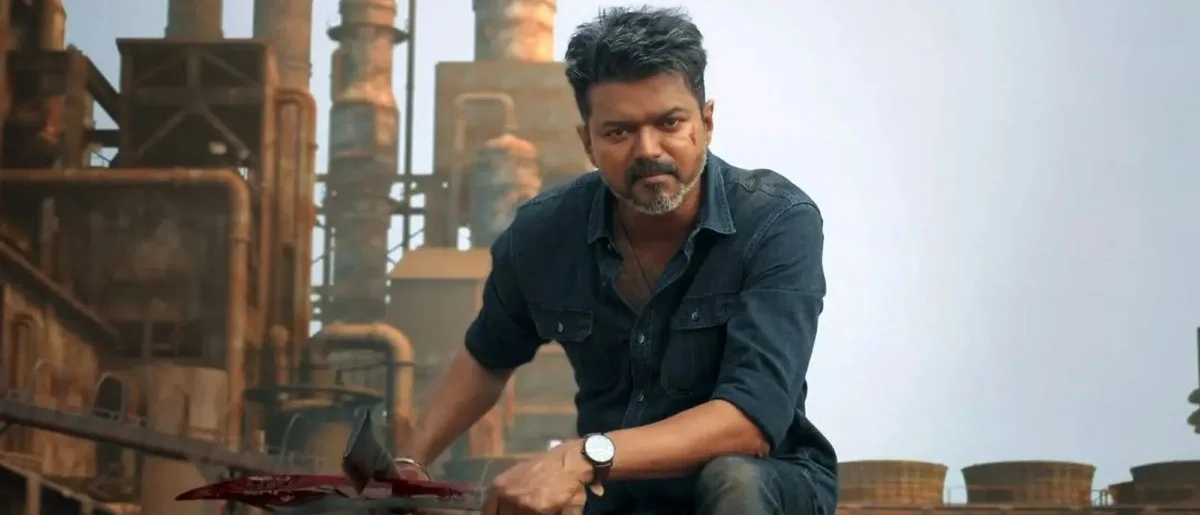
I’ve watched a lot of bad movies in my time, but “Jana Nayagan” is the first one that made me feel bad for the flies. There’s a scene where a corpse gets thrown from a moving van, and the hero drapes a flag over her body to preserve some dignity, except the corpse is AI-generated, and so are the flies buzzing around it. I sat there trying to locate the emotion the scene was reaching for and came up empty, because there’s no reaching for anything when the tool doing the work can’t feel the weight of what it’s rendering.
This is supposedly Vijay’s final starring role, arriving right as his career collides with his new one; he was recently elected Chief Minister of Tamil Nadu. You’d expect a swan song to come with some ambition attached, but “Jana Nayagan” is a remake of 2023’s “Bhagavanth Kesari,” and it plays like a production that ran out of money before it ran out of ideas, or maybe never had enough of either to begin with.
Vijay stars as Thalapathy Vetri Kondan, an ex-con and ex-cop raising his late friend’s daughter Viji, played by Mamitha Baiju, who’s dealing with panic attacks after watching her mother die in a riot. Her father wanted her in the army, which her trauma now complicates, and into all of this walks Bobby Deol as a mercenary with the deeply unfortunate name John Himmler, orchestrating some vague plot to destabilize India. There’s a twist after the intermission meant to make the rivalry feel personal. It doesn’t do much of anything.
None of that plotting is really the issue, though, since masala cinema has run on convoluted stakes and larger-than-life villains for decades and thrived on it when the craft is there. What sinks “Jana Nayagan” is what fills the space around the plot, because the film leans on AI-generated imagery so constantly that it stops functioning as a stylistic choice and starts functioning as the movie’s entire personality.
A climactic battle involving laser-blasting androids and robotic dogs looks less like an action set piece and more like a screensaver malfunctioning at scale, and the musical numbers fare even worse, dropping Vijay into oversaturated AI backdrops surrounded by AI-composited dancers who move like nobody bothered to finish animating them.
I’d like to tell you what I thought of Anirudh’s score, since he’s normally reliable, but I spent most of these scenes distracted by the sinking feeling that I was watching a star celebrate himself against what amounted to a rendering error.
To the film’s credit, there’s at least one moment early on where you can feel a person behind the camera reaching for something playful, a scene where Vijay intimidates a group of would-be assassins into singing an old man a lullaby. It doesn’t quite land as comedy, but it has a human fingerprint on it, which is more than I can say for most of what follows.
Where the film goes from merely bad to genuinely ugly is in how it handles violence against women while simultaneously lecturing the audience about respecting them. Viji spends much of her screen time as something to be threatened rather than a person with her own interior life, and the film doesn’t stop there: it also trots out AI-generated atrocity footage, lynching victims, starving children, presented as evidence of the chaos its hero is single-handedly holding back, evidence that mostly exists to justify a strongman fantasy dressed up in patriotic colors.
shortly after, Vijay beats down a man for boasting about overpowering Viji, delivers an earnest speech about honoring women, then pivots straight into blowing up a helicopter with a rocket launcher, rendered in the same flat AI sheen as everything else, before muttering “Blast!” to himself like he’s auditioning for a Roger Moore tribute reel, the tonal whiplash isn’t just clumsy. It’s the clearest sign the film never figured out what it actually wanted to say.
None of this excess is new territory for Vijay, whose films have traded in overstuffed spectacle and moral simplicity for years, usually to his benefit, since knowing exactly what an audience wants and giving it to them without apology has its own kind of charm. What’s missing here isn’t restraint in the usual sense.
It’s presence. There’s a version of “Jana Nayagan” that’s merely loud and dumb and entertaining the way this genre can be when it’s actually firing, and this isn’t that version, this is a film that outsourced its imagination to software and hoped nobody in the audience would notice the difference.
Vijay is stepping away from the screen to run a state now, and I hope whatever comes next for him, on either front, has more of an actual person behind it than this did.
Parental Guidance
Rating: Not MPA-rated; content is broadly comparable to a hard PG-13/R crossover depending on region and cut
Violence & Intensity: Frequent and often disturbing. Includes a graphic depiction of a woman’s corpse, AI-rendered atrocity footage (lynching, starvation imagery), large-scale action violence with weapons and explosions, and recurring threats against women and girls. Some sequences unsettle more through their casual tone than their visual intensity.
Language: Largely mild within the dialogue itself, though the thematic content around misogyny and violence carries a harsher weight than the language alone suggests.
Sexual Content / Nudity: Brief nudity involving a deceased character (AI-generated, pixelated). No sexual content beyond that; nothing played for titillation.
Drugs, Alcohol & Smoking: Minimal on-screen substance use; not a significant element of the film.
Age Recommendations: Not appropriate for children or younger teens. The combination of graphic violence against women, disturbing AI-generated atrocity imagery, and heavy thematic content around trauma and political violence makes this one for mature adult viewers only, and even then, discretion is warranted given how the film handles its most sensitive material.