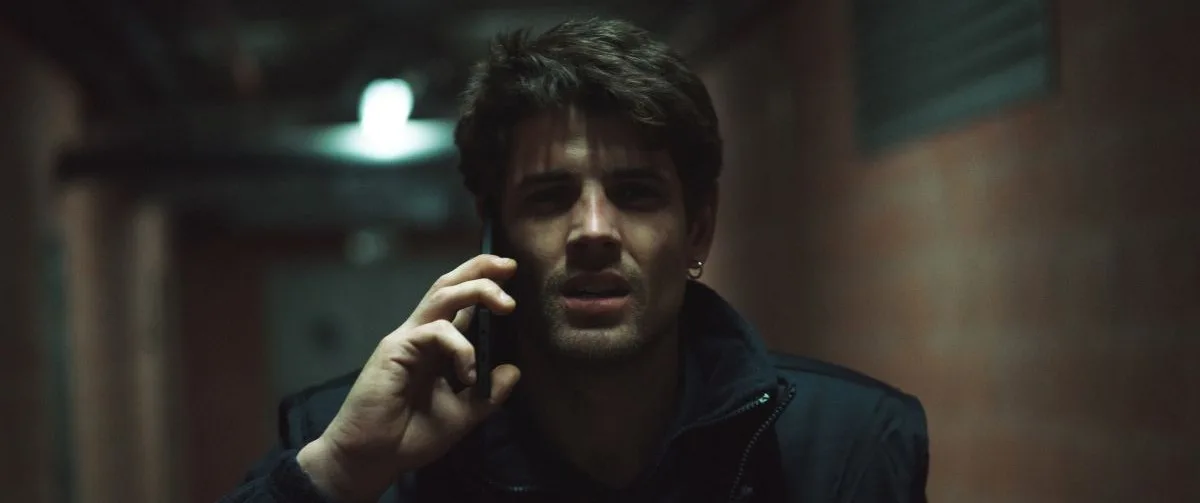
There’s a particular kind of horror that has nothing to do with monsters. It’s the horror of watching someone you love explain, calmly and without raising his voice, why up is actually down and there’s no point arguing about it. That’s the horror The Truthers is built on, and it took me a solid twenty minutes into Roger Gual’s new Netflix thriller before I understood the film wasn’t going to give me the comfort of a monster to point at, just a father, and a kitchen also a daughter starting to wonder if the man who raised her is capable of something unspeakable.
Ruth is a DJ living in Berlin, which tells you almost everything you need to know before the plot even starts, she built a whole life out of being somewhere else. Stéphanie Magnin plays her not with the shattered grief you’d expect from a homecoming-after-tragedy story, but with a guarded, low-grade exhaustion, the fatigue of someone who left home specifically to avoid this exact conversation and is furious that death has dragged her back into it anyway.
Her mother is gone under circumstances that don’t quite line up, and when Ruth returns to the family house in Asturias, she finds her father Martín, played by Jose Coronado, has spent his retirement falling into conspiracy theory, not the loud, cartoonish kind you see on cable news, a real corkboard in a spare room nobody uses anymore. A man who used to read the whole newspaper now reading only the parts that confirm what he’s already decided is true.
So Ruth comes home to bury her mother and ends up doing something much harder: sitting across the dinner table from her own father, trying to work out whether grief has cracked him or whether he’s hiding something worse.
Coronado is the reason to watch this movie, he plays Martín as a man who’s convinced himself that vigilance is a form of love, which is its own quiet tragedy before you even get to the murder question. There’s a scene at that dinner table I haven’t stopped thinking about, where he corrects Ruth’s memory of something from her childhood, gently, with total confidence, and you genuinely cannot tell whether he’s manipulating her or whether he simply believes it now. Coronado never raises his voice to sell that ambiguity, he just sits there, still, like a house with the lights turned off inside. It’s the best work in the film by a wide margin.
Carlos Montero and Darío Madrona wrote Élite together, and they know how to build a household stuffed with things nobody’s saying out loud. That show ran six seasons on precisely that skill. But a teen soap can dangle a secret for an entire season and get away with it.
A hundred-and-six-minute thriller has to actually spend the secrets it raises, and The Truthers keeps pulling loaded guns off the mantelpiece and setting them back down without firing. A locked room that turns out to hold something almost mundane. A prescription bottle that doesn’t match a diagnosis, mentioned once and never again.
A neighbor who saw something, questioned once, then forgotten. By the third time this happens you stop feeling like you’re solving a mystery and start feeling like you’re being handled by writers stalling for the second act, which is frustrating, because the movie clearly wants to be something quieter and sadder than a whodunit: a story about how grief curdles into suspicion inside a family that had already stopped talking honestly to each other years before anybody died. That’s a genuinely good movie hiding inside this one. It just doesn’t fully commit to being that movie instead of the plottier one.
Fanny Gautier, as Lucía, gets stuck holding most of the exposition, which is a thankless job. Half her scenes exist so someone can say a piece of backstory out loud for Ruth’s benefit, and by extension ours. Alberto Olmo fares better as Arón, mostly because the film seems willing to let him have an inner life instead of just information to deliver. But in spirit this is a two-hander. Every time the camera drifts away from Ruth and Martín circling each other in that damp stone house, the tension goes slack, and you can feel the runtime.
What the house itself is doing, though, is remarkable, and I don’t say that lightly. Asturias in this film is all wet stone and low grey light, and cinematographer Juana Jiménez shoots it the way a good ghost story shoots its haunted location: like the walls have been quietly absorbing this family’s dysfunction for years before Ruth ever walked back through the door.
There’s a long stretch in the middle where I genuinely forgot I was watching a mystery, I was just sitting in the atmosphere of the place, feeling the sense that something in that house had sealed itself shut long before the mother died, and that Ruth’s whole visit is really an autopsy on her own childhood.
Tonally, the film lands closer to melancholy than to menace. It resists turning Martín into a monster. Mostly, it resists turning Ruth into a simple victim of his instability too. What it doesn’t resist is the urge to tidy its ambiguity into a tidy conclusion right at the end, and something real gets lost in that tidying, the ambiguity was the best thing this movie had going for it. The plot mechanics were always the weakest part.
So is it worth your evening. Yes, honestly, but go in wanting a character study wearing a mystery’s clothes, not the reverse, if you need your thrillers to click shut like a well-oiled lock, the back half here will drive you a little crazy, the way it drove me a little crazy, if you’re the kind of viewer who can sit with a story more interested in how a family stops trusting each other than in who actually did what, there’s real feeling in this one, carried almost entirely on Coronado’s shoulders and Magnin’s tired eyes..
The Truthers Parents Guide
Rating: TV-MA (Netflix). Plays closer to an R-rated psychological drama than an action-thriller. Nothing gratuitous, but the atmosphere sits heavy and adult from the opening scene.
Violence & Intensity: No graphic on-screen violence. Nearly all the tension is psychological: suspected murder, a father’s erratic and intimidating behavior, a slow-building fear as a daughter starts to wonder if she’s living with something dangerous. There’s dread throughout rather than action or gore, which can actually feel more unsettling for younger or sensitive viewers than a straightforwardly violent film would.
Language: Strong language appears here and there, in line with an adult drama. Not wall-to-wall profanity, but not a script built for family viewing either.
Sexual Content / Nudity: Minimal to none. The film keeps its energy on family conflict and mystery rather than romance.
Drugs, Alcohol & Smoking: Some social drinking and smoking, consistent with the adult characters and their world. Nothing that plays as a drug-abuse storyline.
Age Recommendation: 16 and up is a reasonable floor, though this really plays best for adults. The subject matter, grief, paranoia, a fractured parent-child relationship, needs some life experience to land properly. Younger teens are more likely to find it slow or confusing than gripping.