Couples Weekend is Rated R by Motion Picture Rating (MPA) for sexual content and language.
I want to talk about the snowstorm. Not as a plot device though that’s what it is, but as a directorial decision, because Nora Kirkpatrick leans on it hard, and it mostly works. Four people in a cabin. Two of them have just been caught in bed together by the two people they were supposed to love most. And then the snow comes down, and nobody’s leaving. It’s the oldest trick in the bottle-episode playbook, and Couples Weekend pulls it off with enough self-awareness to make you forgive the contrivance. For a while, anyway.
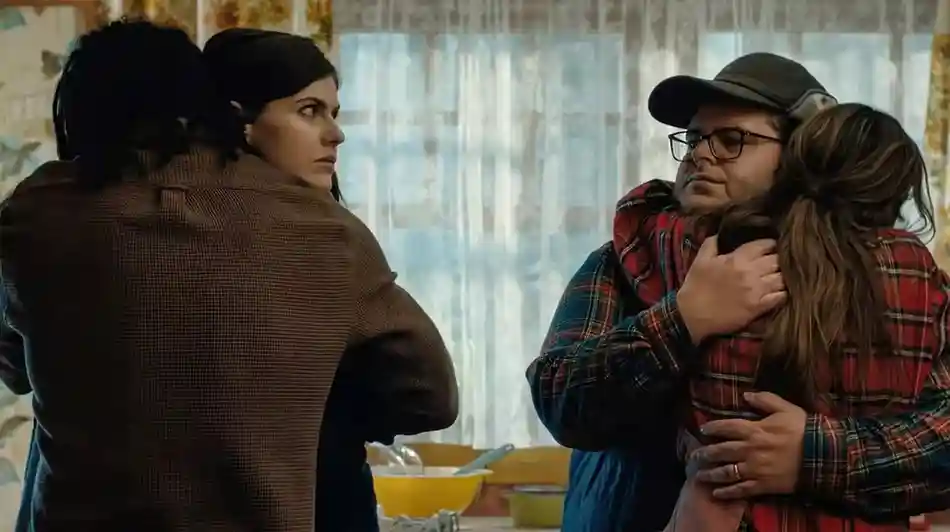
The film opens with a bit of philosophy George Berkeley’s old tree-falling-in-a-forest question, which the screenplay uses to frame its central wound: if an affair happens and the wronged parties never find out, does the betrayal still exist? Mitch (Josh Gad) and Debs (Alexandra Daddario) are lifelong friends, each married, who come devastatingly close to getting crushed by a falling tree on a morning hike. They return to the cabin shaky and alive and grateful, and what they find waiting for them is almost worse than the tree. Their spouses, Josh (Daveed Diggs) and Melanie (Ashley Park), in bed. Together. This is the film’s inciting event, and it’s blunt and ugly in exactly the way it needs to be.
Recommended: All That We Love (2025) Parents Guide
What follows for the first half, at least is genuinely good. The four characters circle each other like animals who’ve forgotten how to trust the room, and Kirkpatrick’s dialogue has this lovely, barbed quality where every sentence lands a half-inch to the left of where you expect it. Nobody makes a speech. Nobody says the obvious thing. People deflect and snap and occasionally say something so accurate it cuts like glass. I watched these early scenes with real pleasure the kind you feel when a movie is doing exactly what it promised and doing it well.
“Gad doesn’t mug. He doesn’t reach for the easy laugh. He just stays in the moment and lets the comedy find him which is a harder skill than it sounds.”
Gad is the engine here. His Mitch is a man for whom stillness is physically impossible under ordinary circumstances, let alone these ones, and Gad plays that with a precision that keeps surprising you. There’s a scene where he’s alone in the kitchen trying to process what he saw — and he doesn’t cry, doesn’t monologue, doesn’t break anything. He just stands there, opens the fridge, stares into it like it might have an answer, and closes it again. It’s ten seconds of screen time. I haven’t stopped thinking about it. That’s the whole character, right there.
Daddario does solid work too, though her Debs is drawn thinner. The script gives her the more interior wound the slower, quieter devastation and Daddario handles it honestly. The problem is that the film keeps insisting she and Gad have a thirty-year friendship, and I never quite felt it. Their scenes together don’t vibrate the way they should. The warmth between them feels indicated rather than lived-in, which matters because the whole architecture of the ending rests on you believing in this friendship. When the emotional payoff comes, it lands a little short.
Recommended: I Love LA (2025) Parents Guide
Somewhere in the second act, the film loses its footing. The conversations, so sharp at first, start repeating themselves not in the way that real arguments repeat themselves, with each loop escalating or revealing something new, but in the way that suggests the screenplay hit a wall and decided to keep talking anyway. The same grievances resurface. The same accusations. The same counter-accusations. You start to feel the script’s anxiety, its uncertainty about where to take things next.
And then and I’m still a little baffled by this Mitch discovers a bottle of ancient mystery liquor in the cabin basement, and all four characters drink it, and the film goes somewhere profoundly strange and not in a good way. What follows is a long, shapeless psychedelic sequence that’s played as comedy and lands as neither funny nor illuminating. It doesn’t reveal character. It doesn’t advance the drama. It just happens, and it keeps happening, and the entire momentum the film spent its first hour building bleeds out quietly onto the floor. I don’t know what Kirkpatrick was going for. I’m not sure she did either.
Recommending: Love Is Blind Season 9 Parents Guide
The final stretch recovers. The humor pulls back, the characters stop performing their pain and start actually sitting in it, and the film remembers that its best instincts were always the quieter ones. The themes that matter the way resentment calcifies over years, the way a long relationship can sand you down to something you don’t quite recognize these get their moment. It’s enough to leave you wishing the rest of the film had trusted those instincts earlier and more often.
Couples Weekend is a frustrating watch in the specific way that only almost-good films are frustrating. It’s not a bad film it’s a film that keeps interrupting its own best scenes. Kirkpatrick has a voice. Her cast, Gad especially, deserves a tighter edit and a screenplay that commits. There’s a genuinely sharp movie somewhere inside this one. It keeps almost getting out.
Couples Weekend Parents Guide
Violence & Intensity: Mild: No physical violence. Emotional confrontations are raw and sustained — the discovery of infidelity and its fallout is depicted with genuine weight. Some scenes may be distressing for viewers with personal experience of betrayal or relationship breakdown.
Language: Moderate: Strong language throughout, particularly during arguments. Profanity is consistent with the film’s adult dramatic tone. No slurs. Dialogue is often cutting and emotionally pointed.
Sexual Content Moderate: Infidelity is the film’s central premise. Two characters are discovered in bed together; the scene isn’t explicit but its implication is unmistakable. Sexual themes — desire, neglect, intimacy, run throughout the dialogue without graphic depiction.
Drugs, Alcohol & Smoking Notable: A lengthy and prominent sequence depicts all four main characters consuming an unknown substance that produces a psychedelic episode. Alcohol is used throughout as a social habit and emotional crutch. The substance use is played for comedy and carries no meaningful consequence within the film.
Recommended for ages 15 and up Adult themes of infidelity, identity erosion in long-term relationships, and prolonged substance use make this unsuitable for younger viewers. The comedic framing doesn’t blunt the maturity of the subject matter. Parental discretion advised for viewers under 17.
