The first thing that came to mind when Ted Levine appeared on screen with a knife in his hand wasn’t fear. It was recognition. A strange, almost guilty recognition. Cinema has a long memory, and so do we. You don’t cast the man who once whispered his way through The Silence of the Lambs and expect us not to feel a chill when he leans over something lifeless and starts to cut. The show knows that. It leans into it. Not loudly, not with a wink, but with the quiet confidence of something that understands how images echo across time.
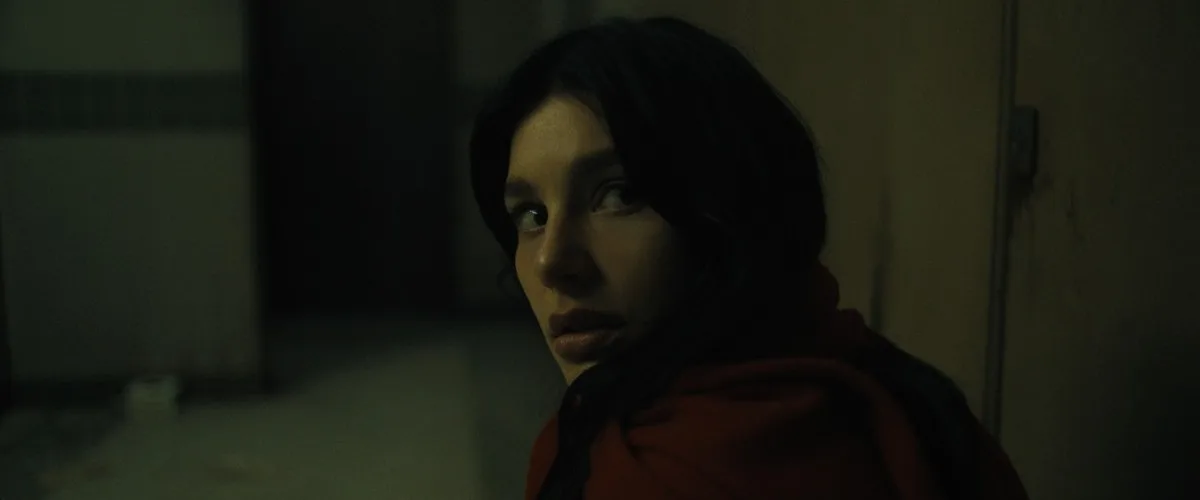
“Something Very Bad is Going to Happen” doesn’t announce its intentions so much as it breathes them into your ear. The dread arrives early and never quite leaves, like waking up too soon from a nightmare and realizing you’re still inside it. There’s a grayness to everything light that never fully commits to being daylight, shadows that feel patient. You could pause almost any frame and swear it’s holding something back.
A lot of that comes from the careful orchestration behind the camera. With Haley Z. Boston steering the ship, and the Duffer Brothers lending their instinct for unease, the series feels constructed rather than assembled. Veronica Tofilska directs half the episodes with an eye for the kind of stillness that makes you lean forward instead of relax. Even the quiet scenes hum. Especially the quiet scenes.
Recommended: The Faithful: Women of the Bible Parents Guide
At the center of it all is Camila Morrone, and she doesn’t waste the opportunity. I kept thinking about how easily this role could’ve collapsed into attitude tattoos, sarcasm, the casual defiance of someone who lights up whenever she feels like it, but Morrone builds Rachel from somewhere deeper. There’s a quickness to her, a mind that’s always working a beat ahead of everyone else in the room. It’s not just intelligence; it’s survival. You get the sense she learned early on how to read danger before it announced itself.
She’s engaged to Nicky, played by Adam DiMarco, who brings a kind of soft-spoken decency that never quite settles into trust. If you’ve seen him in The White Lotus, you’ll recognize that same polite uncertainty, the sense that he wants to be a good man but hasn’t entirely figured out what that requires. There’s something slippery there. Not villainous, exactly. Just… unsteady.
They drive together into the kind of place horror stories love: a wealthy family compound tucked deep in winter woods, isolated enough that leaving feels like a decision instead of an option. Rachel senses it immediately. The air’s wrong. The people are worse.
And what a collection of people.
Jennifer Jason Leigh moves through the house as if she belonged to it more than the others, as if she might dissolve into the walls if she stood still long enough. Ted Levine, gruff and simmering, carries himself like a man permanently interrupted. The rest of the family fills out the edges in ways that never feel decorative. Even the child, because there’s always a child, lands exactly where you expect and still manages to unsettle.
There’s a moment, early on, when you start thinking Rachel should just leave. Get in the car. Don’t look back. Of course, she doesn’t. Stories like this depend on that one fatal decision to stay, to believe, to push through discomfort in the name of love or obligation or curiosity. The show doesn’t argue with that instinct; it studies it. Turns it over. Wonders why we ignore the obvious when it matters most.
Recommended: Mike & Nick & Nick & Alice Parents Guide
What unfolds over the course of the week leading to the wedding isn’t chaos so much as accumulation. Strange looks. Offhand comments. Small violations of normal behavior that pile up until normal itself starts to feel like an illusion. The ticking countdown to “I do” becomes less romantic with each passing day. Time doesn’t build anticipation here. It builds pressure.
There’s an episode that dips into old home video footage, grainy, late-90s recordings that feel too intimate to watch comfortably. It’s one of the few times the show explains anything directly, and even then, it leaves enough unsaid to linger. I found myself replaying those images later, trying to decide what they revealed and what they deliberately kept hidden.
Music drifts in and out like a memory you can’t quite place. Paul Anka’s “You Are My Destiny” plays less like a love song and more like a question. Destiny, according to whom? And at what cost? Even the more familiar tracks feel slightly off, as if they’ve been chosen not for comfort but for contrast.
Visually, the show occasionally slips into something more experimental. There’s a sequence that adopts a perspective not entirely human, recalling the uneasy point-of-view work in Fallen. It doesn’t overuse the trick. Just enough to make you aware that whatever’s happening here isn’t confined to what the characters understand.
But for all its style and there’s plenty of it the series keeps returning to a simpler, more unsettling question: how well do we really know the person we’ve decided to spend our life with? It’s easy to say “forever” when the room is warm, the lights are soft, and everyone’s behaving. It’s harder when the walls start to close in, and the people smiling at you seem to know something you don’t.
Morrone carries that tension beautifully. She plays Rachel as someone caught between instinct and commitment, between the part of her that wants to run and the part that needs to believe she’s chosen correctly. Love doesn’t blind her. It complicates her. That’s more interesting.
By the time the story edges toward its final moments, the title stops feeling like a warning and starts to feel like a promise that was always going to be kept. Not loudly. Not cleanly. Just… inevitably.
And what stays with you isn’t any single shock or reveal. It’s the quieter realization that sometimes the worst thing isn’t what happens to you.
It’s what you agreed to before you understood what it meant.
There’s a moment early on when someone gets hurt, and the reaction isn’t shock—it’s confusion, panic, a kind of disbelief that quickly curdles into something uglier. That’s the tone the series sets and rarely lets go of. The violence here isn’t constant, but when it arrives, it feels invasive. Personal. Knives are used. Blood is shown. There are scenes involving dead bodies and at least one sequence of skinning that’s hard to shake, made more unsettling by how calmly it’s handled. The show prefers dread over chaos, but when it crosses the line into brutality, it doesn’t soften the blow.
Something Very Bad Is Going to Happen
People talk the way they do when they’re stressed, angry, or trying to cover something up, meaning the language can get sharp. There’s frequent profanity, including strong language used in moments of fear and confrontation. It never feels decorative. It comes out because the situation demands it, and that makes it land harder.
Sexual content isn’t the focus, but it exists in the margins of a story built around a relationship heading toward marriage. There are suggestive moments, some intimate behavior, and references to sex, though nothing especially graphic. Nudity, if present, is brief and not lingered on, but the emotional undercurrent of these scenes can feel heavier than what’s shown.
Substance use is woven into Rachel’s character. She smokes marijuana casually, sometimes as a way to steady herself, sometimes just because she can. Alcohol flows in social settings—family dinners, tense gatherings, but it’s less about excess and more about what people reveal when their guard slips.
As for age, this isn’t something you casually put on for a younger viewer. The series deals in psychological unease as much as physical danger, and it assumes a level of emotional maturity to process both. Older teens might handle it, depending on their tolerance for slow-building dread and sudden violence, but it’s clearly aimed at adults who can sit with discomfort rather than look away from it.
