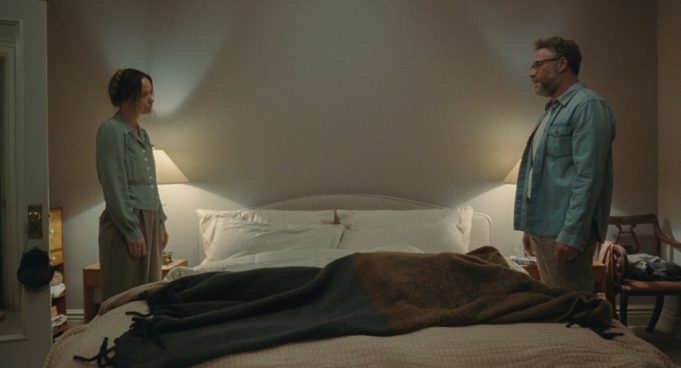
There’s a particular kind of silence that happens after a couple has just been overheard fighting the silence of two people trying to look like they weren’t seconds ago screaming about grout. Olivia Wilde’s “The Invite” opens its dinner party literally on the other side of that silence: Piña and Hawk, the impossibly comfortable upstairs neighbors, standing at the door, wondering aloud whether tonight is still a good night to come down. It is not a good night, It hasn’t been a good night in years, That’s rather the point.
I kept thinking, watching this film, about how rarely American comedies let a marriage look genuinely tired without turning it into either tragedy or slapstick. “The Invite” threads that needle for long stretches, and when it works which is often it’s because Wilde and her actors understand that contempt between spouses has a rhythm, almost a choreography. Joe and Angela know exactly where the soft tissue is. They go for it anyway.
Seth Rogen plays Joe, a former indie musician who peaked once, a long time ago, and now teaches middle-schoolers to scrape through their instruments with the enthusiasm of a man watching his own eulogy get written in real time. It’s a performance built almost entirely out of deflation the loud, easy Rogen persona we’ve watched for two decades has curdled here into something quieter and sadder, a guy who still tells jokes because the jokes are the only load-bearing wall left in the house.
There’s a scene midway through, after Joe gets hurt in a moment I won’t spoil, where he’s reduced to groaning and cursing from the floor, utterly humiliated and utterly unable to stop narrating his own humiliation, and it’s the funniest and most nakedly sad thing in the movie. Physical comedy this precise usually needs a stunt double’s timing and a great actor’s shame. Rogen has both.
Wilde directs herself as Angela, a woman who gave up an art degree for a life of tasteful renovations, and who has invited the upstairs neighbors partly out of curiosity and partly as an act of quiet aggression against a husband who barely registered the plan existed. Wilde the director serves Wilde the actor well she’s not vain about the character, doesn’t soften Angela’s pettiness or her hunger, and the scenes between her and Rogen have the compressed, specific bitterness of two people who’ve had the same argument in fourteen different outfits.
And then there’s Penélope Cruz, who arrives as Piña with the kind of ease that makes everyone else’s tension look like a symptom. Piña is a psychotherapist and self-described sexologist, which on paper reads like the setup for a cheap continental-seductress joke, the sort of role that exists to make American characters feel uptight by comparison.
Cruz simply refuses to play it that way. She lets Piña be amused rather than predatory, curious rather than superior, and by the film’s midpoint she’s become the only person at the table nobody gets to mock including, crucially, the film itself.
Edward Norton, as her partner Hawk, has less to chew on, but there’s a nice, loose confidence to him, a man who’s made peace with living exactly the life he wants and finds the other couple’s misery almost touching, the way you might feel for a dog barking at its own reflection.
The premise, lifted from Cesc Gay’s Spanish film “The People Upstairs,” is a chamber piece by design one apartment, one night, four people circling a question that the movie is admirably direct about: whether Joe and Angela’s marriage can survive being shown, in explicit detail, an alternative to itself. The film’s frankest passages are conversational rather than visual, long exchanges about open relationships and desire dressed up as dinner-party small talk, and there’s real nerve in how unashamed the writing is about wanting to talk about sex as if it were simply a subject, not a taboo requiring a wink.
Where the film stumbles, and it does stumble, is in its own nerves about its style. The first act is shot and scored like it’s terrified you might miss that something Meaningful is happening the cello work claws at scenes that would land harder in silence, and Wilde occasionally directs like she’s still making the movie that follows “Booksmart,” all quick cuts and hyperactive camera moves, before the film seems to remember it’s actually a two-hander in a living room and settles down. When it settles, it’s very good. When it doesn’t, you can feel the seams.
There’s a moment in the back half I haven’t stopped turning over: after all the dangerous, funny, honest talk of the evening, “The Invite” pulls back from where it’s clearly capable of going. It flirts with real transgression and then, gently, tastefully, declines the invitation of its own title. I understand the impulse there’s something moving in a marriage choosing itself, deliberately, with open eyes, rather than being blown up for the sake of a third-act twist.
But I couldn’t shake the feeling that the movie had spent ninety minutes building a case for danger and then handed us safety instead, like a chef who spends the whole meal describing a dish he never actually serves.
Still. A comedy this interested in the actual texture of a long marriage the score-keeping, the resentment that masquerades as banter, the way people who’ve stopped desiring each other can still desire being desired is rare enough that I’ll forgive it for flinching at the end. Rogen and Wilde are terrific opposite each other, prickly and exact, and Cruz gives what might be the best supporting turn of her year.
It’s a film that earns most of its ambitions and loses its nerve at exactly the moment it needed to keep it. A little Wilder, as somebody else already put it, and better for it. As is, it’s a sharp, funny, occasionally too-loud evening that mostly deserves your company.
Parental Guidance
Rating: R (MPAA) — for sexual material, language throughout, and drug use
Violence & Intensity: Minimal physical violence. One character suffers an injury played largely for dark physical comedy rather than horror, involving pain, groaning, and immobility. The real intensity comes from emotionally charged marital arguments raised voices, cutting insults, and confrontational dialogue that some viewers may find more upsetting than any action-movie violence.
Language: Frequent and strong profanity throughout, including repeated use of the F-word in both angry and comedic contexts. No slurs reported. The tone leans harsh and blunt during arguments, sardonic and crude during comedic beats.
Sexual Content / Nudity: Extensive and explicit sexual dialogue open relationships, group sex, and specific sexual practices are discussed candidly and at length. Most of this is verbal rather than visual, though the film includes sensuality and suggestive content. This is a talk-heavy film about sex rather than an explicit visual one, but the conversations are frank enough that discretion is warranted.
Drugs, Alcohol & Smoking: Characters drink wine steadily throughout the dinner-party setting, and there are references to and depiction of drug use during the evening.
Age Recommendations: Firmly adult viewing. Not appropriate for children or younger teens, older teens (16–17) could watch with a parent present given the mature themes, but the film is really made for and about adults navigating long-term relationships.
