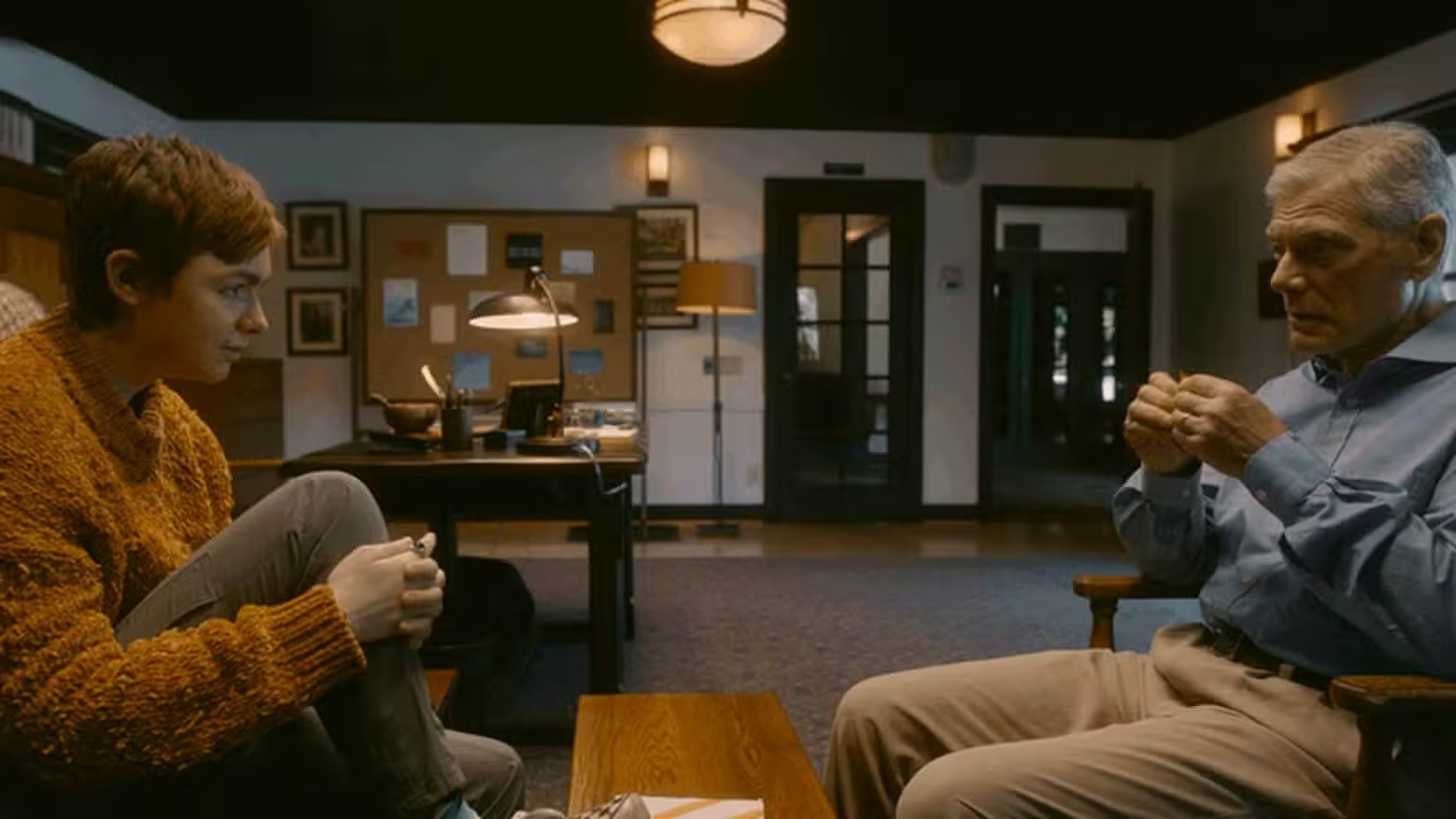
It’s a testament to Stephen Lang’s range that in The Optimist, we readily accept him as a tall but otherwise ordinary elderly man. That’s quite a shift from the imposing physical presence he brought to films like Avatar and Don’t Breathe, where he seemed capable of carrying a refrigerator up the stairs without breaking a sweat. Here he plays Herbert Heller, a Czechoslovakian-American Jew who, after receiving a terminal cancer diagnosis, decides it’s finally time to recount the long and painful journey that took him out of Nazi-occupied Czechoslovakia. The story includes moments of terror, guilt, and humiliation that he has kept buried for decades.
Herbert was a real person, a clothing store owner in San Rafael, California, who spent years speaking with school groups and history enthusiasts about what he endured during the war. Before he died in 2021 at the age of 92, he asked writer-director Finn Taylor to adapt his experiences for the screen. Lang doesn’t appear to have drastically altered his physique for the role, but his performance sells the illusion anyway. His posture and movements suggest a man who still carries himself like someone decades younger but occasionally has to stop and remind his body of its limits. When Herbert strides across a room and then pauses to gather himself, there’s a faint sense that the world might tilt under his feet. The accent is convincing, too: the sound of someone raised in Eastern Europe who moved to America as a teenager and never quite shed the old rhythms of speech.
Lang’s work is one of two things the film gets completely right. The other is Elsie Fisher as Abby. Abby is in rehab after a drug-related tragedy, living under the watchful eye of counselor Ruth (Robin Weigert). Ruth happens to be recording interviews with Holocaust survivors as a side project and recruits Abby to help with the process. She pairs the young woman with Herbert on camera, partly to help guide the conversation and partly to give him someone he might feel comfortable confiding in. Eventually, Abby opens up as well, revealing the mistake that led her to rehab: after uncovering painful truths about her father, she made a reckless choice that resulted in the death of someone she loved, a free-spirited young woman named Sabrina (Ursula Parker).
Recommended: The Bride (2026) Parents Guide
Fisher may only be 23, but she already works with the confidence of someone who has spent most of her life in front of cameras. She first voiced Agnes in Despicable Me at the age of eight and has continued in the role ever since, while also taking on prominent parts in projects like Eighth Grade and the series Barry and Castle Rock. In The Optimist, she captures the hesitant body language of someone who has spent years being pushed to the margins. Abby struggles to meet anyone’s gaze, even her own reflection, but there’s a quiet resilience simmering beneath the surface that she barely recognizes in herself. Fisher taps into a very specific kind of sadness: the sort carried by slight, soft-spoken young people who are bright enough to irritate insecure bullies yet too straightforward to outmaneuver them. Watching her performance, you immediately feel like you’ve met someone like Abby before.
Even with Lang and Fisher doing such careful work, The Optimist struggles to overcome its clumsy storytelling. The film has so many lessons and revelations it wants to deliver that it rarely slows down long enough to let the drama breathe. Its nonlinear structure only adds to the problem. Scenes from different time periods, Herbert in the mid-2000s, Abby’s recent past, and Herbert’s wartime experiences in Czechoslovakia, followed by his life as a displaced immigrant in the United States, are constantly intercut, giving the impression that several separate movies have been sliced apart and rearranged into a single 95-minute patchwork.
It’s hard not to suspect that this structure might have been imposed in the editing room to shrink what could otherwise have been a sprawling three-hour film. Whatever the reasoning, the frequent leaps between timelines often undermine the emotional momentum. Just when a scene begins building toward something meaningful, the film abruptly jumps somewhere else. Moments that should feel intimate and sustained instead come across as interrupted conversations.
That’s particularly frustrating because Lang and Fisher are so compelling together. A version of this story that let the two characters sit and talk, almost like a stage play, might have been mesmerizing. Another approach could have focused entirely on Herbert’s wartime ordeal, or solely on Abby’s unraveling. Instead, the film keeps juggling these different threads and tones without quite finding a rhythm that allows them to coexist smoothly.
Recommended: In the Blink of an Eye (2026) Parents Guide
One recurring problem is the way the film handles storytelling within the story. Herbert or Abby will begin describing a painful memory, drawing us in with a careful buildup and then, just as the actors have us hooked, the movie cuts away to a dramatized flashback. At other times, we’re immersed in the past only to be pulled back into the present at the exact moment we’d rather stay where we are. The effect is less like a flowing narrative and more like someone repeatedly changing the channel.
Still, for all its structural missteps, there’s never a sense that the film is cynical or careless. Every scene feels earnestly made, and the actors approach the material with complete sincerity. Now and then, the movie even achieves something quietly hypnotic. There are brief passages where the storytelling slips into that peculiar cinematic trance when you stop noticing the passage of time and simply drift along with the images.
The most memorable of these sequences follows a young Herbert returning to Prague after escaping his pursuers. The city he once knew has been warped by Nazi occupation, its streets scarred, and many of its residents reduced to fearful collaborators. The scene unfolds through fragments of action and observation, accompanied rather unexpectedly by Jeff Tweedy’s song Love Is the King. Pairing imagery from the 1940s with an alternative rock track released in 2020 sounds like an idea that should collapse under its own weight, yet the combination works beautifully. Moments like this hint at the film The Optimist might have been if its storytelling had been more confident.
In the end, the film is undeniably messy, but it’s also deeply heartfelt. And sometimes that sincerity is enough to carry you through the rough patches.
The Optimist: The Bravest Act Is Truth Parents Guide
The Optimist (sometimes promoted as “The Bravest Act Is Truth”) is not rated by the Motion Picture Association(MPA). Even so, the film’s tone and subject matter make it clear that it’s aimed primarily at mature teens and adults. It deals with the emotional aftermath of war, trauma, addiction, and guilt, often through conversation rather than graphic imagery, but the themes themselves can be heavy.
Violence & Intensity: The film contains scenes connected to the Holocaust and life under Nazi occupation. While it doesn’t rely on graphic violence, the subject matter itself is disturbing. Flashbacks depict persecution, fear, and the moral collapse of people living under Nazi rule. Some moments involve implied brutality and emotional distress rather than explicit gore. The intensity comes more from the historical reality and the characters’ memories than from on-screen action, but younger viewers may still find the themes upsetting.
Language and profanity: The dialogue is generally restrained, reflecting the film’s reflective and somber tone. Mild profanity appears occasionally, mostly in moments of frustration or emotional confession. Because the story deals with antisemitism and wartime prejudice, references to hateful ideology and language may appear in context, though the film does not linger on them gratuitously.
Sexual Content / Nudity: Sexual content is minimal. There are references to relationships and emotional intimacy, particularly when Abby discusses the young woman she loved, but nothing explicit is shown. The film avoids nudity and graphic sexual situations, keeping its focus on emotional consequences rather than physical depiction.
Drugs, Alcohol & Smoking: Substance abuse is part of the story. Abby is in rehab following a drug-related tragedy, and her past behavior includes drug use that contributed to a fatal mistake. These elements are discussed openly but without sensationalism. Alcohol and smoking may appear briefly in background or character scenes, though they are not a major focus.
Age Recommendations: Because of its mature historical themes, discussions of addiction, and emotionally heavy subject matter, the film is best suited for older teens (around 14–16+) and adults. Younger viewers may struggle with the emotional weight and the historical context surrounding the Holocaust. For families willing to engage in conversation afterward, however, the film can serve as a thoughtful starting point for discussions about history, guilt, resilience, and the difficult act of telling the truth.
