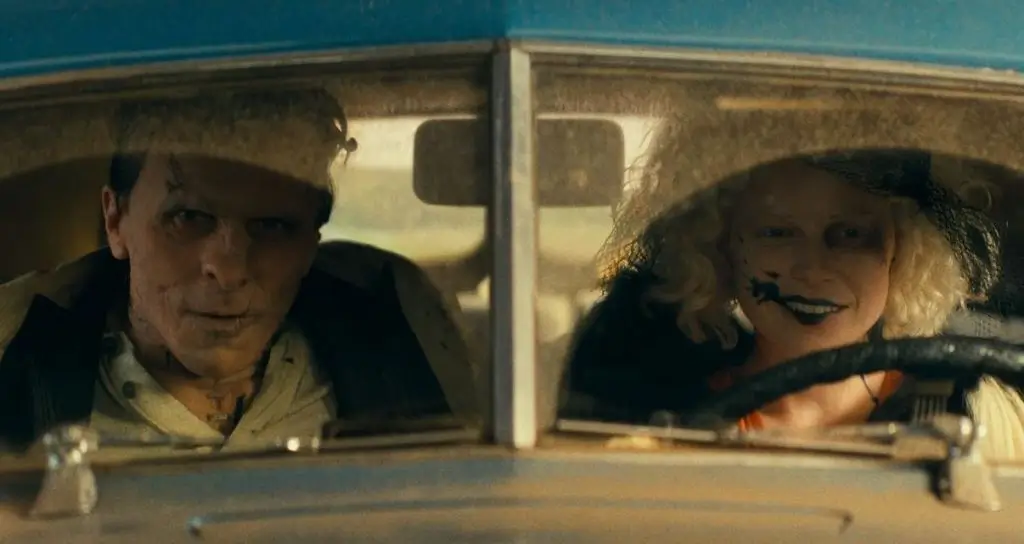
With her second outing behind the camera, Maggie Gyllenhaal makes a dramatic leap in scale. After the intimate, quietly unsettling world of The Lost Daughter, she pivots toward something much larger and far stranger with The Bride. The shift isn’t subtle. Armed with a sizable budget and a screenplay of her own, Gyllenhaal attempts nothing less than a full reimagining of the classic Bride of Frankenstein mythology. Hovering over the project is the spectral presence of Mary Shelley, as well as a palpable love for old movie magic itself. The ambition is clear: to reshape this familiar monster story into something unruly, anarchic, and deeply personal, a twisted meditation on love, power, and female autonomy.
You can admire the audacity even when the execution falters. And falter it does. “The Bride” lunges boldly toward a wild tonal landscape, crafting characters that feel half-operatic, half-delirious. Gyllenhaal seems intent on transforming the monster narrative into an allegory about feminism and warped empowerment. It’s a fascinating idea on paper. Yet watching the film unfold can feel like sitting through an endurance exercise. The director often appears less interested in building a coherent story than in letting the film drift through waves of performance and spectacle. Actors are given enormous space to roam, and many of them seize that freedom with gusto, sometimes to the point where the movie begins to resemble an unrestrained acting workshop.
Recommended: Send Help (2026) Parents Guide
The story begins in 1936 Chicago, where Ida, played with ferocious energy by Jessie Buckley, exists on the margins of the criminal world as the girlfriend of a gangster. She lives under the thumb of powerful men, particularly the city’s crime boss, Lupino, portrayed by Zlatko Buric. Ida’s life is defined by submission, the sort of quiet degradation that accumulates until something inside finally snaps. One evening, that rupture arrives. During an emotional breakdown, Ida appears to become possessed by the spirit of Mary Shelley herself, also played by Buckley, splintering her personality as she lashes out against the patriarchal control that has shaped her existence.
Her rebellion doesn’t last long. In a grim act of punishment, Ida is killed for stepping out of line.
Elsewhere in this strange universe is Frank, portrayed by Christian Bale. Frank has been alive for more than a century, wandering through the world like a relic of an earlier horror story. What he wants now is something painfully human: companionship, intimacy, what he bluntly describes as intercourse. To achieve that, he turns to Dr. Cornelia, played by Annette Bening, asking her to help create a partner for him. Their solution is as grotesque as you might expect. They exhume Ida’s body and bring her back to life.
But resurrection doesn’t mean obedience. Far from it.
When Ida returns to the world, she carries fragments of conflicting identities inside her. The obedient woman she once was has vanished. In her place is someone driven by curiosity, hunger, and a restless urge to experience life on her own terms. Frank may imagine her as a companion, but Ida has no interest in fulfilling anyone else’s expectations.
The pair drifts into the city together, navigating this uneasy partnership. Trouble inevitably follows. When two men attempt to sexually assault Ida, Frank responds with lethal violence, killing them both. Suddenly, the pair are fugitives, leaving behind a growing trail of bodies.
Their pursuers arrive in the form of Detective Jake, played by Peter Sarsgaard, and his secretary Myrna, portrayed by Penelope Cruz. The two attempt to untangle the bizarre crimes spreading across the city before the situation spirals even further out of control.
Before any of that chaos unfolds, however, the film introduces us directly to Mary Shelley. She’s the first figure we encounter onscreen a restless, swirling mind brimming with thoughts, confessions, and stray fragments of storytelling. She addresses the audience almost conspiratorially, describing this tale as a kind of “love story” she must expel from her imagination, as though it were a creative tumor demanding removal. From there, the film slides into Ida’s final moments as a living woman.
It’s a striking introduction. Ida’s outburst in a restaurant becomes a fierce rejection of the objectification she’s endured, and that rebellion opens the door for Shelley’s spirit to inhabit her. Unfortunately for Ida, the predatory men surrounding her respond with deadly force. Her murder is shockingly abrupt a harsh opening note that forces Gyllenhaal to juggle conflicting tones from the start. Death, grotesque humor, camp theatrics, they’re all swirling together here.
Soon enough, the story pivots toward Frank and his peculiar existence. His loneliness is palpable, and his repression oddly poignant. Dr. Cornelia’s mad-science intervention resurrects Ida, leaving her body marked with dark chemical stains and fragments of forgotten memory. The result is a woman reborn into chaos, her psyche split between past and present, sanity and something much wilder. For Frank, this unpredictability is oddly enchanting.
From there, “The Bride” mostly trails behind Frank and Ida as they attempt to navigate their strange circumstances. Frank reveals an unexpected obsession with cinema, particularly a movie star named Ronnie, played by Jake Gyllenhaal. He spends long stretches sitting in darkened theaters, watching Ronnie on screen and absorbing the dreamlike possibilities of movie fantasies he himself will never quite inhabit.
Recommended: Mercy 2026 Parents Guide
Ida, meanwhile, erupts into chaos. She dances, shouts, wanders through the world as though discovering existence for the first time. Gyllenhaal clearly delights in this volatility. The camera lingers on Ida’s bursts of expression, her inability to control the competing voices in her mind. You can sense a more introspective film lurking here a story about fractured identity and rebirth. But that thread never fully takes hold.
Instead, the movie seems more interested in tossing its monstrous protagonists into increasingly strange encounters with the outside world. When others discover what they are, horror follows. Occasionally, we return to Detective Jake and Myrna, though their scenes generate a curious kind of stiffness. It’s almost startling how mismatched Sarsgaard and Cruz feel together, their dialogue exchanges landing awkwardly rather than playfully. Myrna’s storyline circles back to familiar territory: the frustration of being a brilliant woman dismissed by men who underestimate her.
Across the film, the performances become a spectacle in themselves. Both Buckley and Bale are famously fearless actors, capable of devouring scenery when given the chance. Here, they are granted plenty of opportunity. Gyllenhaal rarely reins them in. Instead, she encourages the grandest possible expressions of their characters, leaning heavily into theatricality.
At first, the energy is intriguing. Eventually, it grows exhausting.
The director seems far less interested in grounding these performances within a sturdy dramatic framework. Real narrative momentum doesn’t truly appear until the final act, when Ida’s fragile memory begins to threaten everyone involved. Until then, the film wanders through stretches of stylistic showmanship. One particularly eyebrow-raising moment arrives when Frank hears the song “Puttin’ on the Ritz” and suddenly feels compelled to dance on a crowded floor, a wink that practically begs the audience to recognize the reference.
It’s the kind of moment that reveals what Gyllenhaal is chasing: something punkish, chaotic, knowingly ridiculous. At the same time, she wants the film to speak seriously about patriarchal oppression and the psychological toll of feminine confinement. The ambition is admirable. The idea of a monster movie doubling as feminist rebellion has genuine potential.
But potential isn’t enough.
“The Bride” ultimately suffers from loose construction and indulgent pacing. Scenes drift on longer than they should. The editing feels slack, as though the film itself can’t quite decide what rhythm it wants. Without stronger discipline, the project’s wild creativity collapses under its own weight.
There’s a fascinating movie buried somewhere inside this experiment a fierce, strange meditation on gender and monstrosity. But the film we’re given feels less like controlled madness and more like chaos without direction. In the end, the sheer permissiveness of it all becomes overwhelming, dragging the entire enterprise down when it should have soared.
The Bride (2026) Parents Guide
Rating: The film is rated R by the Motion Picture Association for strong violence, sexual content, nudity, and language.
Violence & Intensity: Violence appears throughout The Bride, though it’s often delivered with a strange mixture of gothic horror and dark comedy. The film opens with a disturbing moment in which a woman publicly rebels against the men controlling her life and is quickly murdered for her defiance. Her body is later dug up and brought back to life through an experiment that echoes the original Bride of Frankenstein, complete with medical procedures, stitched flesh, and unsettling imagery tied to resurrection.
As the story unfolds, the revived Ida and the monster Frank leave a trail of chaos behind them. There are scenes where Frank violently kills men who attempt to assault Ida, resulting in bloody consequences. Other moments show characters being beaten, attacked, or hunted by authorities as the pair go on the run. While the film sometimes treats these encounters with stylized theatricality, the subject matter, including attempted sexual violence and murder, can feel intense and unsettling.
Language and Profanity: Strong language is used regularly throughout the film. Characters in the criminal underworld speak harshly and often with profanity, particularly in arguments or confrontations. Words meant to demean or belittle women also appear, reflecting the film’s focus on sexism and the rigid power structures of the 1930s setting.
The tone of the dialogue can be sharp and confrontational. Some lines are delivered theatrically or sarcastically, but the film still contains frequent strong language that contributes to its mature rating.
Sexual Content / Nudity: Sexual themes play a significant role in the story. Frank’s desire to find a partner is openly discussed, and his request for a companion is described in blunt terms. The narrative also includes moments where male characters attempt to sexually assault Ida, which leads to violent retaliation. These scenes are unsettling in tone, even if not graphically explicit.
There are also instances of partial nudity connected to Ida’s resurrection and other intimate situations. The film approaches sexuality with a mix of dark humor, horror, and commentary about control and female autonomy. While it isn’t a sexually explicit movie in the traditional sense, the themes are mature and often uncomfortable.
Drugs, Alcohol & Smoking: Because the story takes place in 1930s Chicago, alcohol and smoking are common background details. Characters are frequently shown drinking in bars, nightclubs, or private gatherings, and smoking appears regularly among gangsters and other adults.
Drug use is not a major focus of the narrative, though alcohol consumption is frequent enough to be noticeable throughout the film.
Age Recommendations: Due to its violent moments, sexual themes, nudity, and frequent strong language, The Bride is best suited for older teens and adults. The film also deals with heavy ideas about exploitation, identity, and gender power dynamics that may be difficult for younger viewers to process.
A reasonable guideline would be ages 17 and up, particularly for audiences comfortable with stylized horror and mature thematic material.
Recommended: Return To Silent Hill (2026) Parents Guide
