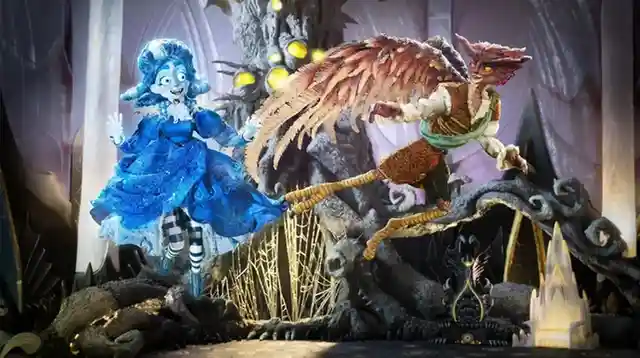
The first time Topus Terrenus appears on screen, I stopped chewing my popcorn. Not as a figure of speech I actually stopped. The nightmare kingdom materializes out of darkness like something pulled from the back of a child’s closet: spires that curl like dried fingers, creatures with too many joints moving in ways that feel anatomically wrong in the best possible sense, fog that seems to have its own agenda.
The Ambriz Brothers built this world by hand literally, frame by frame, puppet by puppet and you can feel the obsessive labor of it. It’s the kind of animated world you want to pause and just live in for a while.
Then a character opens their mouth and starts explaining everything, and the spell cracks.
That’s where I kept losing I Am Frankelda not in the world, which is extraordinary, but in the storytelling, which never figures out how to trust what it has built. The film announces its themes like a student reading an essay aloud. Imagination is powerful. Dark stories have value. Believe in yourself. These are not wrong ideas. They’re just ideas the visuals are already communicating and the script keeps interrupting.
Francisca is the girl at the center of it. She writes horror stories in 19th-century Mexico, gets mocked for it by her grandmother and her peers, and channels her loneliness into fiction dark enough to accidentally power an entire nightmare dimension.
The young prince of that dimension, Herneval, eventually crosses into her world to bring her back with him, because his kingdom is dying its official nightmare-maker is a bureaucratic hack named Procustes, and the whole operation is running on fumes. When Herneval offers Francisca an audience, she takes it immediately. Who wouldn’t.
There’s a genuinely interesting film buried in that setup. The idea of a writer discovering that her darkest, most private imaginings have been feeding something real that the inner life has real weight, real consequence is rich territory. And the wrinkle that Herneval himself was one of her creations, before he became someone she loves, is the kind of psychologically loaded detail that could make a story genuinely strange. The film acknowledges it. Then it mostly sets it aside.
What we get instead occupies a lot of runtime with Procustes maneuvering for control of the kingdom. He steals Francisca’s stories, he undermines her at court, he schemes. And look he’s actually the most interesting character in the movie. Not because he’s frightening, but because he’s recognizable.
He’s a mediocre talent who built a career on the fact that nobody better had shown up yet, and he knows it, and that knowledge has curdled into something mean and desperate. That’s a real human thing. But the movie uses him as a plot mechanism rather than a mirror for Francisca, which is the smarter version of this story.
The romance between Francisca and Herneval should be the emotional engine. The film jumps ten years forward in its second act specifically so their feelings become permissible and I understand the logic, but it doesn’t work. When they finally look at each other as adults, I didn’t feel the history between them. I felt the gap where the history should have been. He exists in the story almost entirely in relation to her journey. She exists in the story mostly in relation to her creative potential. Neither of them quite becomes a person you ache for, which makes the film’s emotional climax land softer than it should.
What kept pulling me back was the craft. There’s a scene where Francisca’s stories physically manifest in Topus Terrenus her handwritten words becoming architecture, becoming weather, becoming creatures with their own weight and logic and it’s the movie at its best, showing rather than telling, letting the animation do the argumentative work. That’s the version of this film I wanted more of. The Ambriz Brothers clearly understand, on a purely visual level, what the story is about. The stop-motion medium itself is the argument: things built carefully, by hand, out of nothing, becoming real.
Del Toro’s influence hangs over everything he worked as an advisor, and you’d know it even if the credits didn’t say so. The design philosophy, the conviction that darkness is a legitimate language for children, the insistence on handmade texture over digital smoothness all of it points in his direction. The references to Nightmare Before Christmas and Coraline are equally present, not as plagiarism but as inheritance, as a film situating itself within a tradition it clearly loves. That’s not a problem. The problem is that the film leans on those forebears a little too comfortably rather than finding its own reason for existing alongside them.
Francisca’s assumption of the name “Frankelda” her literary alter ego, the horror writer she becomes is framed as a transformation, a shedding of the girl who was dismissed. But it didn’t feel like transformation when I watched it. It felt like continuation. She was always this person. Nothing broke. Nothing was sacrificed. And without something breaking, the new name feels like a title given rather than a self remade.
There’s a great film in here, wearing this film like a coat that doesn’t quite fit. Maybe it needed another draft. Maybe it needed someone to take the script and treat it the way the animators treated the puppets disassemble it, rebuild it, make every joint move the way it’s supposed to. The bones are right. The world is magnificent. The heart is willing. It just needed the same patient, meticulous craftsmanship in the writing room that the Ambriz Brothers clearly brought to everything else.
Parental Guidance
Rating: Unrated (Netflix original); content equivalent to PG — best suited for ages 8 and up, parental discretion below that.
Violence & Intensity: Mild to moderate. The film operates in a register of gothic fantasy horror nightmare creatures, dark dungeons, tense confrontations, and an antagonist who imprisons and manipulates the protagonist. There is no blood, no death rendered graphically, and no physical brutality. The intensity is atmospheric rather than visceral, closer in feeling to Coraline or The Nightmare Before Christmas than anything live-action. Children under 7 who are sensitive to monster imagery or dark visual tones may find certain sequences unsettling.
Language: None. The film is clean throughout, no profanity, no slurs, no harsh language of any kind.
Sexual Content / Nudity: None. There is a romantic storyline between the two leads that involves emotional longing and closeness, handled entirely at the level of meaningful glances and implied feeling. No physical contact beyond what a family audience would expect.
Drugs, Alcohol & Smoking: None present or referenced.
Thematic Content for Parents: Worth noting: Francisca is actively discouraged from writing by her grandmother and her community, told her stories are inappropriate or worthless. That dynamic a child’s creativity being suppressed by the adults who are supposed to support her may resonate strongly with sensitive kids, and is worth a conversation afterward.
The film’s central argument, that dark imagination is valid and valuable, is a healthy message but one that some parents may want to contextualize. The nightmare world is framed entirely positively, which is a considered creative choice rather than an oversight.
Age Recommendation: 8 and up without reservations. 6–7 with a parent present, particularly for children sensitive to creature-heavy imagery or stories where adult authority figures are unkind to children. Not recommended unsupervised for children under 5.
