Train Dreams Rated PG-13 by Motion Picture Rating (MPA) for some violence and sexuality.
Train Dreams Review 2025
Clint Bentley’s “Train Dreams” unfolds like a memory half-remembered a story told through fog and light, where each image seems to echo across time. It’s a film about how life and death are stitched together, how progress and ruin ride the same set of rails. The train that unstoppable symbol of the 20th century is both a miracle of connection and a machine of destruction. The tracks that once carved across the American wilderness didn’t just shrink the map; they scarred the land, felling trees that had stood for centuries. Working from Denis Johnson’s slim but aching novella, Bentley and his co-writer Greg Kwedar (Sing Sing) build something quietly monumental a portrait of an ordinary man made extraordinary by grief, guilt, and the soft persistence of memory. Train Dreams becomes less a story than a prayer: to the earth, to time, to the strange beauty of being alive.
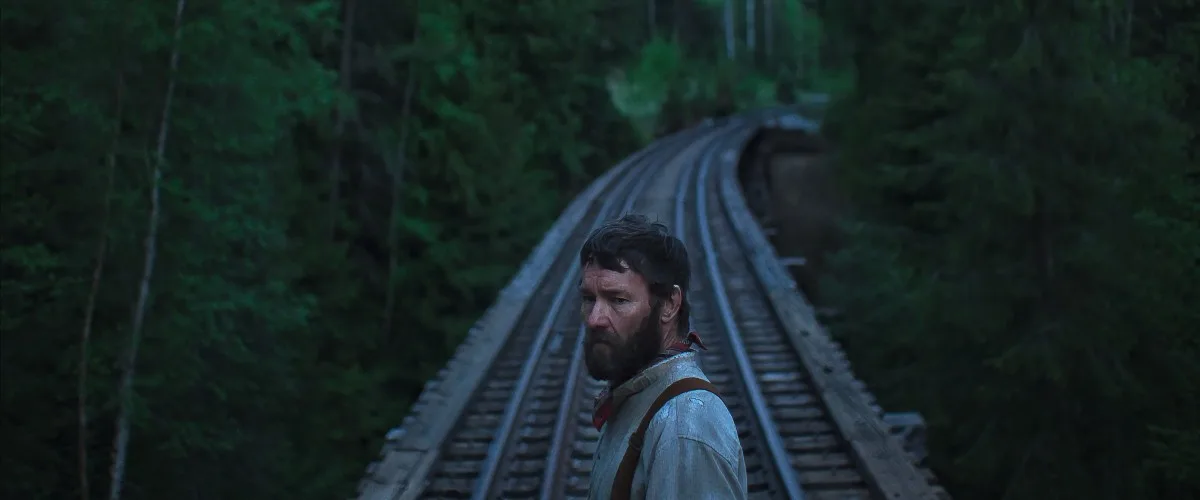
Joel Edgerton delivers what might be the most tender, haunted performance of his career as Robert Grainier, a stoic rail worker who spends his life building the very arteries that change the country. You can see him standing there in the early morning haze cutting trees, hammering spikes, bridging rivers shaping a world that’s forever shifting beneath his boots. For months at a time he’s away from home, one of those anonymous laborers who helped make “progress” possible. Much of his life is told through the voice of Will Patton, whose narration hums like an old radio transmission from the past warm, steady, and filled with a kind of sorrowful wisdom. He speaks for Robert, who rarely does, recounting the memories that form the spine of his story: the men he worked beside, the tragedies that lingered, the choices or silences that he never quite made peace with. One memory in particular gnaws at him: the killing of a Chinese immigrant, a moment when Robert did nothing. That stillness, that failure to act, hangs over everything that follows like a curse.
The film’s opening passages drift by like recollections you can almost touch. The firelight flickers on weathered faces; you can smell the damp wood, the sweat, the smoke curling up into the night. Bentley’s direction blurs dream and realism so fluidly you start to forget which is which. Among the men on the tracks, there’s a charlatan who ends up murdered and an explosives expert played by William H. Macy, who somehow builds a full, three-dimensional life inside a few fleeting scenes. It’s a small role, yet one of Macy’s best a reminder that sometimes a single flicker of humanity can anchor an entire film. His presence steadies Train Dreams just as it threatens to drift too far into the ether.
During a break from his work, Robert meets Gladys, played with quiet radiance by Felicity Jones, and what follows feels lifted straight out of a Malick reverie. The comparison to Days of Heaven is unmistakable lovers silhouetted against an amber sky, their faces soft with wonder, imagining a life yet to come. There’s a scene where they lay stones by the river, sketching out the home they’ll build together. It’s simple, maybe even sentimental, but Bentley lets it breathe you feel their hope as something tactile. They do build that home. They do have a child. And then, in a breath, tragedy comes. The kind that doesn’t just take what you love, but rearranges the shape of your soul.
Bentley, working again with cinematographer Adolpho Veloso (Jockey), captures it all in images that feel born out of memory soft, almost haunted, yet grounded in dirt and bark and fog. The score, by Bryce Dessner of The National, hums with a melancholy grandeur, neither sad nor sentimental but something in between. Early on, Bentley gives us a shot that might as well be the film’s thesis: a pair of boots nailed to a tree, beaten by weather and time until they look fossilized. You can imagine finding them yourself on a long walk that moment when curiosity meets reverence. Who left them there? What story do they carry? It’s a piece of the everyday elevated to myth, which is what Bentley does again and again. He finds the sacred in the ordinary. Life is plain, and yet it’s beautiful.
What’s most striking, though, is how grounded his direction is when it comes to the actors. Many filmmakers chasing poetic transcendence end up losing the human pulse people become symbols, feelings become textures. Bentley resists that temptation. His cast plays truth, not tone. Edgerton, especially, communicates entire inner worlds without a word. Playing a man defined by silence is a trap for many actors, but Edgerton listens really listens to the world around him, and you can see his understanding shift behind his eyes. It’s a masterclass in restraint. Patton’s narration, meanwhile, becomes something more than a storytelling device. In most films, voiceover is a crutch. Here it’s an act of grace. Patton sounds less like a narrator than like a friend remembering a man long gone, choosing his words carefully, like each one might summon the ghost back to life.
Train Dreams is a film of balance or maybe of contradictions that coexist without ever canceling each other out. The world Bentley shows us is both magnificent and merciless. It gives and it takes. It breaks you, then hands you beauty when you least expect it. Late in the film, Kerry Condon appears as a woman Robert meets in his later years, and she says something that lingers long after the credits: “The dead tree is as important as the living one.” It’s the film’s moral, its elegy, its truth. The past doesn’t vanish; it weaves itself into what’s left. We are all part of that tapestry the living and the dead, the dreamers and the forgotten connected like tracks laid across the land. They carry us forward, yes, but they also leave their mark, grooves that will take generations to fade.
If there’s mercy in this world, it lies in remembrance in someone being there to tell your story, or at least to remember that you had one. That’s what Bentley offers Robert Grainier, and by extension, all of us.
Train Dreams (2025) Parents Guide
Violence & Intensity: There are brief scenes of violence related to early 20th-century labor life including an off-screen murder and an accident involving a worksite explosion. None are lingered on or stylized, but they feel emotionally raw. The death of a child (handled with restraint and implied rather than shown) gives the story its emotional center. The tone is more sorrowful than shocking, but sensitive kids may find certain moments distressing.
Language: Very mild overall. A few period-accurate curses (“hell,” “damn,” “bastard”) and some rough, worksite banter between men, but nothing harsh or excessive. No slurs or explicit profanity.
Sexual Content / Nudity: There’s a brief, tender love scene between Robert and his wife, Gladys (Felicity Jones), depicted with emotional intimacy rather than explicitness. Partial nudity is suggested but not shown clearly. The focus is on affection and connection, not eroticism.
Drugs, Alcohol & Smoking: Characters drink whiskey occasionally after long days of work, and smoking is shown throughout, as expected for the historical setting. These moments feel authentic to the period and are never glamorized.
Scary or Disturbing Scenes: Some sequences may feel unsettling for kids or preteens notably the grief scenes after a tragic loss and a few moments where Robert hallucinates or dreams about his past. These aren’t horror-style scares, but the mood can be heavy and somber. The idea of isolation and death hangs over much of the story, though it’s presented with empathy rather than darkness.
Positive Messages / Role Models: Train Dreams is about resilience, humility, and the quiet heroism of ordinary people. Robert isn’t a man of grand gestures he’s someone who endures, learns, and keeps moving forward. The film gently reminds viewers that life’s meaning isn’t in achievements but in the connections we forge and the memories we leave behind. There’s also a strong theme of respect for nature and the passage of time how progress can both create and destroy.
Parental Concerns: Parents should know that the film’s pace is very slow and its themes can feel heavy. It’s not designed to entertain children or even most younger teens it’s more meditative, filled with silence, voiceover, and visual storytelling. The depiction of grief, death, and guilt may be too intense for sensitive audiences, even though it’s handled with delicacy. Nothing is inappropriate; it’s simply emotionally deep.
Filed from the Toronto International Film Festival, September 12. “Train Dreams” opens theatrically November 7, 2025, and arrives on Netflix November 21.
