Long Shadows is Rated R by Motion Picture Rating (MPA) for some violence, bloody images and brief drug use.
There’s a ghost of a good movie inside Long Shadows a version that might have been an introspective Western about trauma, guilt, and the violence of memory. But the film we get, directed without conviction by William Shockley, never finds that heartbeat. Instead, it drifts between tones and half-formed ideas, ending in a twist so unearned it almost feels like a prank. What could have been a taut psychological study collapses into a muddled, emotionally tone-deaf ride through the dust.
Set in the 1890s, Long Shadows opens on an image of a wounded boy named Marcus a stark tableau that promises tragedy and gravity. But almost immediately, the story leaps forward more than a decade, and the promise of that opening fades into confusion. The grown Marcus (Blaine Maye), raised in a mission orphanage since his parents were gunned down by the Warren gang, sets out from his sheltered world with the innocence of someone who’s never seen the West’s true cruelty. He wanders into Tucson looking for a horse, but instead finds Vivian Villerè (Jacqueline Bisset), a brothel madam whose veneer of sophistication hides something rotten. Vivian pairs him with Dulce (Sarah Cortez), a young woman trapped in sex work despite her dream of being a concert pianist. In a rare flicker of decency, Marcus refuses the transaction, buys a scrawny mule, and helps Dulce escape, reuniting her with her sister before he returns to the lonely remains of his family home.
Also Read: Sentimental Value (2025) Parents Guide
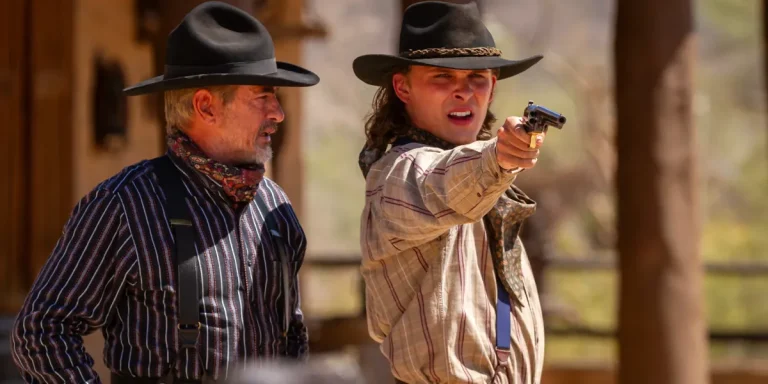
It’s a clean, almost classical setup the kind that could have sustained a quiet, character-driven Western. But Shockley, who co-wrote with Grainger Hines and Shelley Reid, can’t leave simplicity alone. He crowds the story with half-baked subplots: Marcus takes up with Dallas Garrett (Dermot Mulroney), a repentant ex-bank robber who becomes a surrogate father, teaching him to shoot and stoking his thirst for revenge against the Warren gang. Meanwhile, Vivian and her shady partner Ned (Dominic Monaghan) scheme in the background; Marcus’s childhood friend resurfaces with suspicious timing; and a grief-stricken sheriff (played by Hines himself) broods at the edge of the story. You can almost sense the filmmakers straining for a kind of mythic sprawl something like Unforgiven meets The Assassination of Jesse James. But knowing what they’re going for doesn’t make the experience any less of a slog. The film feels less like a tapestry and more like a tangle of threads, each one fraying as you try to follow it.
The same problem infects the editing. Shockley can’t resist the siren call of flashbacks they hit like an involuntary tic, yanking the story back every few minutes. Eventually, we’re told why the film is fractured in this way, and the revelation is meant to be profound. But by the time it arrives, so late and so clumsily, the effect isn’t cathartic it’s wearying. The film doesn’t invite emotion or reflection; it merely explains itself, as though exposition were the same thing as meaning. And when that explanation leans on a real historical tragedy to justify its structure, it feels not insightful but opportunistic a shortcut to significance rather than a path earned through empathy or craft.
Highly Recommended: Train Dreams (2025) Parents Guide
If Long Shadows had some visual poetry to compensate, perhaps its moral confusion could be forgiven. Sadly, even that refuge is denied. The film’s production design is ornate, full of dusty lace and weathered wood but it never harmonizes with the story’s intended grit. Shockley’s camera favors sprawling, empty compositions and inexplicable canted angles, as if searching for symbolism that isn’t there. There are odd insert shots that serve no purpose beyond baffling the viewer. You might wonder if these choices are meant to mirror Marcus’s fractured psyche. I did, for a while. But when the same visual flourishes appear in side plots that have nothing to do with him, it’s hard to see anything but disarray. The film often looks like it was directed by someone who’s seen great Westerns but never understood how they breathe.
The actors, unfortunately, are trapped in this confusion. It’s easy to sympathize with them the dialogue they’ve been given would defeat anyone. Still, none of them manage to elevate it. Sarah Cortez plays Dulce with an overwrought intensity, every emotion pitched an octave too high, as if volume alone could summon truth. Blaine Maye, in the central role, wears a fixed expression that suggests neither innocence nor torment, just vacancy like a smiley-face breakfast congealing under the Arizona sun. Even the small details betray the production’s carelessness: at one point, a wanted poster is printed on what looks suspiciously like modern office paper. When a film’s anachronisms pull you out of the story that completely, you know something fundamental has gone wrong.
There are, however, flickers of life moments when the film briefly stirs awake. A chase sequence between Marcus and the sheriff’s posse is shot with surprising vigor, capturing a fluid sense of motion that the rest of the movie sorely lacks. And Jacqueline Bisset, a consummate professional, tries valiantly to sculpt something memorable out of dialogue that clunks like firewood. You can almost feel her experience pressing against the limits of the script, trying to find air where there’s none.
But those moments don’t redeem Long Shadows; they only remind us of what could have been. Beneath its tangle of timelines, its awkward performances, and its misguided attempt at profundity lies a faint glimmer of a better film one that might have explored the lonely ache of a man haunted by his past, rather than burying him in a heap of contrived tragedy. Instead, we’re left with a Western that mistakes convolution for depth and confusion for mystery. The shadows here aren’t long they’re just murky.
Content Breakdown for Parents
Violence & Intensity: There’s frequent gun violence and several disturbing flashbacks to murder. Shootouts are bloody but not gratuitous more grim than thrilling. The story also involves sexual exploitation and human trafficking themes, which may be distressing to teens or sensitive viewers. Emotional cruelty, suicide imagery, and tense standoffs make this unsuitable for younger audiences.
Language: Strong profanity is used throughout, including multiple uses of “f—” and “s—.” Some characters use period-appropriate slurs common in Western settings. The tone is harsh and occasionally mean-spirited.
Sexual Content / Nudity: The brothel setting brings mild nudity and suggestive scenes, including partial female nudity, implied sexual encounters, and discussions of prostitution. While not explicit, the context is adult and emotionally heavy.
Drugs, Alcohol & Smoking: Frequent scenes of drinking whiskey, saloons, and drunken brawls are part of the backdrop. Occasional cigar and cigarette use. No modern drug references.
Scary or Disturbing Scenes: Several flashbacks to childhood trauma and murder are shot in a fragmented, disorienting style. The tone is bleak, and the film’s depiction of captivity and loss might feel emotionally intense for younger teens.
Parental Concerns
Parents should know this is not a traditional Western adventure. It’s slow, introspective, and often grim. The sexual exploitation subplot and moments of emotional breakdown make it inappropriate for preteens. The violence, while stylized, is disturbing because of its emotional weight rather than its gore.
Recommended Age Range: Mature teens (16+) who can handle serious themes, occasional nudity, and violence rooted in trauma rather than action spectacle. Adults interested in dark, revisionist Westerns will connect more deeply than families looking for adventure.
