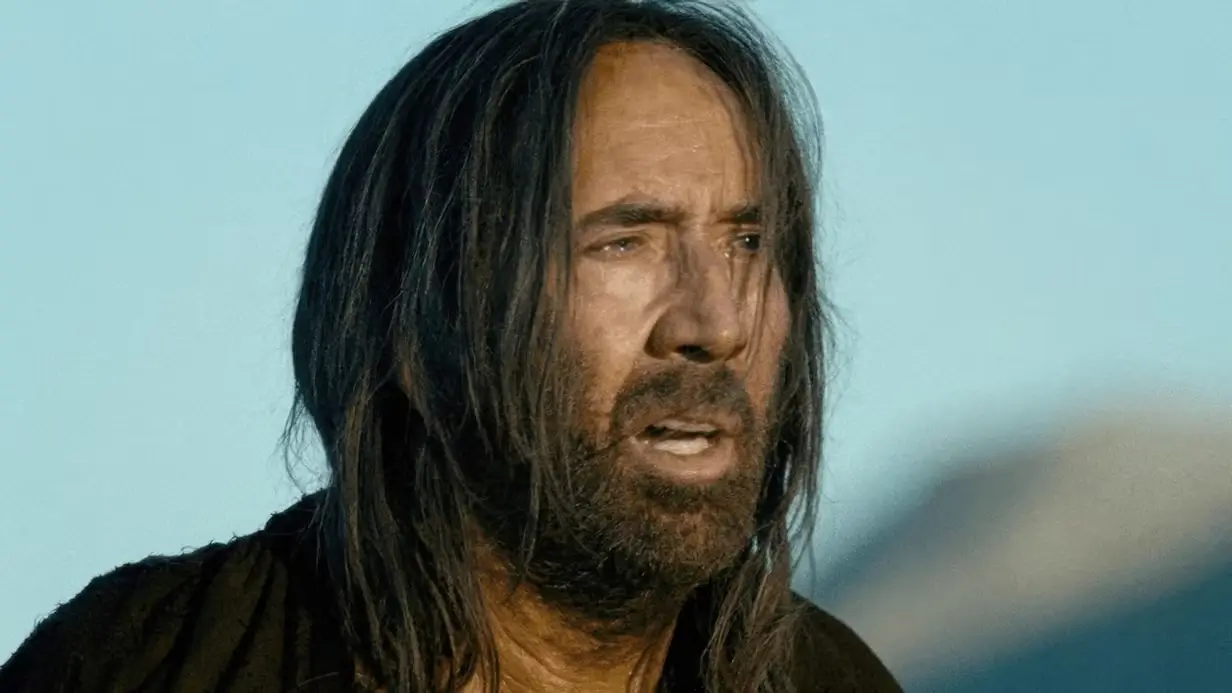
The Carpenter’s Son is Rated R by Motion Picture Rating (MPA) for strong/bloody violent content, and brief nudity.
The Carpenter’s Son – Movie Review
Ever wondered what it would be like if Jesus Christ wasn’t quite ready to be…Jesus Christ? That’s the strange question at the heart of The Carpenter’s Son, a biblical horror story that plays like a slow, spiritual chess match…until it suddenly decides to throw snakes, hallucinations, and mass horrors at you in the final act.
Set in a remote village in Roman-era Egypt, the film follows a young boy simply called “The Boy” (Noah Jupe) whose family, including his father Joseph the Carpenter (Nicolas Cage, doing his usual unpredictable, sometimes distracting thing) and Virgin Mary (FKA twigs, looking elegant but oddly stiff), are caught in the crosshairs of mysterious, supernatural forces. Inspired by the Infancy Gospel of Thomas, this is less a traditional miracle story and more a dark, slow-burn meditation on faith, doubt, and the early stirrings of divine power.
The Boy is a preteen on the cusp of discovering his abilities. He’s forbidden to engage with the sick and suffering, which makes for some genuinely tense and occasionally tedious scenes as he struggles to reconcile curiosity with obedience. Meanwhile, he meets The Stranger (Isla Johnston), a girl with an eerie, unsettling presence who seems to perceive the world and the pain in it very differently. The tension between these two, plus the curious villagers who are perhaps not spiritually equipped to handle The Boy’s emerging powers, forms the emotional and narrative backbone of the film.
For much of its 94-minute runtime (which somehow feels like 154), The Carpenter’s Son plods along. The early pacing is dominated by small dramas, half-baked philosophical questions, and the awkward throes of puberty for a soon-to-be-savior. Even the standout talent of Nicolas Cage can’t fully lift the film; his usual wild energy feels misaligned with the contemplative, slow-moving tone of the story. FKA twigs, meanwhile, seems miscast and struggles to bring life to a Mary who feels more like a cardboard placeholder than a character with depth.
That said, there’s genuine merit in what Jupe and Johnston bring to the table. Noah Jupe quietly grounds the story, giving The Boy a believable sense of wonder, fear, and emerging moral awareness. Isla Johnston, with her haunting presence, injects a sense of unpredictability and unease that keeps the story watchable, even when the pacing threatens to lull viewers into checking their watches.
And then there’s the third act, where the slow burn finally explodes into jaw-dropping, grotesque imagery: snakes emerging from throats, visions of evil, and masses of writhing bodies clinging to ledges in what can only be imagined as the gates of Hell. These moments feel inspired and nightmarish, but arriving at them requires a lot of patience perhaps more than casual viewers or Sunday school students might have.
In tone, the film’s a peculiar mix of horror, religious drama, and philosophical musing, leaning heavier on dread and unsettling imagery than actual storytelling or character development. Think of it as Brightburn meets biblical lore, but with a much slower crawl to the chaos and far less payoff along the way.
So who is this for? Fans of Noah Jupe or viewers who adore twisted, surreal religious horror might find something to appreciate, particularly in the visuals and the eerie dynamic between The Boy and The Stranger. For everyone else, it’s a tedious pilgrimage punctuated by flashes of brilliance and head-scratching casting decisions. The Carpenter’s Son has ambition and occasional audacity, but the journey there is slower than watching paint dry on the side of a stable.
Overall: If you’re curious about biblical horror with a trippy, nightmarish finale, there’s something here to admire but brace yourself for a long, slow ride. Jupe and Johnston carry the story, Cage and FKA twigs distract, and the end result is an uneven, frustrating, yet occasionally fascinating exploration of a young savior unsure of his destiny.
Detailed Content Breakdown for Parents
Violence & Intensity: Expect strong, disturbing supernatural horror: bloody imagery, grotesque events, moments of terror (e.g., snakes from throats, bodies clinging to ledges). The intensity is high, especially in the climax.
Language: While full details on profanity are limited, given the horror genre and R‑rating, language may include harsh words and intense tones. No major indication of slurs, but the tone is dark and adult.
Sexual Content / Nudity: Brief nudity is mentioned in the rating description. Sexual content appears minimal but the presence of nudity (even if brief) means parents should be aware.
Drugs, Alcohol & Smoking: There is no strong evidence or mention of drug use, heavy alcohol, or smoking as central to the story though the environment is grim and adult‑oriented.
Parental Concerns
The horror content is strong: younger children may find the imagery deeply disturbing. Nightmares, fear, and unsettling visuals are likely.
Brief nudity and the adult tone make it unsuited for children.
The religious re‑imagining may be controversial in some households: the portrayal of Christ‑figures in a horror setting could raise questions or discomfort depending on one’s faith background.
The pacing is slow (“slow‑burn”) for the first two acts, meaning younger viewers might lose interest or become restless before the payoff.