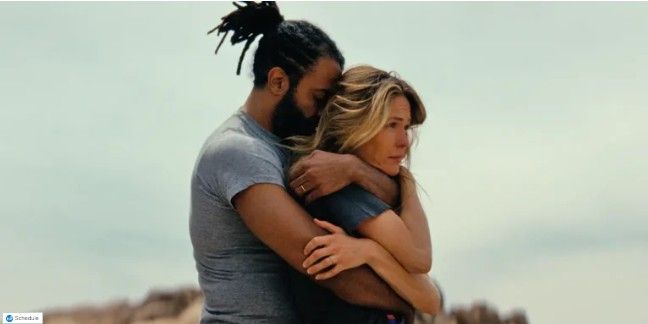
Directed by: Katie Aselton | Written by: Katie Aselton & Mark Duplass Starring: Katie Aselton, Daveed Diggs, Brad Garrett, Susan Sullivan, D.J. ‘Shangela’ Pierce Runtime: 80 minutes | Release: May 15, 2026
I don’t entirely trust films that open with home video footage. It’s become such a reliable shortcut to nostalgia shaky frame, oversaturated color, some couple being adorable before the movie reminds you that adorable things end, that I’ve started bracing for it the way you brace for the jump scare you saw coming. But the footage that opens Magic Hour got me anyway. A woman trying to cajole a terrified man onto a Ferris wheel. He doesn’t want to go. She’s laughing at him, and there’s so much love in it, not the kind that flatters, the kind that teases, that when the movie proper begins and you register that something between these two people has gone badly, irreversibly wrong, you already feel the loss. That’s not a small thing. Aselton earns it in forty seconds.
What she does with the next eighty minutes is trickier to assess.
She plays Erin, a woman who has decamped to a friend’s borrowed house in Joshua Tree Marshall’s place, clean lines and good bones, the kind of desert property that says money without shouting it. Her partner Charlie, played by Daveed Diggs, is supposed to be there too. And he is, sort of. The film withholds the specifics for about twenty minutes before laying them down plainly enough, and I won’t say more than this: once you understand what you’re actually watching, the movie changes shape. Not dramatically, not with a gasp, it’s more like pressing your weight onto a floor you thought was solid and feeling it give, just slightly, beneath you.
Recommended: Silent Friend Parents Guide
What Aselton is really making here is a film about the internal life of grief. The way someone who is gone can still occupy every room you walk into. Charlie is luminous, Diggs plays him with a warmth so unguarded it’s almost suspicious, and you understand why Erin can’t cut the cord. She’s arguing with him, laughing with him, letting him talk her down from her own darkest ledges. And Diggs, to his enormous credit, never lets Charlie become a saint. There’s a fight in the second act, the kind of fight where people stop being careful, and he drops the warmth for something rawer. He says something about being blamed for something he never wanted. It sits in the air after he says it. I didn’t write it down and I wish I had.
Sarah Whelden’s cinematography is doing real work here. Joshua Tree rendered in colors slightly too vivid, the light slightly too insistent, it’s not quite realism and it’s not quite dream, and that suspension is exactly where the film wants to live. Some of Aselton’s best decisions as a director are the quiet ones. A single held shot of Erin’s face. The way the landscape keeps appearing in windows, dwarfing everything.
Her worst decisions are the louder ones. A scene where a group of drag queens descend on the house — led by Shangela, who is genuinely funny and has earned goodwill I’d spend in a different movie — never finds its footing. It wants to be cathartic. It lands as a detour. And a massage sequence that should quietly devastate, this idea of Erin being reminded what it feels like to inhabit a body that craves contact, gets edited into fragments when it needed to breathe. I wanted the camera to stay. Aselton cut away, and I think she blinked.
Brad Garrett shows up as Marshall, and I’ll admit I didn’t expect much, Garrett has spent years being the big guy in the back of the room, but he’s genuinely touching here. Understated. He knows when to leave. There’s a moment where he just hands Erin the keys and says something simple about working through the crap, and it’s the most human thing anyone says in the film. Susan Sullivan gets even less time and does even more with it, appearing as Erin’s mother and offering the particular helpless love of a parent who doesn’t know what to do with a child’s pain except stand next to it.
The film is eighty minutes, which is correct. Aselton and Duplass know better than to let a story like this overstay. What’s strange is that even at that length, there are scenes that feel like the film killing time before it’s ready to face itself again. The drag queen sequence isn’t the only one. There’s a sprawl in the middle that the tight ending doesn’t fully justify.
Recommended: Lord of the Flies (2026) Parents Gide
And yet. Certain images from Magic Hour have stayed with me in a way I didn’t anticipate on the drive home. That opening footage. The argument. A specific look on Aselton’s face when Charlie says something that would’ve made her laugh two months ago and still almost does, except now it can’t quite. Grief on screen usually performs itself, it announces and underlines. Aselton, as an actress, doesn’t do that. She lets it bleed through the edges of scenes that are ostensibly about something else. That’s harder than it looks. She should know.
Magic Hour is an imperfect film made by someone who clearly had something real to say. I’d rather watch that than a perfect film made by someone with nothing on their mind. The light it’s chasing is real. It doesn’t quite catch it. But you feel the reaching.
Magic Hour (2025) Parents Guide
Estimated Rating: PG-13 (No official MPAA rating assigned at time of writing — based on content reported from festival screenings)
Violence & Intensity: None in the physical sense. Emotionally, the film goes to difficult places it’s built around loss, grief, and the psychological aftermath of a death. Several scenes are quietly hard to sit through. Parents of children who’ve recently lost someone close should be especially thoughtful here.
Language: Scattered adult language throughout, with a few stronger words. Not pervasive, the script is more interested in emotional bluntness than profanity, but it’s there.
Sexual Content / Nudity: No nudity. A massage scene carries obvious emotional and sensual weight, handled tastefully but deliberately. Flashback moments between the couple are warm and romantic, nothing explicit.
Drugs, Alcohol & Smoking: Social drinking, the kind that appears when adults are grieving or gathering. No drug use. No smoking of any note.
Thematic Content: The film deals directly with death, denial, and the grief of losing a romantic partner. These aren’t background elements, they’re the entire film. There are also drag queen characters, depicted with warmth and humor, who parents of younger or more sheltered children may want to be aware of.
Age Recommendation: 15 and up. This is an adult film in the truest sense, not because of explicit content, but because it asks things of its audience that require some lived experience to meet halfway. A teenager who’s never sat with loss may find it slow. One who has will likely find it uncomfortably familiar.
Recommended: Mortal Kombat II Parents Guide
