I don’t usually remember what a killer says to her victims before she kills them, mostly because the shows I watch don’t bother giving her anything worth saying. But Catherine, the woman at the center of “Furious,” talks to the men she’s about to murder like she’s trying to work something out about them, or maybe about herself, and by the third time she does it I’d stopped watching a thriller and started watching an interrogation of an entirely different kind.
That’s the trick of this show. It hands you the setup you’ve seen a thousand times, a female detective, a serial killer, a life falling apart at the seams, and lets you settle into that shape before quietly dismantling it from the inside. I went in expecting to write off “Furious” within twenty minutes, and I never got that twenty minutes.
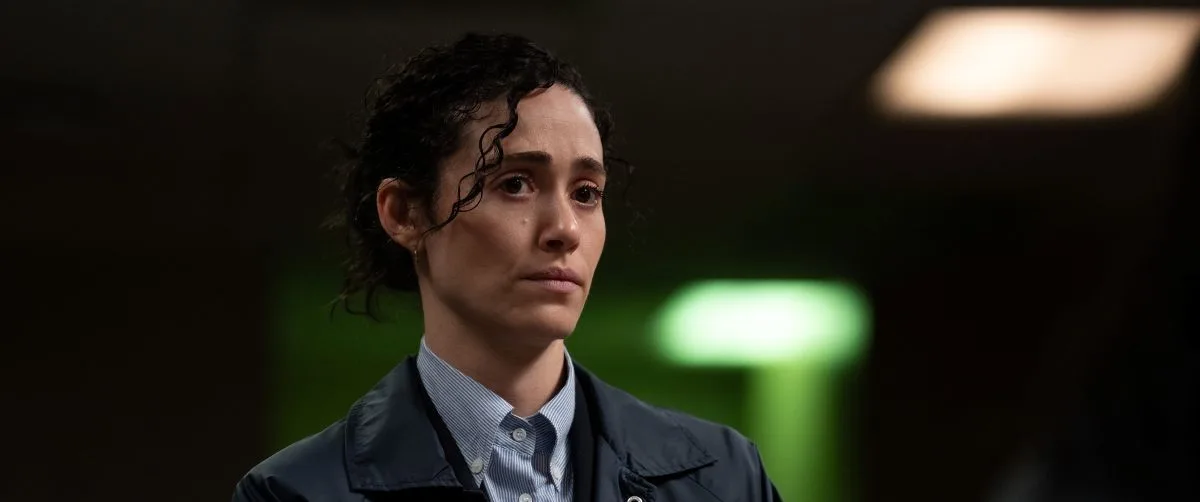
Emmy Rossum plays Alice Black, a former homicide detective demoted, in a way that feels almost punitive, to answering 9-1-1 calls. When she’s pulled back into the field for a wealthy man’s murder, she notices the case matches one she worked a year earlier, same method, same evasive figure lingering at the edges of both crime scenes.
That figure has a name: Catherine, played by Lola Petticrew with a stillness that unsettled me far more than screaming would have. She’s small and unremarkable, easy to miss on camera, and she knows it, which is exactly how she keeps getting away with it. She drugs her victims, then talks to them, then kills them, and it’s that middle step, the talking, that I still can’t shake.
Most shows built like this would settle for a straightforward cat-and-mouse chase, but “Furious” won’t let itself off that easily. Alice and Catherine aren’t opposites circling each other so much as the same wound expressed two different ways.
Alice folded her trauma inward, building a private, controlled ritual around it that she can walk away from by morning: men invited over, allowed to get rough, then sent home so she can finish the moment alone. Catherine took a similar injury and aimed it outward, methodically, at men whose power the show slowly reveals was never as clean as it looked. Creator Elizabeth Meriwether isn’t interested in asking us to pick a side or hand out absolution; she’s interested in the fact that both responses grow out of the same place, which is more patience than most crime dramas bother to show.
There’s a scene about halfway through that I keep replaying, where Alice interviews one of Catherine’s near-victims and somewhere in the middle of it stops asking cop questions and starts asking the questions of someone who already knows the answer in her own body. Nobody raises their voice, the camera barely moves, and somehow it becomes the most violent scene in the season without anyone laying a hand on anyone else.
Visually, the show is deliberately unglamorous, and I’ve come to think that’s the point rather than a limitation. The rooms are lit flat and beige, the kind of overlit institutional glow you get in break rooms and interrogation suites, places built for function rather than comfort. So many crime shows dress violence against women up until it looks almost tasteful, all shadow and composition, something you could hang on a wall, and “Furious” simply refuses to give you that. It keeps its rooms ugly on purpose, and after an episode or two I stopped missing the polish, because I’d started noticing how rare that refusal actually is.
The show would be a much harder watch without Scoot McNairy’s Dan Kelly, Alice’s closest friend on the force, whose loyalty to her has quietly cost him standing in a department that rewards men for protecting each other first. Every scene between Rossum and McNairy breathes differently than the rest of the season, whether it’s a tense argument in a parked car or a whispered conversation on a bathroom floor that the show never flags as important and that turns out to be one of the best scenes it has. Their bond doesn’t fit neatly into romance or friendship; it’s closer and stranger than either label, and it’s the only place the show lets itself, and us, exhale.
I won’t pretend the back half is flawless. There’s a subplot about departmental politics that never earns the time it takes up, and a stretch where the actual manhunt for Catherine feels like an obligation the writers have to clear before returning to the two women who matter. But I’d rather watch a show reach for something ambitious and fumble a plot beat than execute a tired formula without a single wrong step, and what “Furious” is really reaching for is a harder question than who did it: why we’ve spent decades treating violence against women as entertainment, and what that costs the people watching it, not just the people living it.
By the finale, I cared less about whether Alice would catch Catherine than about what it would cost both of them to finally stand in the same room. That’s not a spoiler, just where a show this deliberate earns the right to land, not on handcuffs but on recognition.
I keep coming back to that first conversation, the one where a killer talks to a man before she ends him. It isn’t a twist, and it’s barely even plot. It’s just a woman doing what she needs to do to keep existing inside herself, and a show with the nerve to let us watch without looking away.
Parental Guidance
Rating: TV-MA
Violence & Intensity: Frequent and pointed, though rarely gratuitous in a slasher sense. Depicts drugging, restraint, interrogation-style torture, and murder, and several scenes disturb more through calm, procedural delivery than visible gore. Discussions of past sexual assault and abuse recur throughout, sometimes in detail, so this isn’t suited to viewers sensitive to depictions of trauma, coercion, or violence against women.
Language: Strong profanity used consistently throughout, in line with an adult crime drama. No slurs.
Sexual Content / Nudity: Sexual content is present and handled with psychological weight rather than titillation, including a survivor’s use of rough sex and self-pleasure as coping mechanisms. Nudity appears but isn’t extensive, and the tone stays clinical and character-driven rather than erotic.
Drugs, Alcohol & Smoking: Injected drugs appear as a murder method rather than recreational use, while alcohol shows up periodically in adult social settings.
Age Recommendations: 18+ only. The show’s core subject matter, sexual abuse, trauma responses, and violence against women, is handled with intelligence, but it’s sustained and unflinching rather than softened for younger or more sensitive viewers, and isn’t recommended for family viewing.